

Pound Sterling is broadly under pressure ahead of BoE rate decision
- The Pound Sterling weakens against its major currency peers ahead of the BoE’s monetary policy announcement.
- Investors expect the BoE to reduce interest rates amid a slowdown in the UK economy and inflation.
- The US headline inflation YoY is expected to have accelerated to 3.1% in November.
The Pound Sterling (GBP) trades lower against its major currency peers on Thursday ahead of the Bank of England’s (BoE) interest rate decision, which will be announced at 12:00 GMT.
The BoE is widely anticipated to cut interest rates by 25 basis points (bps) to 3.75% from 4%, with a 5-4 majority, amid higher United Kingdom (UK) job market and economic concerns, and cooling inflationary pressures. This will be the fourth interest rate cut by the BoE this year.
During the month, the Office for National Statistics (ONS) reported that the UK Gross Domestic Product (GDP) declined by 0.1% in October. This was the second straight month of economic contraction. The broader data show that the UK economy has not expanded in any month after June, underpinning economic risks that typically boost the need for monetary easing.
This week, the UK labour market data for the three months ending October showed that the economy shed 17K jobs and the ILO Unemployment Rate jumped to 5.1%, the highest reading seen in almost five years.
On Wednesday, the ONS reported that inflationary pressures in November grew at a moderate pace. The headline CPI grew at a slower pace of 3.2% year-on-year (YoY) against 3.6% in October. In the same period, core inflation – which excludes volatile components of food, energy, alcohol, and tobacco – fell to 3.2% from the prior release of 3.4%.
Daily digest market movers: Pound Sterling edges down against US Dollar ahead of US CPI data
- The Pound Sterling ticks lower to near 1.3365 against the US Dollar (USD) during the European trading session on Thursday. The GBP/USD pair is under mild pressure ahead of the United States (US) CPI data for November, which will be published at 13:30 GMT.
- At the time of writing, the US Dollar Index (DXY), which tracks the Greenback’s value against six major currencies, trades flat around 98.40.
- Investors will pay close attention to the US inflation figures as they will influence market expectations for the Federal Reserve’s (Fed) monetary policy outlook. Signs of price pressures remaining sticky would force traders to pare bets supporting more interest rate cuts in the near term. On the contrary, soft numbers would boost them.
- The US CPI report is expected to show that the headline inflation accelerated to 3.1% YoY in November from 3% in the previous month, with CPI ex Food and Engery remaining steady at 3%.
- Currently, the CME FedWatch tool shows that the probability of the Fed reducing interest rates by 25 basis points (bps) to 3.25%-3.50% in the January meeting is 24.4%.
- On Tuesday, Atlanta Fed Bank President Raphael Bostic stated that further monetary easing could boost already elevated inflation, and “that is not a risk he would choose to take right now”. Bostic also stated on Wednesday that "inflation is more worrying than jobs".
- Going forward, the announcement of Fed Chair Powell’s successor is expected to be the major driver for the US Dollar. Speaking in a national address early Thursday, US President Donald Trump refrained from naming the new chairman, but stated that he will be someone who believes in lower interest rates "by a lot”, a scenario that will be unfavourable for US Treasury yields and the US Dollar.
Technical Analysis: GBP/USD holds key 20-day EMA
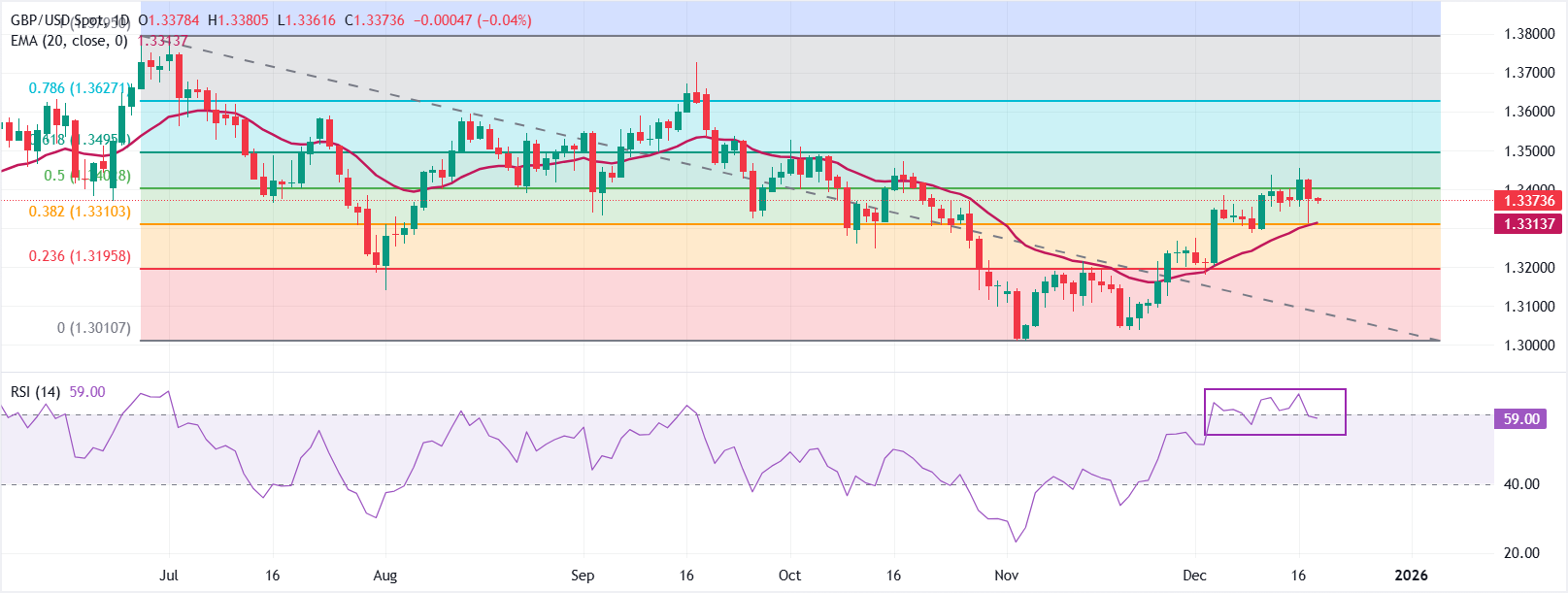
GBP/USD trades marginally lower at 1.3374 on Thursday. The 20-day Exponential Moving Average (EMA) at 1.3314 rises, and the price holds above it, keeping an upside bias. A sustained close above the average would preserve the recovery, while a pullback toward it would test near-term support.
The Relative Strength Indicator (RSI)stands at 59, showing firm bullish momentum without overbought signals. Measured from the 1.3795 high to the 1.3011 low, the 50% Fibonacci retracement at 1.3403 acts as immediate resistance. A daily close through the upper retracement level could open further gains towards the psychological hurdle of 1.3500, while failure to break this band would keep price contained and encourage consolidation above the rising average.
(The technical analysis of this story was written with the help of an AI tool.)
Pound Sterling FAQs
The Pound Sterling (GBP) is the oldest currency in the world (886 AD) and the official currency of the United Kingdom. It is the fourth most traded unit for foreign exchange (FX) in the world, accounting for 12% of all transactions, averaging $630 billion a day, according to 2022 data. Its key trading pairs are GBP/USD, also known as ‘Cable’, which accounts for 11% of FX, GBP/JPY, or the ‘Dragon’ as it is known by traders (3%), and EUR/GBP (2%). The Pound Sterling is issued by the Bank of England (BoE).
The single most important factor influencing the value of the Pound Sterling is monetary policy decided by the Bank of England. The BoE bases its decisions on whether it has achieved its primary goal of “price stability” – a steady inflation rate of around 2%. Its primary tool for achieving this is the adjustment of interest rates. When inflation is too high, the BoE will try to rein it in by raising interest rates, making it more expensive for people and businesses to access credit. This is generally positive for GBP, as higher interest rates make the UK a more attractive place for global investors to park their money. When inflation falls too low it is a sign economic growth is slowing. In this scenario, the BoE will consider lowering interest rates to cheapen credit so businesses will borrow more to invest in growth-generating projects.
Data releases gauge the health of the economy and can impact the value of the Pound Sterling. Indicators such as GDP, Manufacturing and Services PMIs, and employment can all influence the direction of the GBP. A strong economy is good for Sterling. Not only does it attract more foreign investment but it may encourage the BoE to put up interest rates, which will directly strengthen GBP. Otherwise, if economic data is weak, the Pound Sterling is likely to fall.
Another significant data release for the Pound Sterling is the Trade Balance. This indicator measures the difference between what a country earns from its exports and what it spends on imports over a given period. If a country produces highly sought-after exports, its currency will benefit purely from the extra demand created from foreign buyers seeking to purchase these goods. Therefore, a positive net Trade Balance strengthens a currency and vice versa for a negative balance.
Artigos Recomendados


