


Federal Reserve set to hold interest rates steady despite persistent inflation
- The US Federal Reserve is widely expected to keep interest rates unchanged after the October meeting.
- Markets see a strong probability of a rate hike in December.
- Fed Chair Warsh’s remarks at the press conference could lift US Dollar volatility.
The United States (US) Federal Reserve (Fed) announces its Interest Rate Decision on Wednesday, following another pivotal meeting that could provide key insights into the bank’s monetary policy outlook heading into the end of the year.
Markets widely expect the Federal Open Market Committee (FOMC) to leave the policy rate unchanged in the range of 3.75%-4% following the 25 basis points (bps) hike announced in September.
This decision is almost fully priced in, with the CME FedWatch Tool pointing to about only a 9% chance of an increase in borrowing costs. Hence, Fed Chair Kevin Warsh’s comments in the post-meeting press conference could offer important clues on the rate outlook and drive the US Dollar’s (USD) valuation.
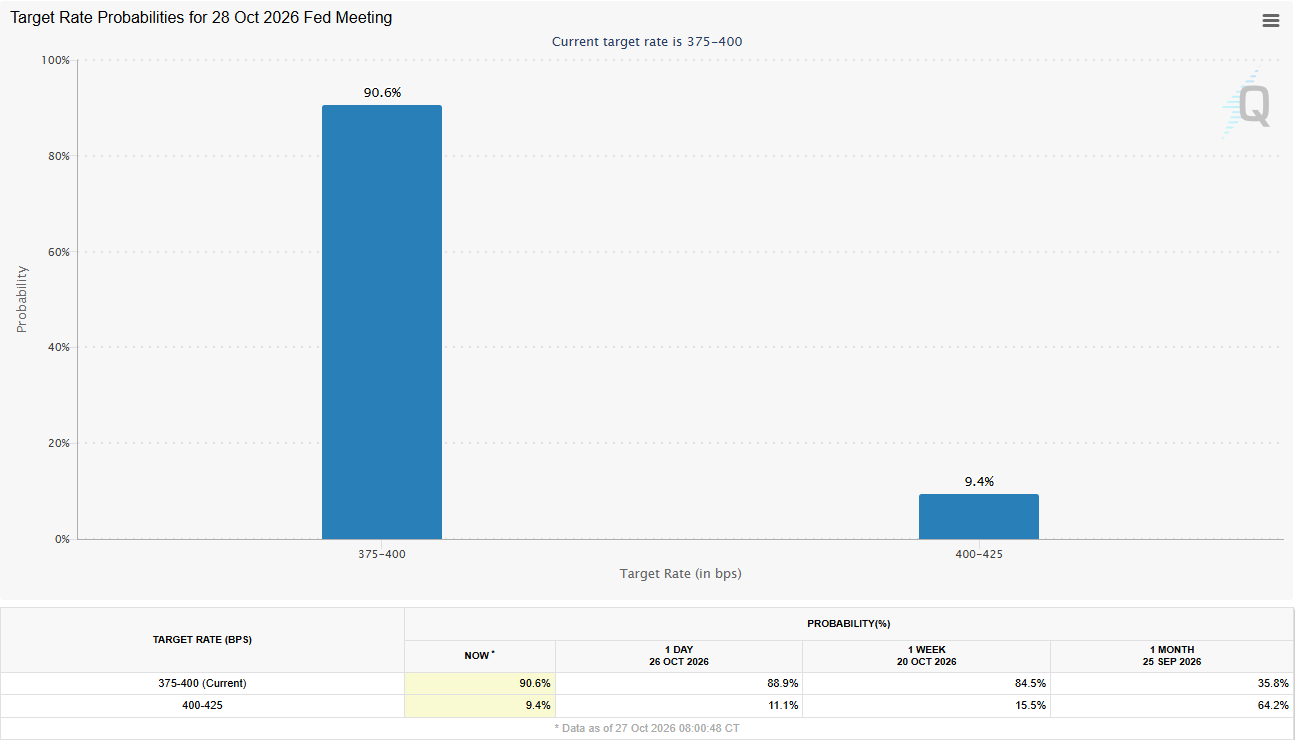
While speaking at an International Monetary Fund (IMF) event earlier in the month, Warsh reiterated that they remain focused on delivering price stability but added that he doesn’t believe in “pre-judging meetings.” This particular comment caused investors to effectively dismiss the possibility of a rate hike in October even though the US Consumer Price Index (CPI) for September came in hotter than expected, with the headline annual inflation rate rising to 3.7% from 3.4%.
Economists at Deutsche Bank note that with a rate move largely off the table at the upcoming meeting, market attention will pivot to the communication tone, noting that “the interest will therefore be in Chair Warsh’s press conference and how the Fed balances still-elevated inflation and solid growth against the recent tightening in financial conditions.” They suggest the policy message will be judged on how convincingly the Fed acknowledges persistent price pressures and robust activity while also addressing the impact of more restrictive market conditions on the broader outlook.
When will the Fed announce its interest rate decision and how could it affect EUR/USD?
The Fed is scheduled to announce its Interest Rate Decision and publish the Monetary Policy Statement on Wednesday at 18:00 GMT. This will be followed by Fed Chair Kevin Warsh’s press conference starting at 18:30 GMT.
In September, the revised Summary of Economic Projections (SEP) showed that 12 of 18 officials penciled in one more 25-basis-point (bps) rate hike this year, while four members saw two hikes and two projected no more hikes.
In June, the dot plot, the component of the SEP that shows policymakers’ interest rate forecasts, highlighted that policymakers’ projections implied only a 25 bps increase in 2026, followed by a 25 bps rate cut in 2027 and another 25 bps cut in 2028.
According to the CME FedWatch Tool, there is only about a 17% chance the policy rate will remain unchanged at the end of the year. This market positioning suggests there is room for renewed USD strength in case Warsh goes against his prior comments at the IMF event and hints at an interest rate increase in December, citing persistently high inflation. In this scenario, EUR/USD could come under bearish pressure in the immediate reaction. It is worth noting, however, that the European Central Bank (ECB) will also announce its policy decision on Thursday. Thus, a potential decline in the currency pair on a hawkish Fed tone could pause heading into the ECB event.
Analysts at MUFG/BTMU highlight that “the final FOMC meeting of the year is not until 9th December,” and note that “the signs of tightening financial conditions continue to build,” leaving “certainly a chance that Fed rate hike expectations for December could ease.” In their view, “the willingness of Warsh to signal the Fed remains on the path highlighted by the dots will be important.” MUFG/BTMU add that “in circumstances of tightening financial conditions and bond market volatility in Europe we would assume the Dollar will remain underpinned, and the risks remain skewed to the upside.”
Conversely, the Greenback could weaken against its major currency rivals if Fed Chair Warsh downplays the inflation developments and refrains from signalling a rate hike in December. In case Warsh repeats that he won’t pre-judge the outcome of the last meeting of the year, investors could refrain from fully pricing in a rate hike and help EUR/USD edge higher. Still, market participants are unlikely to dismiss this probability unless they see a significant improvement in inflation data or a horrible employment report.
Commerzbank’s Thu Lan Nguyen points out that the recent resilience in EUR/USD masks a more troubling underlying dynamic for the single currency. She notes that “short-term inflation expectations have risen more strongly in the Euro Area than in the US,” yet “higher inflation expectations are currently not being offset by a corresponding shift in relative interest-rate expectations.” According to Commerzbank, this disconnect “is, in principle, a negative signal for the Euro,” as it suggests that markets are not pricing in sufficient policy tightening to counter the pickup in Euro Area inflation expectations, potentially leaving the currency vulnerable if sentiment turns.
Eren Sengezer, FXStreet European Session Lead Analyst, provides a short-term technical outlook for EUR/USD:
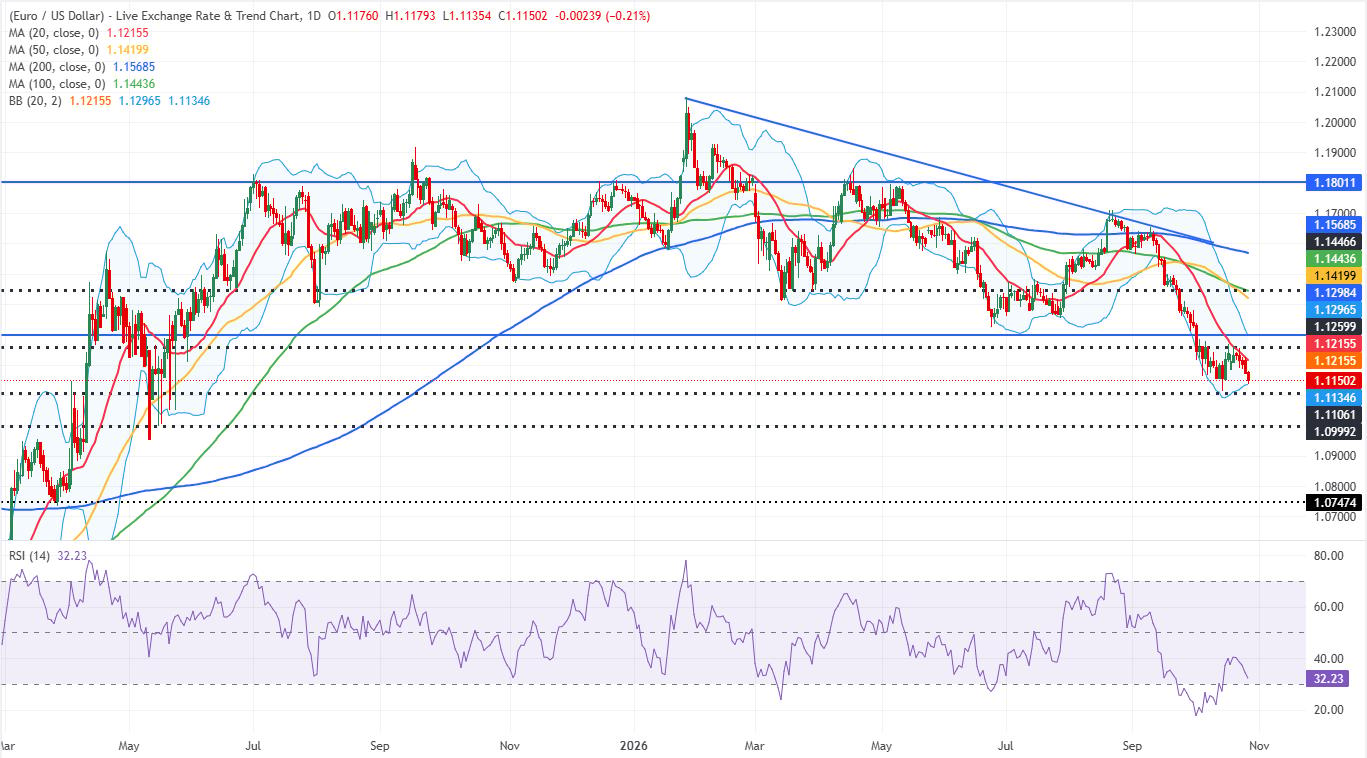
“The near-term technical outlook for EUR/USD highlights a bearish bias as the pair remains in the lower half of the Bollinger Band on the daily chart and the Relative Strength Index stays well below 40. On the downside, 1.1130-1.1100 (lower limit of the Bollinger Band, static level) aligns as the immediate support level ahead of 1.1000 (psychological level, static level). If this latter support fails, a deeper pullback toward 1.0750 (static level) could be witnessed. If the daily RSI falls into the oversold territory below 30 and EUR/USD stays below the lower limit of the Bollinger Band, investors could wait for a technical correction before committing to an extended decline.”
“Looking north, an interim resistance area could be spotted at 1.1260 - 1.1300 (static level, upper limit of the Bollinger Band). In case the pair manages to stabilize above this region, the 50-day and the 100-day Simple Moving Averages in the 1.1420-1.1440 area could become the next difficult hurdle to clear.”
Fed FAQs
Monetary policy in the US is shaped by the Federal Reserve (Fed). The Fed has two mandates: to achieve price stability and foster full employment. Its primary tool to achieve these goals is by adjusting interest rates. When prices are rising too quickly and inflation is above the Fed’s 2% target, it raises interest rates, increasing borrowing costs throughout the economy. This results in a stronger US Dollar (USD) as it makes the US a more attractive place for international investors to park their money. When inflation falls below 2% or the Unemployment Rate is too high, the Fed may lower interest rates to encourage borrowing, which weighs on the Greenback.
The Federal Reserve (Fed) holds eight policy meetings a year, where the Federal Open Market Committee (FOMC) assesses economic conditions and makes monetary policy decisions. The FOMC is attended by twelve Fed officials – the seven members of the Board of Governors, the president of the Federal Reserve Bank of New York, and four of the remaining eleven regional Reserve Bank presidents, who serve one-year terms on a rotating basis.
In extreme situations, the Federal Reserve may resort to a policy named Quantitative Easing (QE). QE is the process by which the Fed substantially increases the flow of credit in a stuck financial system. It is a non-standard policy measure used during crises or when inflation is extremely low. It was the Fed’s weapon of choice during the Great Financial Crisis in 2008. It involves the Fed printing more Dollars and using them to buy high grade bonds from financial institutions. QE usually weakens the US Dollar.
Quantitative tightening (QT) is the reverse process of QE, whereby the Federal Reserve stops buying bonds from financial institutions and does not reinvest the principal from the bonds it holds maturing, to purchase new bonds. It is usually positive for the value of the US Dollar.
추천 기사


