


Markets just priced out rate hikes on financial stress. This chart shows why 2022-23 says they’ll be wrong
Traders have taken about one quarter-point hike out of their European Central Bank (ECB) forecasts since mid-September, betting the ECB will stop raising rates because of a French debt selloff. The same bet failed twice in 2022 and 2023, when the ECB kept raising rates through financial stress because inflation was above its 2% target. Euro-area inflation came in at 3.8% in September.
The ECB's deposit rate, which it pays banks on overnight deposits and which sets Euro borrowing costs, is 2.50% after hikes in June and September. Germany's two-year bond yield moves with what traders expect from the ECB over the next two years. On the Bundesbank's daily series, it reached 3.32% on September 28, the highest since October 2008, and has since fallen 0.3 points to 3.02%. That high was a hundredth of a point above the yield on March 8, 2023, two days before Silicon Valley Bank failed.
France's bond selloff took about one hike out of the ECB's path
The gap between French and German 10-year borrowing costs reached 1.54 percentage points on October 2, the widest since 2011, after its biggest one-week widening in 17 years. Selling spread to Italian, Belgian and Greek bonds, and Spain called a snap election for November 29. France's 2027 budget targets a deficit of 5% of output, from 5.4%, against a European Union (EU) cap of 3%, which closes a sixth of the gap. When yields jump like that, governments and companies pay more to borrow without the ECB doing anything, so traders assume the ECB needs to do less.
Money-market pricing, the bets traders place on the deposit rate after each meeting, shows how much came out. On October 5, that pricing showed 0.28 of a hike at the October 29 meeting, 0.89 by December 17 and 2.69 by September 2027. In mid-September, it had October at about three in four and about one more hike through mid-2027. Priced out still means 2.69 hikes.
ECB President Lagarde gave traders their argument on September 28. She told the European Parliament that higher long-term rates would slow growth and spread energy costs into other prices by more than ECB staff had projected. ECB Chief Economist Lane made the same point on October 5. The two-year yield's biggest one-day fall, 0.19 of a point, came on October 2, when the French gap peaked and yields fell everywhere after a weak US jobs report.
Twice in 2022-2023 the two-year yield lost a point on stress and got it back
The first scare came in June 2022, when Italian borrowing costs jumped. Germany's two-year yield fell 1.05 points between June 16 and August 2, to 0.10%, because traders expected a slower ECB. The ECB raised rates by half a point on July 21, twice what it had signalled, then by three-quarters of a point in September and again in October. The yield was back above its June high on September 9, the day after the first of those three-quarter-point hikes.
The second came in March 2023, after Silicon Valley Bank failed and Credit Suisse shares fell to a record low. On March 15, traders priced the ECB's peak near 3%, down from 4% a week earlier, and the two-year yield fell 1.09 points in the eight sessions to March 20. The ECB raised rates by half a point on March 16 and four more times after that. It stopped at 4%, where traders had put the peak the week before Credit Suisse.
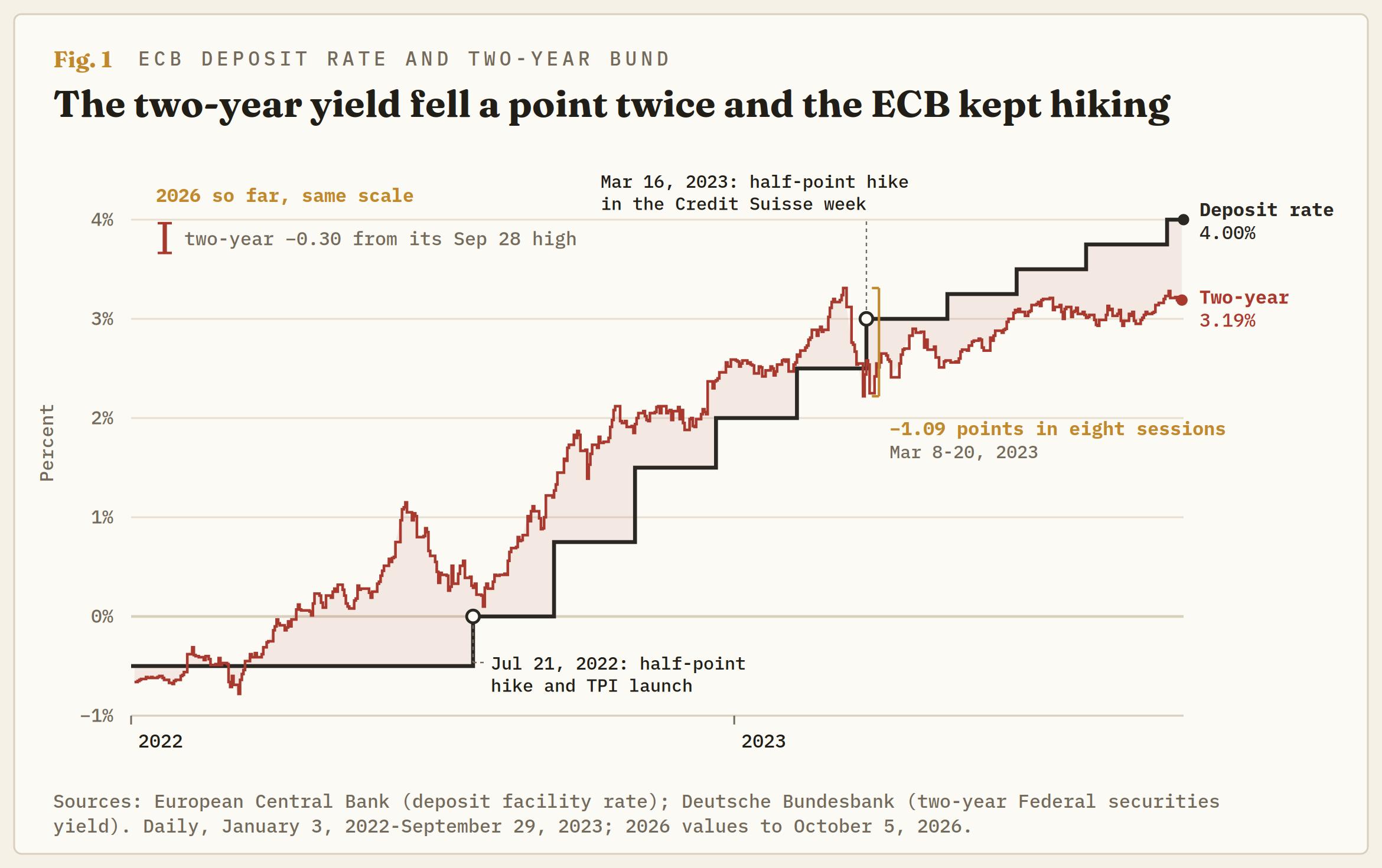
Both repricings unwound for the same reason. Core inflation, which strips out energy, food, alcohol and tobacco, was 3.7% in June 2022 and a record 5.7% in March 2023. Stress could move the date of a hike but not the need for one. By September 21, 2023, the two-year yield was back at 3.28%, almost all the way to its March 8 level.
Central banks gave each scare its own tool and kept rates on inflation
In June 2022, the ECB held an unscheduled meeting to steer reinvestments from its pandemic bond portfolio toward the countries under pressure. On July 21 it launched the Transmission Protection Instrument (TPI), a bond-buying backstop for countries whose borrowing costs run away from their fundamentals, alongside the half-point hike.
The Bank of England (BoE) bought long-dated government bonds between September 28 and October 14, 2022, to stop a fire sale by pension funds. Three weeks later it raised its rate by three-quarters of a point. The Federal Reserve (Fed) raised rates 12 days after Silicon Valley Bank failed. Then-Fed Chair Powell said on March 22, 2023, that tighter bank lending could do the work of a rate hike, and the Fed raised rates twice more.
ECB President Lagarde made the Powell argument about long-term yields on September 28. When the ECB launched the TPI, it said the backstop would let rate increases reach every euro country evenly. Bundesbank President Nagel said on October 1 that the ECB's job is price stability, not holding the gap between countries' borrowing costs at a particular level. The ECB's own September forecasts have inflation excluding energy and food at 2.6% in 2027 and 2.3% in 2028, above target throughout.
2011 is the year traders were right
The case against this is 2011. The ECB raised rates in April and July 2011 because energy was pushing inflation up, then cut them in November and December after the debt crisis reached Italy and Spain. Both hikes were gone by the end of the year.
ECB President Lagarde told French newspaper La Croix that this is not 2011. The difference is outside France, where Italy's 10-year premium over Germany averaged 5.19 percentage points in November 2011 and Spain's reached 5.55 in July 2012. Italy's touched about 1.1 points on October 1, and Spain's is about 0.65, less than half of France's.
The weak link is France, which has been in the EU's excessive deficit procedure (EDP), the process for governments running deficits above the rules, since July 2024. A country in the procedure qualifies for the TPI only if the EU hasn't found it failing to fix the deficit. The TPI has never been used, and the first country to need it may not qualify. If the selling reaches Italy and no tool fits France, the deposit rate is all that's left, and that is the 2011 template.
Core inflation is the other soft spot. At 2.5%, it is closer to 2011's 1.6% than to the 5.7% of March 2023, and most of the rise to 3.8% is energy, up 18.8% on the year. That headline rate is above 2011's 3.0% peak, and ECB President Lagarde has called the energy shock too large to look through.
The hike traders took out has a date: December 17
The lean is that December's hike is delivered and the 2027 hikes traders removed go back into the price. Both 2026 hikes came at meetings with new staff forecasts, in June and September, and October 29 has none. December 17 does, and money markets have 0.89 of a hike priced by then.
Germany's two-year yield is the gauge. A move back above 3.20%, where it traded before October 2, would say the stress is coming out of ECB pricing. Below 2.90%, its September 1 level, everything traders added around the September hike is gone. Italy's 10-year premium is the 2011 tripwire, and a move toward 1.5 points from about 1.1 would say the selling is no longer only French.
The Euro fell to its lowest against the US Dollar since May 2025 on Monday. It gains if December's hike goes back into the price and loses if Italy's premium widens. The call is wrong if the ECB holds on December 17 with core inflation at 2.5% or higher, because that would mean bond markets, not inflation, are setting euro-area rates.
추천 기사


