


How the CLARITY Act unlocks Wall Street’s tokenization pipeline
- The full-fledged tokenization of financial assets, including equities and real estate, hinges on the passing of the US CLARITY Act.
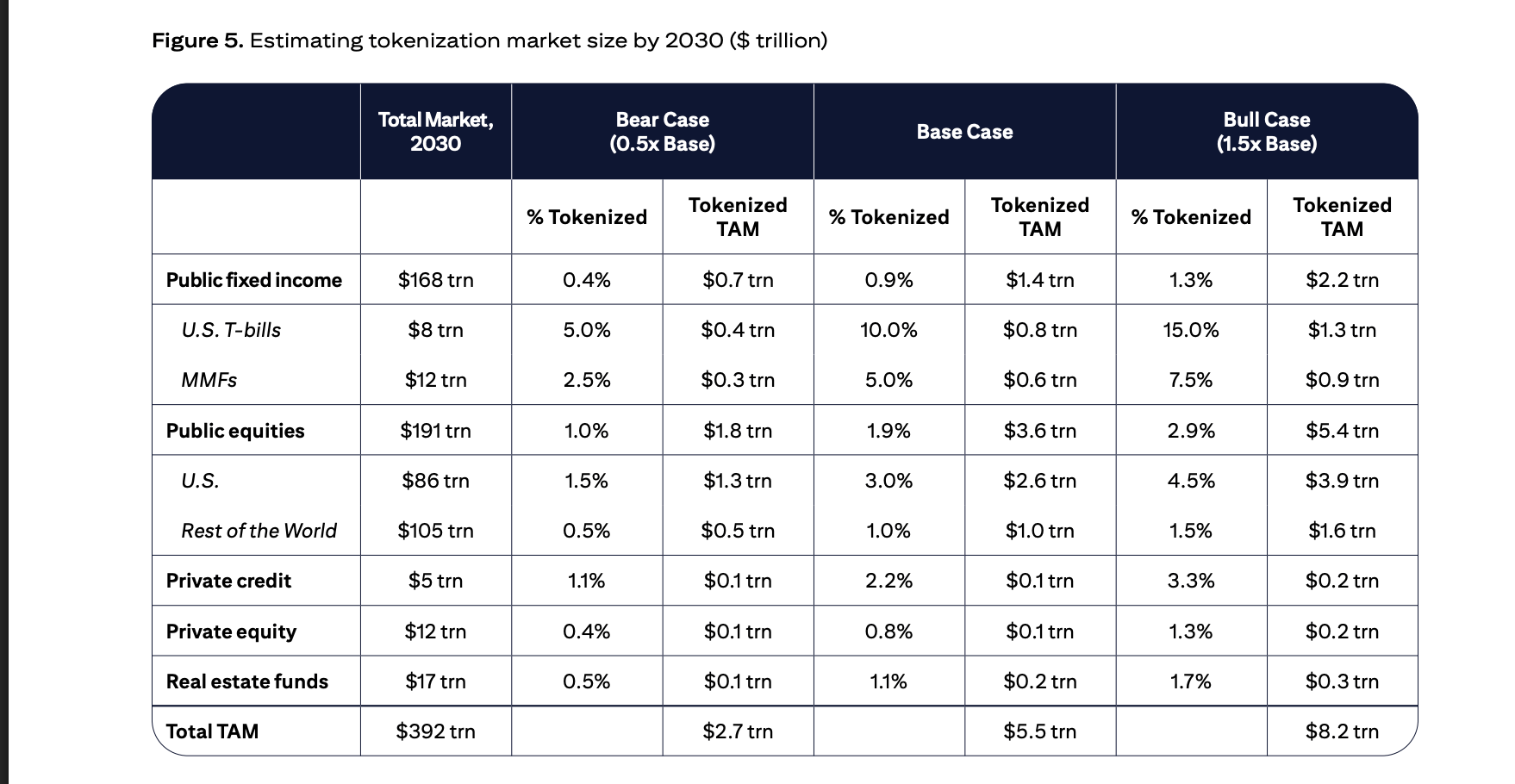
- Citi Institute projects that the tokenized asset market, valued at $17 billion, will reach $5.5 trillion by 2030.
- The ambitious transition will depend on market-structure providers, regulated on-chain money growth, and regulatory clarity.
The United States (US) Digital Asset Market Clarity Act (CLARITY Act), awaiting a full Senate floor vote, promises to unlock Wall Street’s potential to tokenize financial assets, including equities, US Treasuries, private credit, real estate and commodities at a scale that could supercharge the real-world asset (RWA) market from the current $17 billion level to $5.5 trillion by 2030, according to a report by Citi Institute.
Wall Street on-chain
From an adoption perspective, tokenization of real-world assets has never been hindered by a lack of technology or innovation but by regulatory risk. While Wall Street banks, private equity firms, and asset managers may want a digital representation of securities as digital tokens executing on blockchain infrastructure, regulatory uncertainty, lack of on-chain settlement funds, and fragmented financial systems have blurred the line between adoption and projected growth.
Pragmatically, tokenization growth would “be led by public market securities, particularly US equities and treasuries, rather than private markets, where adoption remains early-stage and structurally constrained,” the Citi Institute report states.
Several forces have the potential to shape and accelerate the RWA tokenization market, including major stakeholders in the financial market infrastructure. The Depository Trust & Clearing Corporation (DTCC), New York Stock Exchange (NYSE) and Nasdaq will be critical in tokenization, issuance, trading and settlement at a scale far beyond experimentation.
“The tokenization of financial assets is more than just technology; it is unlocking Wall Street for the digitally-native generation,” Artem Korenyuk, Head of Enterprise Digital Assets at Citi Client Business Development, said.
Advancement of regulated on-chain money, which includes the $300 billion stablecoin market and tokenized deposits, is expected to operate as the settlement layer that was lacking in earlier tokenization projects.
The CLARIY Act would be the glue that ensures all the pieces are not only in place but operate in harmony. This begins with separating digital asset oversight between the Securities and Exchange Commission (SEC) and the Commodity Futures Trading Commission (CFTC) and extends to providing a legal definition of tokens as securities or commodities.
That distinction is critical as securities are subject to stringent registration and compliance requirements, while commodities benefit from a comparatively flexible regulatory framework.
Is institutional participation growing?
Tokenization of real-world assets is emerging as the future of global finance, supported by programmable assets and settled natively on blockchain for 24/7 trading. On-chain finance in this case means collateral, liquidity, and settlement operate in real-time and across borders.
Although still in its infancy, institutional adoption of tokenized assets and deposits would mark the next phase of growth in the RWA sector.
“Institutional participation is now moving beyond experimentation with tokenization being used in issuance, trading, and post-trade workflows. Regulatory clarity is improving across major jurisdictions, providing some legal certainty for institutional adoption,” Citi Institute researchers highlighted in the report.
The benefits of tokenization are likely to occur gradually rather than in a single disruptive move. Adoption is still plagued by uneven asset classes across jurisdictions, challenges related to interoperability and different legal frameworks such as the European Union’s (EU) Markets in Crypto-Assets Regulation (MiCA) and the upcoming CLARITY Act in the US. Other constraints include liquidity coordination, market conventions and investor behavior.
Institutions are poised to build on clear regulations that foster stability and reassure investors that future governments will not roll back key advancements and throw the financial market into disarray.
A 21Shares report states that “rather than serving as a catalyst for crypto access, the significance of the bill lies in structural changes.” Currently, investors can seek exposure to Bitcoin (BTC), Ethereum (ETH) and Ripple (XRP) via Exchange-Traded Funds (ETFs) without the CLARITY Act. However, institutions require a broader, durable structure that is legally binding and harder to roll back by future administrations.
“Instead, it establishes a key structural distinction: A temporary regulatory stance dependent on the current administration versus an enacted statute that provides a durable, legally binding framework resistant to being easily overturned by future administrations,” the 21Shares report adds.
Nevertheless, early institutional adopters of tokenization have over the years launched products, including BlackRock’s BUIDL, with between $2.4 billion and $2.6 billion across multiple chains. Other notable issuers of tokenized assets include JP Morgan Chase with Kinexys, Franklin Templeton with BENJI/FOBXX, BNY Mellon, Citi and Fidelity.
New York Stock Exchange (NYSE) plans to launch a tokenized securities platform in late 2026, subject to regulatory approval. This offering will enable 24/7 trading of US-listed stocks and ETFs with near-instant settlement, supported by stablecoins.
The SEC has approved Nasdaq’s request to offer certain equities and ETFs as tokenized assets for trading and settlement. Nasdaq is integrating tokenization into its existing market infrastructure.
“You’re seeing the full weight of American financial power and the global reserve currency moving on-chain at scale. When DTCC and the NYSE embed tokenization into capital markets, this marks a tipping point,” David Cunningham, Global Head of Institutional Business at Consensys, states.
CLARITY Act passage odds dwindling
The US Congress has come very close to making the CLARITY Act a permanent legal framework for digital assets, but the last mile is proving to be more difficult to achieve. This is despite advancing past the House and clearing two Senate committees.
The US Senate is reported to have delayed the CLARITY Act this week, turning its attention to other matters including Russian sanctions and federal nominations, CoinDesk reported on Monday. The timing of the delay is of concern, as it comes just days ahead of the August recess.
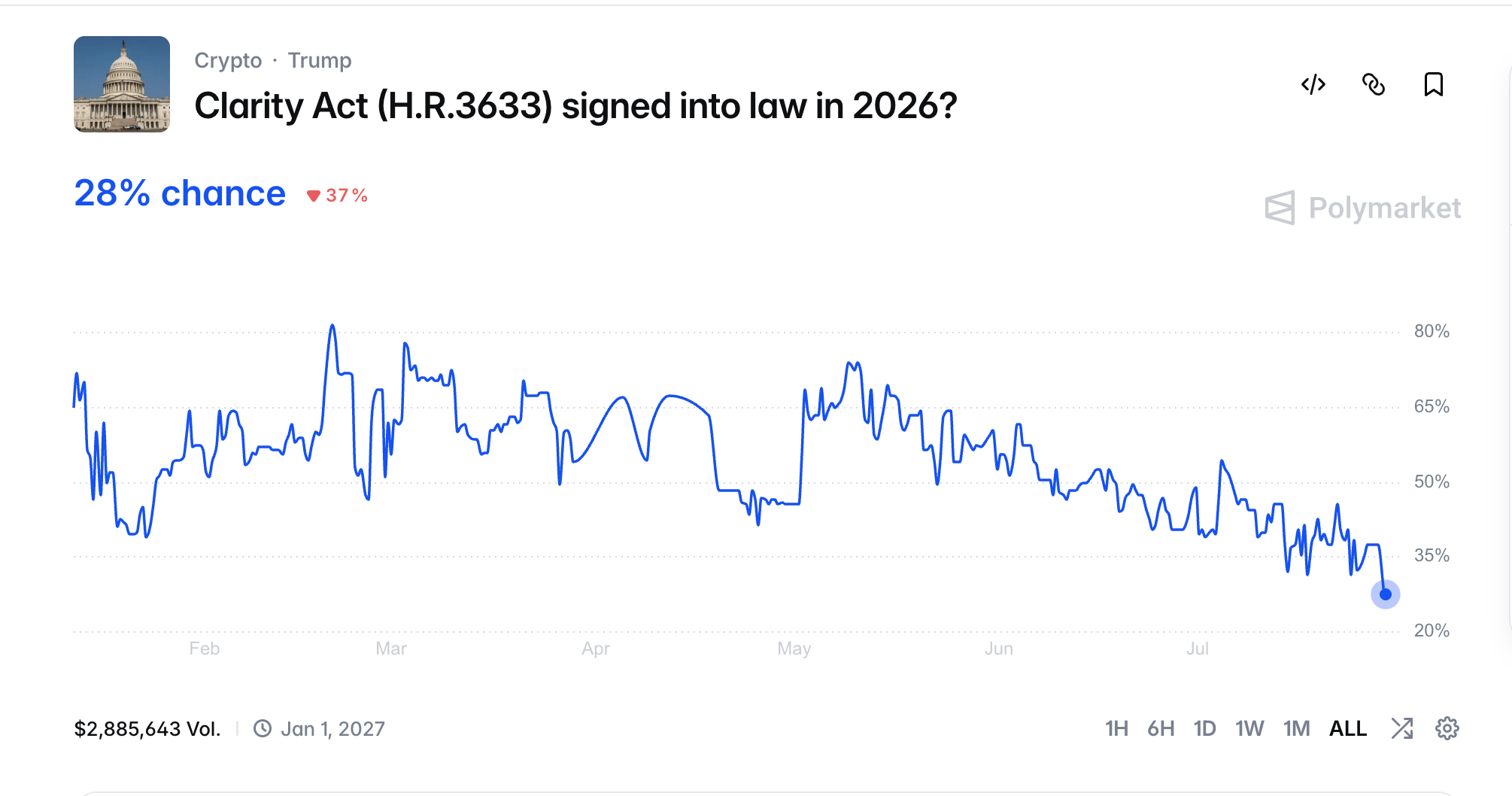
According to Polymarket, the odds of the bill becoming law in 2026 have dwindled further to 28% from 40% on July 1 and 56% on June 1.
The CLARITY Act passage remains the crypto industry’s most awaited moment. Its impact would go beyond digital assets and customer protection to distinguish the roles of the SEC and the CFTC as well as expand tokenization of real-world assets. The principle of irreversibility grounds institutions that want durability and regulatory clarity.
Bitcoin, altcoins, stablecoins FAQs
Bitcoin is the largest cryptocurrency by market capitalization, a virtual currency designed to serve as money. This form of payment cannot be controlled by any one person, group, or entity, which eliminates the need for third-party participation during financial transactions.
Altcoins are any cryptocurrency apart from Bitcoin, but some also regard Ethereum as a non-altcoin because it is from these two cryptocurrencies that forking happens. If this is true, then Litecoin is the first altcoin, forked from the Bitcoin protocol and, therefore, an “improved” version of it.
Stablecoins are cryptocurrencies designed to have a stable price, with their value backed by a reserve of the asset it represents. To achieve this, the value of any one stablecoin is pegged to a commodity or financial instrument, such as the US Dollar (USD), with its supply regulated by an algorithm or demand. The main goal of stablecoins is to provide an on/off-ramp for investors willing to trade and invest in cryptocurrencies. Stablecoins also allow investors to store value since cryptocurrencies, in general, are subject to volatility.
Bitcoin dominance is the ratio of Bitcoin's market capitalization to the total market capitalization of all cryptocurrencies combined. It provides a clear picture of Bitcoin’s interest among investors. A high BTC dominance typically happens before and during a bull run, in which investors resort to investing in relatively stable and high market capitalization cryptocurrency like Bitcoin. A drop in BTC dominance usually means that investors are moving their capital and/or profits to altcoins in a quest for higher returns, which usually triggers an explosion of altcoin rallies.
추천 기사


