


Bitcoin Price Forecast: BTC battles at key technical zone amid mixed flow signals
- Bitcoin holds near the 50-day and 100-day EMAs on Tuesday, where a close above or below could signal the next direction.
- BTC spot ETFs recorded an outflow of $648.64 million while Strategy added another 24,869 BTC on Monday.
- The Kobeissi Letter post on X highlights that Iran has launched “Hormuz Safe,” a Bitcoin-backed maritime insurance service for shipping through the Strait of Hormuz.
Bitcoin (BTC) steadies around the key technical support on Tuesday after its recent correction. The Crypto King’s next directional move could hinge on this key technical zone. Institutional and corporate demand remained mixed, with spot Exchange Traded Funds (ETFs) recording an outflow, while Strategy (MSTR) added BTC to its reserve on Monday. Amid ongoing Middle East conflicts, reports indicate that Iran has launched “Hormuz Safe,” a Bitcoin-backed maritime insurance service for shipping through the Strait of Hormuz.
BTC is stuck between institutional selling and corporate buying
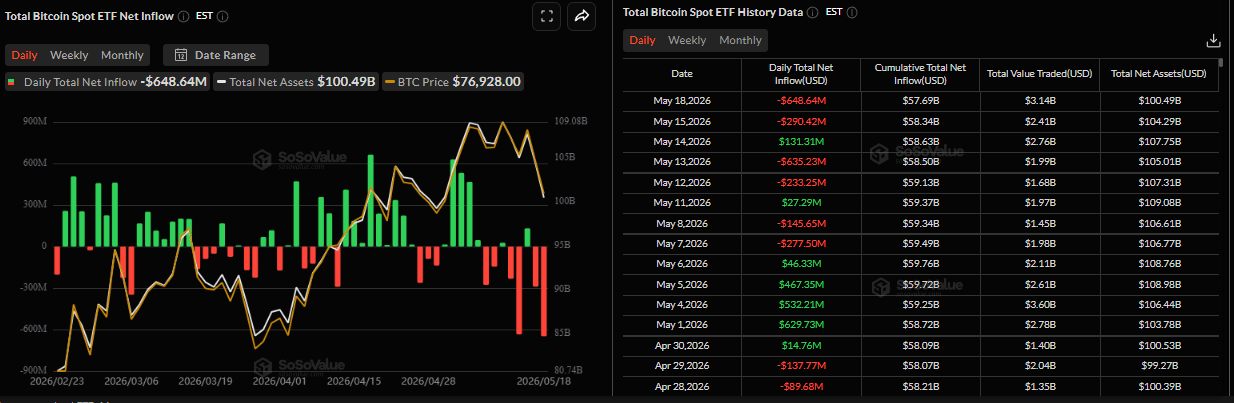
Institutional and corporate demand started the week on a mixed note, with institutional selling and corporate buying BTC. SoSoValue data showed that BTC spot ETFs recorded an outflow of $648.64 million on Monday, following a $1 billion withdrawal the previous week.
On the corporate side, Michael Saylor announced on Monday that his firm, Strategy, had acquired 24,869 BTC, bringing the total holding to 843,738 BTC. The company’s average BTC buying price is $75,700, slightly below BTC’s current trading levels.
This institutional selling pressure and aggressive corporate accumulation indicate a market in indecision as traders await a catalyst to determine the next directional move.
Iran believes in BTC
The Kobeissi Letter reported late Monday that Iran has introduced “Hormuz Safe,” a Bitcoin-backed insurance service for shipping companies seeking to transit the Strait of Hormuz.
According to the report, the Iranian government estimates the initiative could generate more than $10 billion in revenue and stated that the program will primarily serve Iranian shipping companies and cargo owners.
“The shipment will be covered from the moment of confirmation, and a signed receipt will be given to the owner,” Iran said. It is unclear whether this insurance service will be charged in addition to tolls, which have reached as high as $2 million per ship. Iran added that an official website containing further details about the program is expected to launch soon.
These developments follow Iran’s proposal in early April that shipping companies pay tolls in cryptocurrency for oil tankers passing through the Strait of Hormuz.
As explained in a previous report, Iran relies on cryptocurrencies due to US sanctions, and Bitcoin has served as a tool for paying for imports and settling trade. Iran legalized crypto mining in 2019 and has since played a role in its economy.
These latest developments with the Bitcoin-backed insurance service, if implemented, could mark a key milestone in adoption, particularly for regions facing financial constraints. This development could boost Bitcoin demand in the near term, as 20% of global oil tankers pass through the Hormuz Strait.
Some signs of optimism
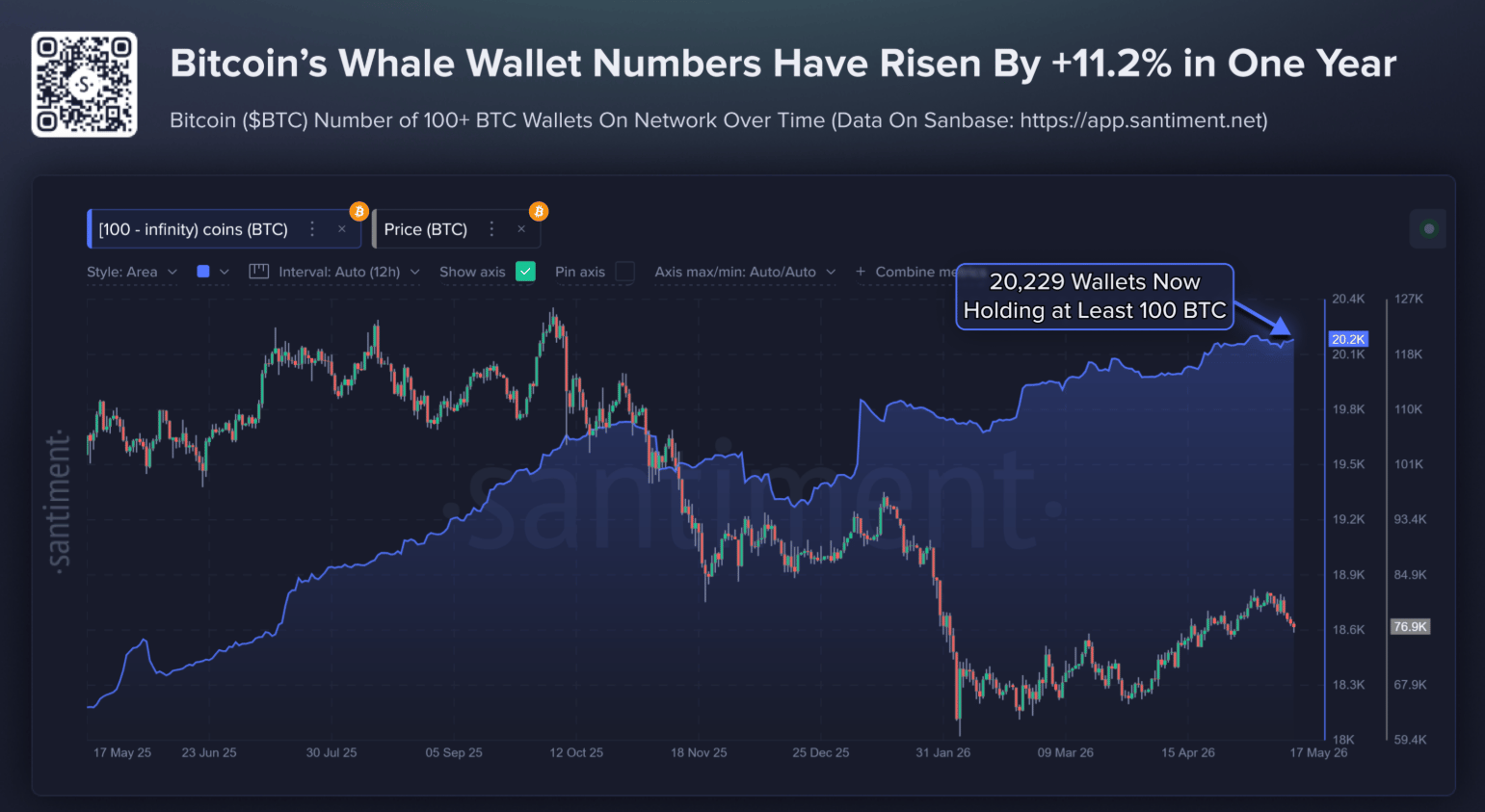
The Santiment chart below shows that Bitcoin whale wallets holding at least 100 BTC have risen to 20,229 on Tuesday, a 11.2% surge compared with the previous year, when there were 18,191 wallets.
“Even with Bitcoin experiencing major volatility throughout the past year, these large wallets have continued to steadily accumulate rather than shrink in number. Historically, rising whale wallet counts are viewed as a sign that key stakeholders still have confidence in Bitcoin’s future value and scarcity,” said the analyst.
Bitcoin Price Forecast: BTC at key technical zone
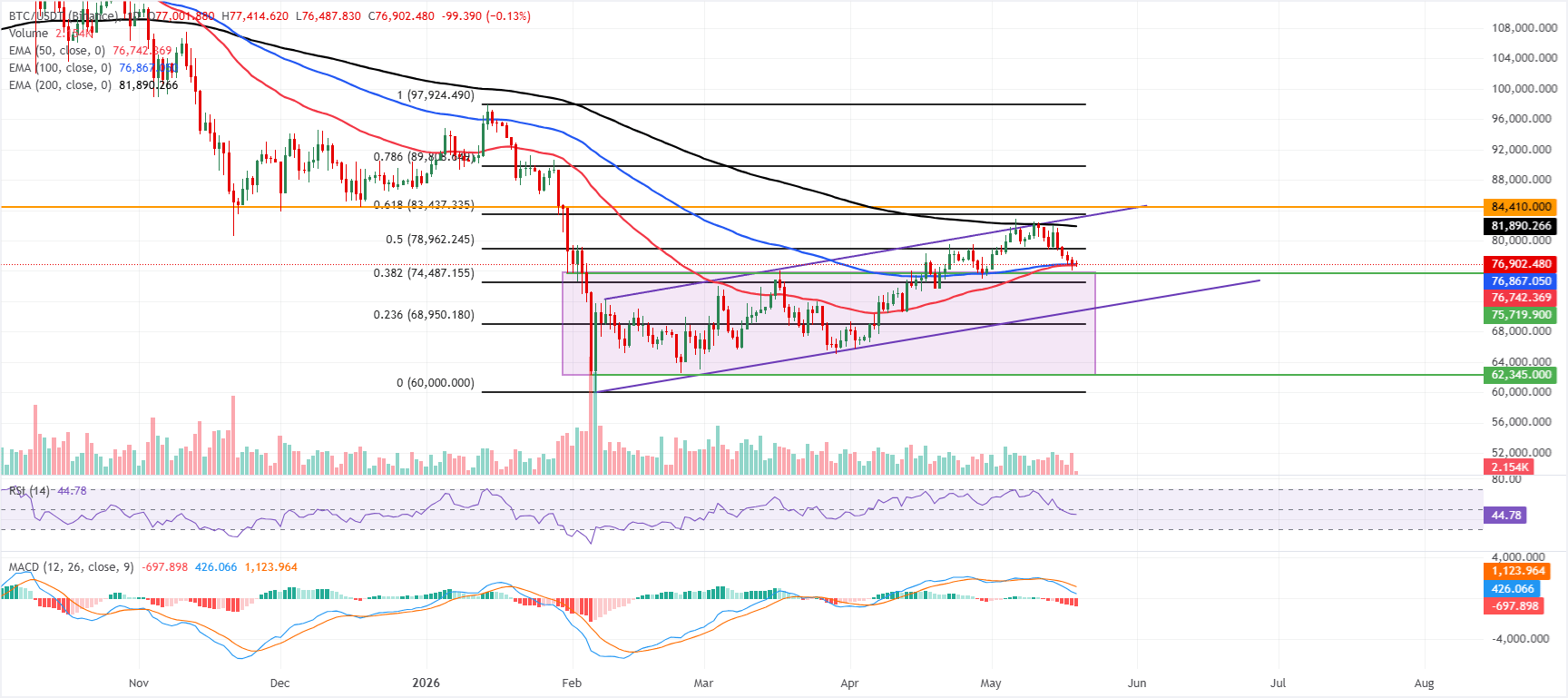
Bitcoin price nears key technical support on Tuesday, trading around the 50-day and 100-day Exponential Moving Averages (EMAs) near $76,750 and $76,900, respectively. This key technical area is roughly above the previously broken horizontal channel at $75,719, making it a key reversal zone for traders to watch.
The Crypto King remains capped below the 200-day EMA at $81,890, as well as higher Fibonacci and horizontal barriers. However, the underlying uptrend is still supported by the intact rising trend structure. The Relative Strength Index (RSI) is below the neutral level of 50, hovering at 44, and the Moving Average Convergence Divergence (MACD) remains negative, suggesting downside momentum and hinting at cautionary signs rather than an outright trend reversal.
On the topside, immediate resistance is provided by the the 50% retracement at $78,962 (drawn from the January high to the February low), with a sustained break opening the door toward the 200-day EMA at $81,890 and the 61.8% Fibonacci retracement at $83,437. Beyond that, a horizontal barrier aligns near $84,410 before the January high around $97,924.
On the downside, initial dynamic support is seen at the 50-day EMA at $76,742, ahead of the previously broken horizontal channel at $75,719 and the 38.2% Fibonacci retracement at $74,487, while deeper pullbacks would likely look to the rising trendline break area around $70,702 and then the 23.6% Fibonacciretracement at $68,950, with the broader bullish cycle only seriously threatened on a loss of the February low of $60,000.
(The technical analysis of this story was written with the help of an AI tool.)
Bitcoin, altcoins, stablecoins FAQs
Bitcoin is the largest cryptocurrency by market capitalization, a virtual currency designed to serve as money. This form of payment cannot be controlled by any one person, group, or entity, which eliminates the need for third-party participation during financial transactions.
Altcoins are any cryptocurrency apart from Bitcoin, but some also regard Ethereum as a non-altcoin because it is from these two cryptocurrencies that forking happens. If this is true, then Litecoin is the first altcoin, forked from the Bitcoin protocol and, therefore, an “improved” version of it.
Stablecoins are cryptocurrencies designed to have a stable price, with their value backed by a reserve of the asset it represents. To achieve this, the value of any one stablecoin is pegged to a commodity or financial instrument, such as the US Dollar (USD), with its supply regulated by an algorithm or demand. The main goal of stablecoins is to provide an on/off-ramp for investors willing to trade and invest in cryptocurrencies. Stablecoins also allow investors to store value since cryptocurrencies, in general, are subject to volatility.
Bitcoin dominance is the ratio of Bitcoin's market capitalization to the total market capitalization of all cryptocurrencies combined. It provides a clear picture of Bitcoin’s interest among investors. A high BTC dominance typically happens before and during a bull run, in which investors resort to investing in relatively stable and high market capitalization cryptocurrency like Bitcoin. A drop in BTC dominance usually means that investors are moving their capital and/or profits to altcoins in a quest for higher returns, which usually triggers an explosion of altcoin rallies.
추천 기사


