


Gold recovery stalls near $4,200 as US Dollar, Treasury yields stabilise
- Gold gains ground but struggles to extend its recovery as the US Dollar and Treasury yields stabilise.
- Traders await US consumer sentiment and inflation expectations data during American trading hours.
- XAU/USD remains confined to the $4,100-$4,200 range, with key daily SMAs capping the upside.
Gold (XAU/USD) trades on the front foot on Friday but struggles to extend its advance as the US Dollar (USD) and US Treasury yields show signs of stabilisation following Thursday’s sharp pullback. At the time of writing, XAU/USD trades around $4,182, up 1.20% on the day, after testing the $4,200 mark, its highest level in a week.
The benchmark 10-year US Treasury yield fell by 11.9 basis points on Thursday, from 5.354% to 5.235%, taking some steam out of the US Dollar rally and helping bullion recover from the two-month lows touched earlier this week.
Strong demand at a US 30-year Treasury auction helped drive the retreat in yields. A pullback in Oil prices also eased pressure on bonds after US President Donald Trump said in a Truth Social post that the United States would not attack Iran before the November midterm elections. Trump's remarks followed earlier reports suggesting Washington was preparing for possible renewed strikes.
However, the downward pressure on the US Dollar and yields fades on Friday as the broader drivers of their recent strength remain intact. Oil prices remain elevated, keeping inflation risks in focus and reinforcing expectations of additional interest-rate hikes by the Federal Reserve (Fed).
The US Dollar Index (DXY), which tracks the Greenback’s value against a basket of six major currencies, trades around 102.19 after recovering from an intraday low of 101.92. Meanwhile, the 10-year Treasury yield edges back toward 5.25% after briefly falling to around 5.21%.
A firmer US Dollar, Treasury yields near multi-year highs and a hawkish Fed outlook remain major headwinds for Gold, even as central bank purchases and ETF inflows provide underlying support. Higher yields increase the opportunity cost of holding the non-yielding metal, while US Dollar strength makes it more expensive for overseas buyers.
According to the CME FedWatch Tool, traders widely expect the Fed to leave interest rates unchanged at 3.75%-4.00% at its October 27-28 meeting, while pricing in an 85% probability of a rate hike in December.
Recent Fed communication also keeps the door open to additional increases as officials seek to bring inflation back toward the central bank’s 2% target. St. Louis Fed President Alberto Musalem said on Thursday, “To bring inflation back to target, more monetary policy firming will be required.” Fed Governor Christopher Waller struck a similar tone, signalling “additional hikes” if economic data develop as expected.
On the US economic docket, traders now await the preliminary University of Michigan consumer sentiment report for October, alongside 1-year and 5-year inflation expectations.
Technical analysis: XAU/USD remains rangebound below key daily SMAs
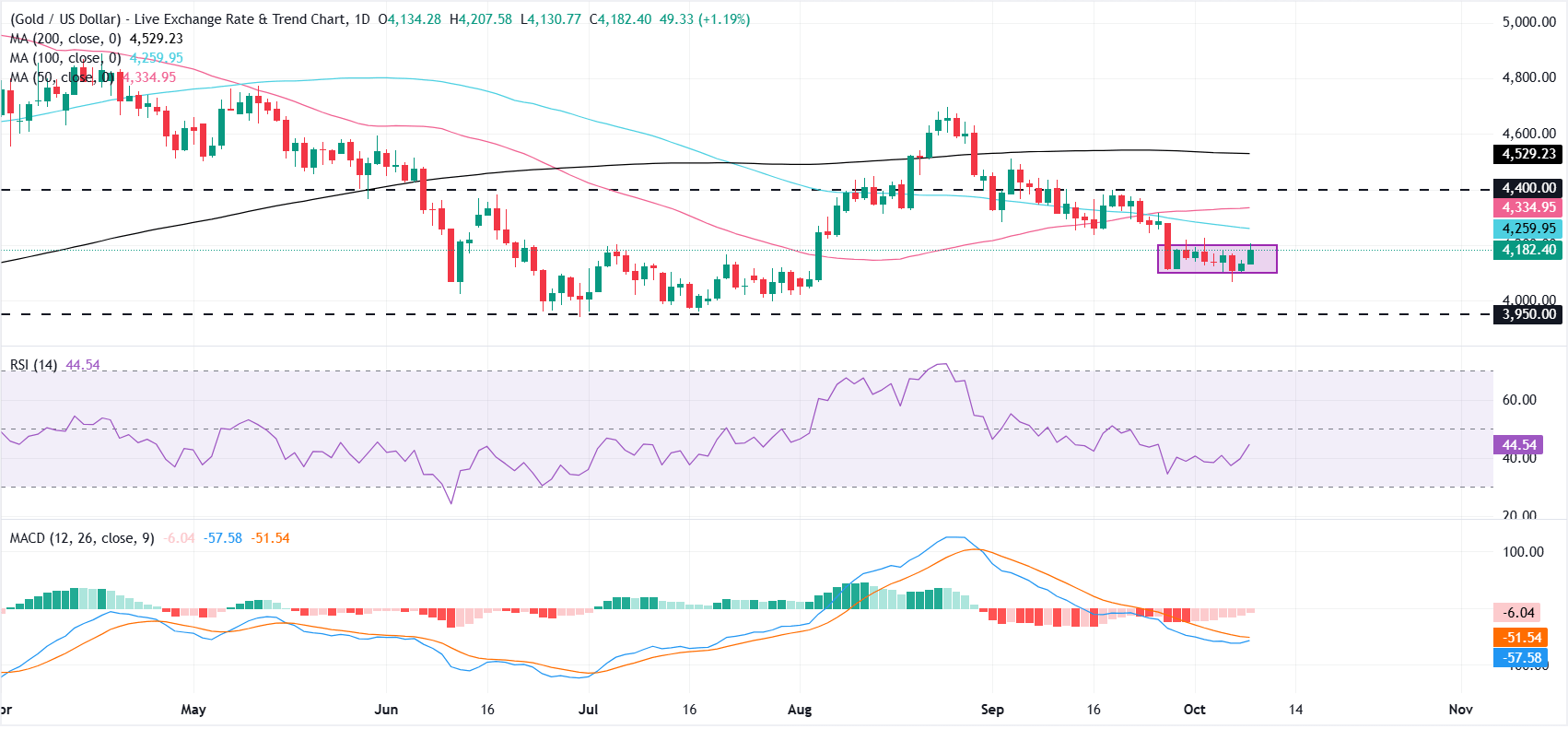
XAU/USD remains largely confined to the $4,100-$4,200 range seen since the start of the month, while trading below the 50-day, 100-day and 200-day Simple Moving Averages (SMAs) on the daily chart. The dense overhead moving-average stack suggests rallies remain capped for now, while the Relative Strength Index (RSI) near 44 retains a mild bearish bias.
Meanwhile, the Moving Average Convergence Divergence (MACD) indicator remains negative but has been narrowing, suggesting that selling pressure is easing rather than reversing decisively.
On the topside, initial resistance lies at the $4,200 psychological mark, followed by the 100-day SMA at $4,259 and the 50-day SMA at $4,334. A stronger recovery would face the $4,400 horizontal barrier ahead of the 200-day SMA at $4,529.
On the downside, initial support stands at $4,100. A sustained break below this level could open the door toward the $4,000-$3,950 support zone.
(The technical analysis of this story was written with the help of an AI tool. Know more.)
Gold FAQs
Gold has played a key role in human’s history as it has been widely used as a store of value and medium of exchange. Currently, apart from its shine and usage for jewelry, the precious metal is widely seen as a safe-haven asset, meaning that it is considered a good investment during turbulent times. Gold is also widely seen as a hedge against inflation and against depreciating currencies as it doesn’t rely on any specific issuer or government.
Central banks are the biggest Gold holders. In their aim to support their currencies in turbulent times, central banks tend to diversify their reserves and buy Gold to improve the perceived strength of the economy and the currency. High Gold reserves can be a source of trust for a country’s solvency. Central banks added 1,136 tonnes of Gold worth around $70 billion to their reserves in 2022, according to data from the World Gold Council. This is the highest yearly purchase since records began. Central banks from emerging economies such as China, India and Turkey are quickly increasing their Gold reserves.
Gold has an inverse correlation with the US Dollar and US Treasuries, which are both major reserve and safe-haven assets. When the Dollar depreciates, Gold tends to rise, enabling investors and central banks to diversify their assets in turbulent times. Gold is also inversely correlated with risk assets. A rally in the stock market tends to weaken Gold price, while sell-offs in riskier markets tend to favor the precious metal.
The price can move due to a wide range of factors. Geopolitical instability or fears of a deep recession can quickly make Gold price escalate due to its safe-haven status. As a yield-less asset, Gold tends to rise with lower interest rates, while higher cost of money usually weighs down on the yellow metal. Still, most moves depend on how the US Dollar (USD) behaves as the asset is priced in dollars (XAU/USD). A strong Dollar tends to keep the price of Gold controlled, whereas a weaker Dollar is likely to push Gold prices up.
추천 기사


