


Crude Oil finds the tollbooth inside the Hormuz corridor
- WTI reverses more than $3.50 off the session low, trading above $82.00.
- Hormuz transits down to four inbound and none outbound on Monday.
- Iran conditions full reopening on a June memorandum that has lapsed.
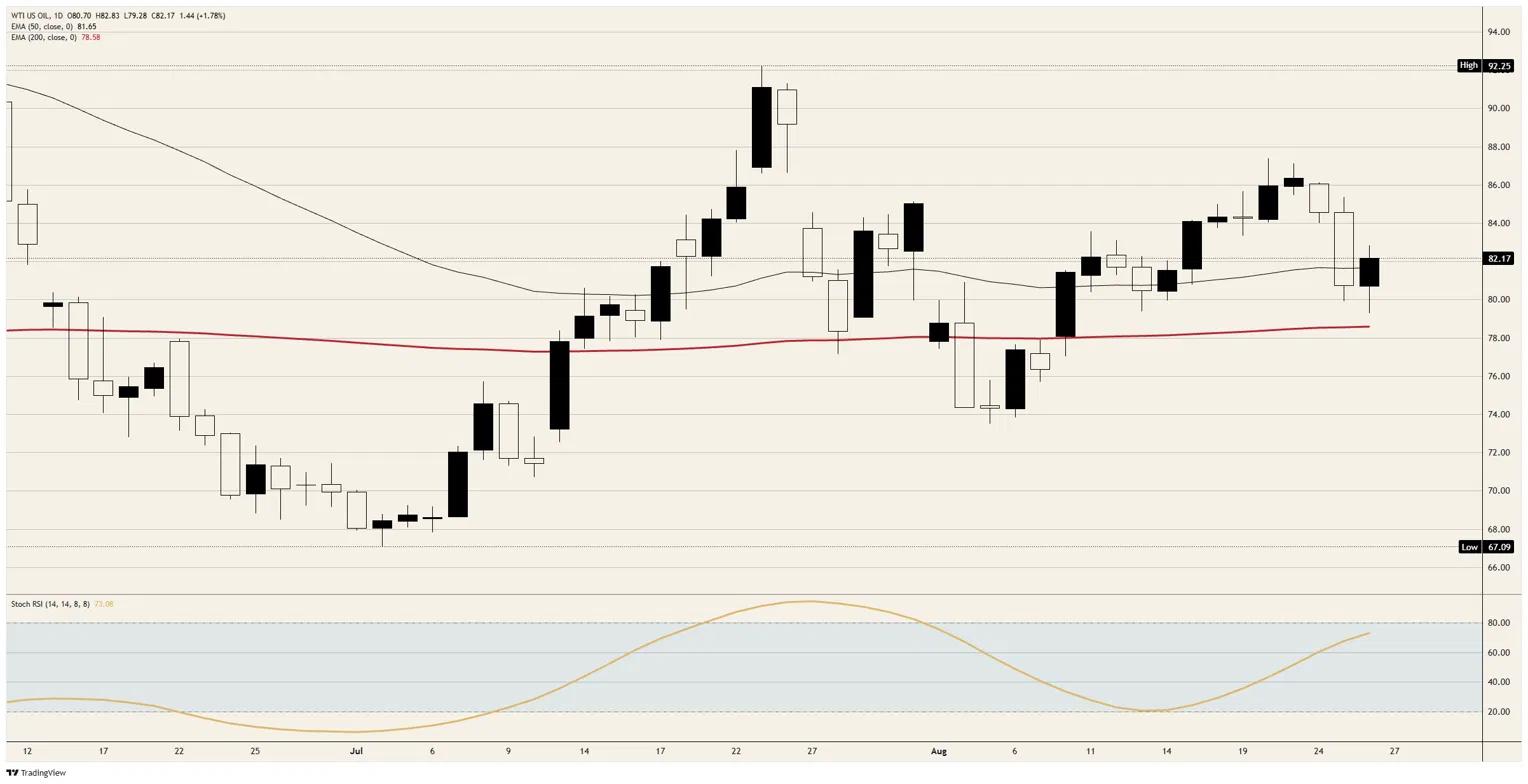
Crude Oil trades just above $82.00 and 1.78% higher on the session, which is not where it was heading. West Texas Intermediate opened short of $81.00, extended a three-session slide to a low just short of $79.50 in the European morning, then reversed more than $3.50 to a session high short of $83.00 after 16:00 GMT. The selling was a response to a headline about the Strait of Hormuz, and the buying was a response to reading what that headline actually says.
The market sold a headline and bought back the terms
Iran and Oman announced a temporary joint maritime corridor through the strait with mine clearance attached, and the barrel gave up roughly 6% across three sessions on it. The wires wrote that up as war premium unwinding. The terms published alongside the announcement do not support the reading.
The corridor is described as temporary and joint, which means Tehran keeps a hand on traffic rather than surrendering it. Iran's deputy foreign minister said the same day that the waterway will not fully reopen until Washington meets its commitments under the June memorandum, an agreement that has since lapsed. A corridor conditioned on the other side honouring a dead document is a negotiating position, not a supply schedule.
The fee question is the part the price eventually noticed. Tehran has run a permission-and-payment regime through the closure, with reported charges of $1 million to $2 million a voyage, and frames those as service charges rather than tolls because maritime law bars tolls on an international strait while permitting charges for services actually rendered. Muscat wants any such charge voluntary and Tehran wants it mandatory, and that gap remains open.
The body that would collect on the Iranian side was designated in May, so a corridor with a fee attached asks a compliant charterer to transact with a sanctioned counterparty before it asks anything of a freight desk. That is a legal problem rather than a shipping one, and it does not resolve on a joint statement.
The transit count went the wrong way
The number that decides the argument is not the price but the transit count, and it has moved in the opposite direction to the tape. Vessels crossing the Strait of Hormuz have declined since August 22, from as many as 20 inbound, 14 outbound and three crossings in dark mode down to as few as four inbound, none outbound and three dark by Monday, against a prewar reference north of 100 a day.
A market took 6% off the barrel across three sessions while physical flow through the chokepoint fell to nothing outbound. Roughly 65% of the Crude Oil leaving through the strait is bound for China, so the leg that matters most to seaborne balances is the one that has stopped. Announcements move the screen and hulls move the barrels, and this week the two have been travelling in opposite directions.
The 50-day Exponential Moving Average (EMA) near $81.50 was lost on the way down and reclaimed on the way back, making it a pivot rather than a trend line for the second time this month. The 200-day near $78.50 has not been tested since the first week of August. Everything today happened inside an August band running roughly $74.00 to $87.00, so a $3.50 reversal is noise at the range level and information at the narrative level.
What the week still has to price
The domestic side of the barrel got firmer today rather than softer. Headline Personal Consumption Expenditures (PCE) prices ran 3.7% over the year against a 3.6% consensus, personal income rose 0.4% against 0.3%, and every price line in the second-quarter revision landed above forecast, including a quarterly core reading marked up to 3.7% from 3.4%. A barrel back above $82.00 into that is a passthrough problem rather than a relief.
Thursday brings initial jobless claims at 12:30 GMT, expected at 208K from 206K, and little else. Friday stacks the Chicago Purchasing Managers Index (PMI) at 13:45 GMT at a consensus of 57 from 57.6, ahead of a 14:00 GMT block carrying the chair's Wyoming keynote, final August Michigan sentiment expected at 51, and one-year household inflation expectations against a 4.3% prior. That last figure is the one a firm barrel threatens.
Levels and bias
Resistance: The session high short of $83.00 is the first line and the tape has faded from it once already. Above that the mid-August shelf near $84.50 is the level that would confirm the reversal, with the August peak around $87.00 and the late-July high just above $92.00 as the distant ceiling.
Support: The 50-day EMA near $81.50 is the level to hold now that it has been reclaimed. Beneath it $80.00 is the next round number, and the session low just short of $79.50 is the line the whole reversal rests on. Below that the 200-day EMA near $78.50 is the first structural floor.
Bias: Bullish above the session low just short of $79.50, because a market that sold a reopening for three sessions and took $3.50 back inside four hours has repriced the terms rather than the headline, and the daily Stochastic Relative Strength Index (Stoch RSI) near 73 is climbing rather than stretched. Objectives are the mid-August shelf near $84.50 and then $87.00. Invalidation comes on a daily close beneath $79.50, which would put the 200-day EMA near $78.50 back in play.
WTI daily chart
WTI Oil FAQs
WTI Oil is a type of Crude Oil sold on international markets. The WTI stands for West Texas Intermediate, one of three major types including Brent and Dubai Crude. WTI is also referred to as “light” and “sweet” because of its relatively low gravity and sulfur content respectively. It is considered a high quality Oil that is easily refined. It is sourced in the United States and distributed via the Cushing hub, which is considered “The Pipeline Crossroads of the World”. It is a benchmark for the Oil market and WTI price is frequently quoted in the media.
Like all assets, supply and demand are the key drivers of WTI Oil price. As such, global growth can be a driver of increased demand and vice versa for weak global growth. Political instability, wars, and sanctions can disrupt supply and impact prices. The decisions of OPEC, a group of major Oil-producing countries, is another key driver of price. The value of the US Dollar influences the price of WTI Crude Oil, since Oil is predominantly traded in US Dollars, thus a weaker US Dollar can make Oil more affordable and vice versa.
The weekly Oil inventory reports published by the American Petroleum Institute (API) and the Energy Information Agency (EIA) impact the price of WTI Oil. Changes in inventories reflect fluctuating supply and demand. If the data shows a drop in inventories it can indicate increased demand, pushing up Oil price. Higher inventories can reflect increased supply, pushing down prices. API’s report is published every Tuesday and EIA’s the day after. Their results are usually similar, falling within 1% of each other 75% of the time. The EIA data is considered more reliable, since it is a government agency.
OPEC (Organization of the Petroleum Exporting Countries) is a group of 12 Oil-producing nations who collectively decide production quotas for member countries at twice-yearly meetings. Their decisions often impact WTI Oil prices. When OPEC decides to lower quotas, it can tighten supply, pushing up Oil prices. When OPEC increases production, it has the opposite effect. OPEC+ refers to an expanded group that includes ten extra non-OPEC members, the most notable of which is Russia.
추천 기사


