


The Euro wins back its slide to a fresh low as France files its budget
- EUR/USD wins back Monday's drop to a 17-month low as France files its budget.
- Money markets give an October ECB hike about 14%, from 60% in late September.
- Euro area retail sales up 0.1% in August against a 0.2% forecast.
EUR/USD has won back all of Monday's drop to its lowest level since May 2025. The pair trades just above 1.1250, back at Monday's opening level, as French bonds steadied and the Dollar eased across the board.
France sent its 2027 budget to parliament on Tuesday's deadline, and the extra yield on French 10-year debt over German debt narrowed to about 1.3 points from close to 1.6 at Friday's peak. That gap has driven the Euro since late September, and its widening through Friday led traders to cut bets on another European Central Bank (ECB) hike. The budget puts France's interest bill at about €91 billion in 2027, more than it plans to spend on defence or education.
An October ECB hike goes from better than even to one in seven
Money markets put an October 29 ECB hike at about 60% in late September and about 14% now, though a move by year-end is still priced near 80%. ECB Chief Economist Lane said in an interview published on Tuesday that high energy costs haven't yet produced strong knock-on effects on wages and wider prices. He has championed the ECB's war scenarios and said it's too simplistic to say whether the euro area is in the baseline or the adverse one.
Retail sales rose 0.1% MoM in August against a 0.2% forecast, after a 0.6% fall in July, and 0.8% YoY against 1%. Fuel volumes were 3.7% below a year earlier while food and other goods grew, so the energy shock is showing up in what shoppers buy. Softer spending and weak knock-on effects both thin the case for an October hike, and without one EUR/USD loses rate support against the Dollar.
France's first budget vote comes nine days before the ECB decides
ECB Vice-President Vujčić speaks on Wednesday at 07:20 and 17:30 GMT, and Chief Economist Lane on Thursday at 10:00 GMT, ahead of the account of the September 10 meeting at 11:30 GMT. That meeting raised the deposit rate to 2.50% while traders still expected another hike in October, so the account may read more hawkish than current pricing. The National Assembly votes on the first part of France's budget on October 20, nine days before the ECB's October 29 decision.
The Federal Open Market Committee (FOMC) minutes follow on Wednesday at 18:00 GMT. Friday's University of Michigan (UoM) survey at 14:00 GMT is forecast to show sentiment at 47.6 from 48.1. US households put one-year inflation at 4.6% in the last survey, above the 4.00% top of the Fed's range, which means they expect prices to rise faster than the Fed's overnight rate. A higher reading would lift Fed hike bets and push EUR/USD back toward Monday's low.
Euro levels under 1.1300
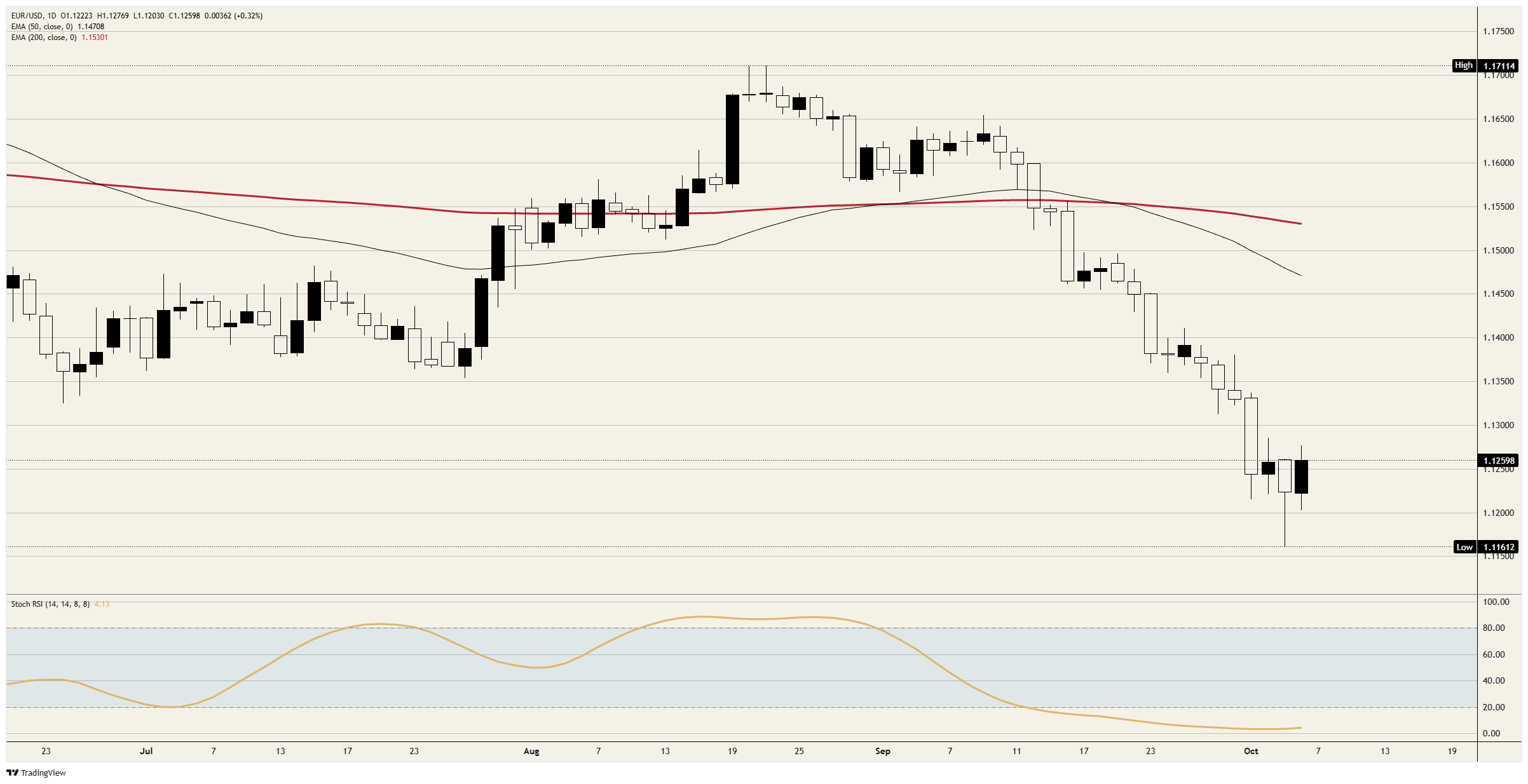
Upside: Tuesday's high stopped short of Friday's, which sits just under 1.1300, and the pair hasn't traded above 1.1300 since October 1. 1.1350 sits just above where the October 1 drop began.
Downside: Tuesday's low, just above 1.1200, is the first floor. Monday's low, just above 1.1150, is the lowest since May 2025, and 1.1100 is the next round level.
Bias: The tape stays offered below 1.1300, with 1.1150 the first objective and 1.1100 after it. The daily Stochastic Relative Strength Index (Stoch RSI), under 20 since September 14, has only just lifted from near 4, which leaves room for a test of 1.1300 before sellers return. The call is wrong on a daily close above 1.1350.
EUR/USD daily chart
Euro FAQs
The Euro is the currency for the 20 European Union countries that belong to the Eurozone. It is the second most heavily traded currency in the world behind the US Dollar. In 2022, it accounted for 31% of all foreign exchange transactions, with an average daily turnover of over $2.2 trillion a day. EUR/USD is the most heavily traded currency pair in the world, accounting for an estimated 30% off all transactions, followed by EUR/JPY (4%), EUR/GBP (3%) and EUR/AUD (2%).
The European Central Bank (ECB) in Frankfurt, Germany, is the reserve bank for the Eurozone. The ECB sets interest rates and manages monetary policy. The ECB’s primary mandate is to maintain price stability, which means either controlling inflation or stimulating growth. Its primary tool is the raising or lowering of interest rates. Relatively high interest rates – or the expectation of higher rates – will usually benefit the Euro and vice versa. The ECB Governing Council makes monetary policy decisions at meetings held eight times a year. Decisions are made by heads of the Eurozone national banks and six permanent members, including the President of the ECB, Christine Lagarde.
Eurozone inflation data, measured by the Harmonized Index of Consumer Prices (HICP), is an important econometric for the Euro. If inflation rises more than expected, especially if above the ECB’s 2% target, it obliges the ECB to raise interest rates to bring it back under control. Relatively high interest rates compared to its counterparts will usually benefit the Euro, as it makes the region more attractive as a place for global investors to park their money.
Data releases gauge the health of the economy and can impact on the Euro. Indicators such as GDP, Manufacturing and Services PMIs, employment, and consumer sentiment surveys can all influence the direction of the single currency. A strong economy is good for the Euro. Not only does it attract more foreign investment but it may encourage the ECB to put up interest rates, which will directly strengthen the Euro. Otherwise, if economic data is weak, the Euro is likely to fall. Economic data for the four largest economies in the euro area (Germany, France, Italy and Spain) are especially significant, as they account for 75% of the Eurozone’s economy.
Another significant data release for the Euro is the Trade Balance. This indicator measures the difference between what a country earns from its exports and what it spends on imports over a given period. If a country produces highly sought after exports then its currency will gain in value purely from the extra demand created from foreign buyers seeking to purchase these goods. Therefore, a positive net Trade Balance strengthens a currency and vice versa for a negative balance.
추천 기사


