


AUD/USD Price Forecast: 20-day EMA remains key barrier amid firm US Dollar
- AUD/USD declines to near 0.7100 as the US Dollar continues its outperformance.
- Fed board members warn of persistent inflation risks amid energy shocks and strong demand.
- Australian preliminary S&P Global Composite PMI arrives lower at 50.8 in September.
The Australian Dollar (AUD) is down 0.15% at around 0.7100 against the US Dollar (USD) during the early European trading session on Wednesday. The Aussie pair faces pressure as the US Dollar extends its advance, with Federal Reserve (Fed) board members delivering hawkish commentary on interest rates and warnings of persistent inflation risks.
US Dollar Price Today
The table below shows the percentage change of US Dollar (USD) against listed major currencies today. US Dollar was the strongest against the New Zealand Dollar.
| USD | EUR | GBP | JPY | CAD | AUD | NZD | CHF | |
|---|---|---|---|---|---|---|---|---|
| USD | 0.21% | 0.24% | 0.17% | 0.12% | 0.21% | 0.43% | 0.10% | |
| EUR | -0.21% | 0.02% | -0.02% | -0.07% | 0.01% | 0.22% | -0.11% | |
| GBP | -0.24% | -0.02% | -0.04% | -0.09% | -0.03% | 0.19% | -0.06% | |
| JPY | -0.17% | 0.02% | 0.04% | -0.04% | 0.01% | 0.26% | -0.02% | |
| CAD | -0.12% | 0.07% | 0.09% | 0.04% | 0.07% | 0.31% | 0.03% | |
| AUD | -0.21% | -0.01% | 0.03% | -0.01% | -0.07% | 0.23% | -0.03% | |
| NZD | -0.43% | -0.22% | -0.19% | -0.26% | -0.31% | -0.23% | -0.27% | |
| CHF | -0.10% | 0.11% | 0.06% | 0.02% | -0.03% | 0.03% | 0.27% |
The heat map shows percentage changes of major currencies against each other. The base currency is picked from the left column, while the quote currency is picked from the top row. For example, if you pick the US Dollar from the left column and move along the horizontal line to the Japanese Yen, the percentage change displayed in the box will represent USD (base)/JPY (quote).
In the early European trade, the US Dollar Index (DXY), which gauges the Greenback’s value against six major currencies, trades 0.17% higher to near 100.73, the highest level seen in over seven weeks.
Dollar support underpinned as Fed hawks stress persistent inflation risks
Analysts at ING highlight that "hawkish Fed commentary was however the clearest driver" of Dollar strength, pointing to remarks from Chicago Fed President Austan Goolsbee and St. Louis Fed President Alberto Musalem. Goolsbee warned that "supply shocks, combined with strong spending and AI-related investment, could keep inflation persistent," cautioning further that "the path back to 2% inflation may not be painless." Later in the day, Musalem "reinforced the hawkish message," arguing that "front-loaded gradual tightening is preferable and that policy remains accommodative." ING notes that Musalem is regarded as "one of the more hawkish members" and may be among "the four officials who projected two additional hikes this year in the dot plot, although he is also a non-voter," underscoring the firm hawkish tone that continues to support US front-end rates.
Meanwhile, the Australian Dollar trades higher against its major currency peers, except North American currencies. Earlier in the day, Australian S&P Global flash Composite Purchasing Managers’ Index (PMI) data for September came in weaker-than-expected. The Composite PMI arrived at 50.8, lower than 52.7 in August due to a decline in the manufacturing sector output and a slowdown in the services sector activity.
AUD/USD Technical Analysis
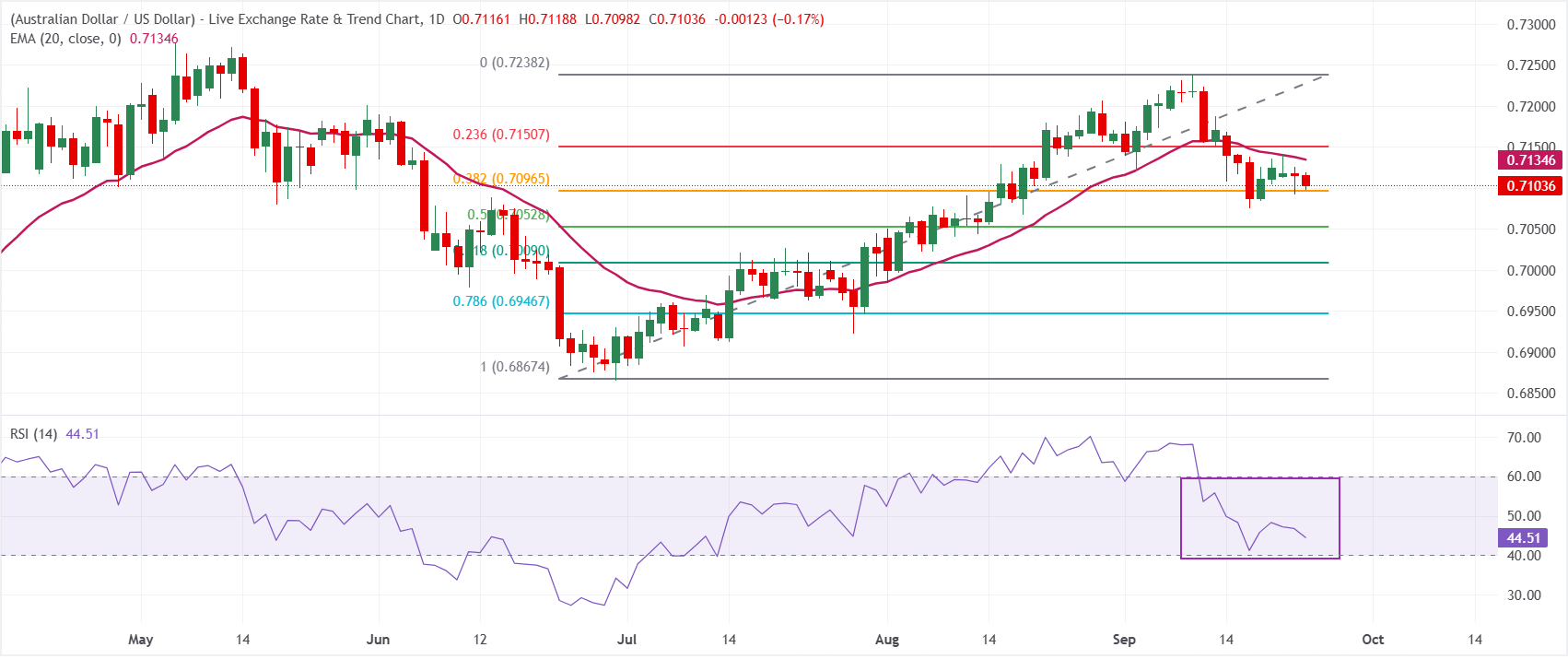
In the daily chart, AUD/USD trades at 0.7104, holding just above the 38.2% Fibonacci retracement at 0.7097 but still capped by the 20-period exponential moving average (EMA) at 0.7135. This configuration hints at a consolidative to slightly bearish near-term tone, as price struggles to reclaim the overhead EMA while staying supported by nearby Fib levels.
The Relative Strength Index (14) at 44.5 sits below the midline, suggesting subdued bullish momentum and reinforcing the idea of a range-bound bias rather than a decisive trend.
On the downside, immediate support is located at the 38.2% retracement at 0.7097, ahead of the denser structural floor formed by the 50.0% and 61.8% Fibonacci levels at 0.7053 and 0.7009, while deeper pullbacks would expose the 78.6% and 100% retracements at 0.6947 and 0.6867. On the topside, initial resistance is seen at the 20-period EMA at 0.7135, followed by the 23.6% retracement at 0.7151, with a more significant barrier emerging at the cycle high anchor near the 0.0% retracement at 0.7238.
(The technical analysis of this story was written with the help of an AI tool. Know more.)
Fed FAQs
Monetary policy in the US is shaped by the Federal Reserve (Fed). The Fed has two mandates: to achieve price stability and foster full employment. Its primary tool to achieve these goals is by adjusting interest rates. When prices are rising too quickly and inflation is above the Fed’s 2% target, it raises interest rates, increasing borrowing costs throughout the economy. This results in a stronger US Dollar (USD) as it makes the US a more attractive place for international investors to park their money. When inflation falls below 2% or the Unemployment Rate is too high, the Fed may lower interest rates to encourage borrowing, which weighs on the Greenback.
The Federal Reserve (Fed) holds eight policy meetings a year, where the Federal Open Market Committee (FOMC) assesses economic conditions and makes monetary policy decisions. The FOMC is attended by twelve Fed officials – the seven members of the Board of Governors, the president of the Federal Reserve Bank of New York, and four of the remaining eleven regional Reserve Bank presidents, who serve one-year terms on a rotating basis.
In extreme situations, the Federal Reserve may resort to a policy named Quantitative Easing (QE). QE is the process by which the Fed substantially increases the flow of credit in a stuck financial system. It is a non-standard policy measure used during crises or when inflation is extremely low. It was the Fed’s weapon of choice during the Great Financial Crisis in 2008. It involves the Fed printing more Dollars and using them to buy high grade bonds from financial institutions. QE usually weakens the US Dollar.
Quantitative tightening (QT) is the reverse process of QE, whereby the Federal Reserve stops buying bonds from financial institutions and does not reinvest the principal from the bonds it holds maturing, to purchase new bonds. It is usually positive for the value of the US Dollar.
추천 기사


