


Indian Rupee rebounds as rally in US yields and oil prices hits a pause
- The Indian Rupee recovers strongly against the US Dollar on Friday after declining significantly this week.
- Oil prices drop as Saudi Arabia mulls alternatives to ship energy products.
- Fed’s hike and interest rate repricing are expected to keep US bond yields contained.
The Indian Rupee (INR) opens sharply higher against the US Dollar (USD) on Friday, with the USD/INR pair correcting to near 95.75 from an over seven-week high of 96.10 posted the previous day. The Indian currency capitalizes on a pause in rally in both oil prices and United States (US) Treasury Yields.
As of writing, the MCX Crude Oil contract expiring on September 21 trades at around Rs. 9,688. The oil price has corrected from its multi-month high of Rs. 10,238 posted earlier this week.
A correction in oil prices brings relief for currencies from economies, such as India, which rely heavily on oil prices to meet their energy needs.
Oil eases as Saudi supply signals improve Middle East flow outlook
Analysts at Deutsche Bank note that some improvement in the outlook for oil flows out of the Middle East has resulted in a pullback move in oil prices. They highlight that this “included news that Saudi Arabia was increasing tanker loadings in the Gulf and ramping up sales of crude from just outside the Strait of Hormuz,” as the Kingdom looks to ship more barrels through the strait following the closure of its East-West oil pipeline.
Deutsche Bank adds that the supply picture was further supported when “Bloomberg report[ed] that Saudi Arabia is aiming to restore about half of the East-West pipeline’s capacity within days and return it to full capability ‘in about six weeks.”
This has provided some relief from tight energy supply concerns, which were escalated following drone attacks by Yemen-linked Houthis on pipeline facilities near Riyadh and Medina.
US Treasury Yields correct on oil relief
Yields on US government-backed securities have cooled down a little after rallying in the past few weeks, following relief from a slight correction in oil prices. As of writing, 10-year US Treasury Yields trade close to ongoing week’s low near 4.94% after hitting a 19-year high of 5.04% on Tuesday.
Lower US bond yields result in an improvement in appeal of risk-sensitive assets, such as the Indian Rupee.
Also, market experts believe the interest rate hike move by the Federal Reserve (Fed) on Wednesday, which resulted in an improvement in central bank’s credibility, has also weighed on US Treasury Yields.
According to TD Securities, a combination of "already-hawkish Fed pricing, increased inflation-fighting credibility, and worries about higher rates impacting growth, should help keep 10-year yields contained."
USD/INR Technical Analysis
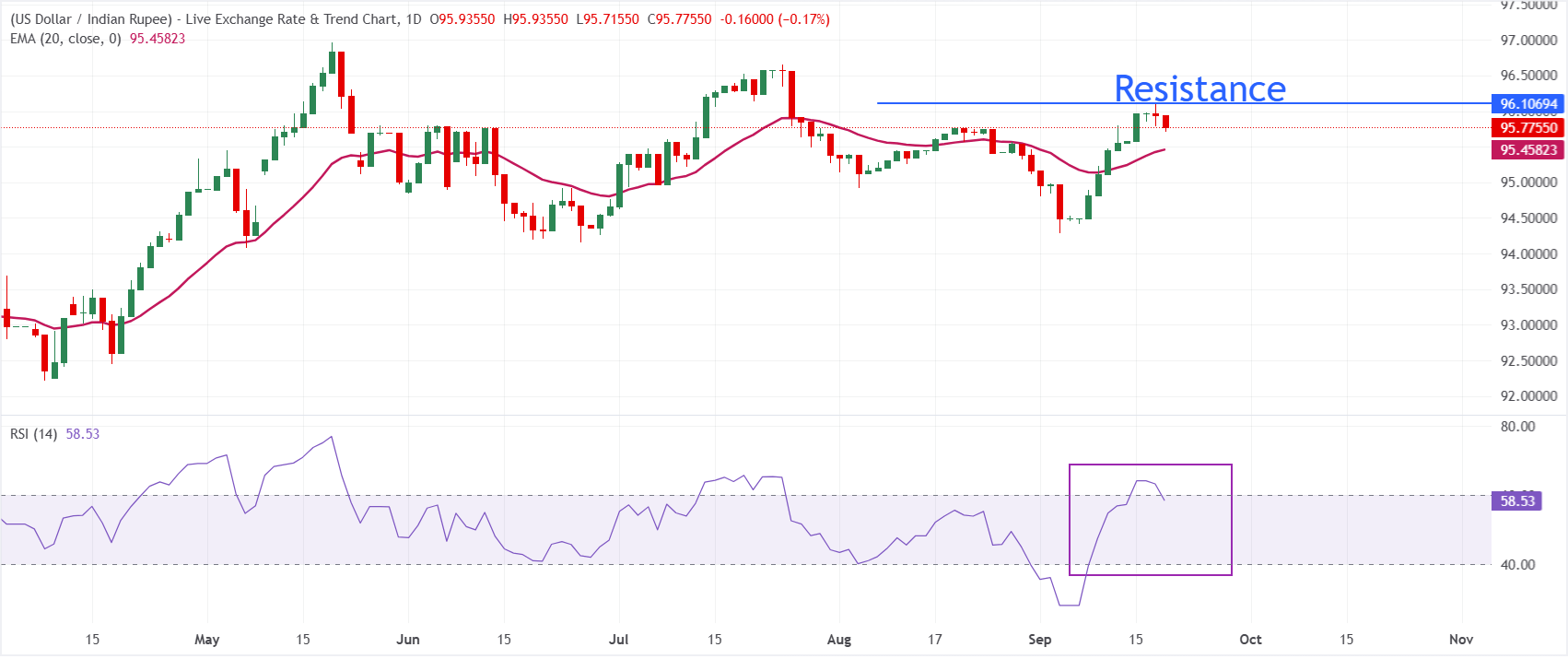
In the daily chart, USD/INR trades at 95.7755, keeping a constructive bullish tone as spot holds above the 20-period exponential moving average (EMA) at 95.4582. The pair is extending its recovery from the mid-94.00s, and the positioning above this short-term EMA suggests underlying demand remains in place, with pullbacks likely to attract buying interest while momentum stays supportive.
On the downside, immediate support is seen at the 20-period EMA near 95.46, which underpins the short-term uptrend and marks the first level where buyers could re-emerge on any corrective move. Looking up, the September 17 high at 96.10 is the immediate support; a decisive break above the same could open the door for revisiting the all-time high near 97.00.
(The technical analysis of this story was written with the help of an AI tool. Know more.)
Indian Rupee FAQs
The Indian Rupee (INR) is one of the most sensitive currencies to external factors. The price of Crude Oil (the country is highly dependent on imported Oil), the value of the US Dollar – most trade is conducted in USD – and the level of foreign investment, are all influential. Direct intervention by the Reserve Bank of India (RBI) in FX markets to keep the exchange rate stable, as well as the level of interest rates set by the RBI, are further major influencing factors on the Rupee.
The Reserve Bank of India (RBI) actively intervenes in forex markets to maintain a stable exchange rate, to help facilitate trade. In addition, the RBI tries to maintain the inflation rate at its 4% target by adjusting interest rates. Higher interest rates usually strengthen the Rupee. This is due to the role of the ‘carry trade’ in which investors borrow in countries with lower interest rates so as to place their money in countries’ offering relatively higher interest rates and profit from the difference.
Macroeconomic factors that influence the value of the Rupee include inflation, interest rates, the economic growth rate (GDP), the balance of trade, and inflows from foreign investment. A higher growth rate can lead to more overseas investment, pushing up demand for the Rupee. A less negative balance of trade will eventually lead to a stronger Rupee. Higher interest rates, especially real rates (interest rates less inflation) are also positive for the Rupee. A risk-on environment can lead to greater inflows of Foreign Direct and Indirect Investment (FDI and FII), which also benefit the Rupee.
Higher inflation, particularly, if it is comparatively higher than India’s peers, is generally negative for the currency as it reflects devaluation through oversupply. Inflation also increases the cost of exports, leading to more Rupees being sold to purchase foreign imports, which is Rupee-negative. At the same time, higher inflation usually leads to the Reserve Bank of India (RBI) raising interest rates and this can be positive for the Rupee, due to increased demand from international investors. The opposite effect is true of lower inflation.
추천 기사


