


The Japanese Yen spikes on a generational wage print and balks by the closing bell
- USD/JPY breaks 153.00 on the wage data and recovers all 147 pips of it.
- Nominal pay grew 4.7% in July, the fastest in Japan since 1997.
- Swaps put next week's Bank of Japan hike at 98%, priced before the data landed.
USD/JPY trades just under 154.00, roughly 40 pips lower on Tuesday after a 147-pip round trip. Japan published the fastest nominal wage growth since 1997, an upward revision to second-quarter growth and a current account surplus above consensus, and the Yen kept none of it past the New York afternoon. A meeting the swaps market has at 98% cannot be made more certain by data.
The wage print the Bank of Japan spent years waiting for
Nominal cash earnings rose 4.7% YoY in July against a 3.9% consensus and 4% in June, the fastest since January 1997 and the sixth consecutive month above 3%. Real wages rose 2.4%, a seventh straight increase and the best in about five years. Base pay rose 4.1%, the fastest since April 1992, so this is not a summer bonus flattering a headline.
That combination removes the objection the Bank of Japan (BoJ) has leaned on against faster tightening, which is that raising rates would choke the wage recovery before it reached households. Swaps put a quarter point to 1.25% on September 18 at 98%, and they were there before the data. The Yen's payment for the strongest pay figures in 29 years was 38 pips.
The mechanism behind the number is structural rather than cyclical. The spring wage round run by Japan's largest labour federation delivered average increases above 5% for a third consecutive year, and the working-age population keeps shrinking while corporate profits fund the raises. Employers are bidding for a workforce that gets smaller every year. That is a wage floor rather than a wage cycle, and it is the thing the Bank has said it needed to see.
Nobody spent the raise
Private consumption was flat in the second quarter. Real incomes turned positive only recently after a long run in which inflation ran ahead of pay, and household demand has not followed yet. The second estimate of Gross Domestic Product (GDP) revised the quarter up to 1.4% annualized against a 1.1% consensus, with the quarterly rate at 0.4% after 0.3%. Second estimates in Japan are rebuilt on a corporate capital spending survey published after the first, and the annual benchmark will revise the quarter again. The deflator printed 2.6% YoY, in line with consensus and unchanged on the prior reading.
The distinction matters because the September move is already in the price and the pace after it is not. A run of consecutive hikes needs households to convert a seventh month of real income gains into spending, and the national accounts say they have not started. July's current account surplus of ¥2.988 trillion against a ¥2.87 trillion consensus is a trade number rather than a consumption one, and it was earned in a month when Japan paid war prices for every barrel it imports. Wages are an economics question and Tuesday was a markets question, and they were answered differently. The economy learned that the recovery is real. The price learned nothing it had not already decided.
Everything left this week belongs to the Dollar
Japan's calendar is empty until the meeting. Wednesday carries a four-week average of a private American payroll estimate at 12:15 GMT and nothing else across the three currencies. Thursday brings the Producer Price Index (PPI) at 12:30 GMT, seen at 0.4% on the month after a flat July and 5.3% YoY after 4.7%, with the core rate at 4.6% YoY after 4.2%, alongside initial jobless claims at 205K after 206K.
Friday is the week. The August Consumer Price Index (CPI) lands at 12:30 GMT, seen at 0.4% on the month after 0.1%, with the annual rate steady at 3.4% and the core rate easing to 2.4%. The Federal Reserve meets September 15-16 and the BoJ follows on September 17-18, so the American print arrives with a decision attached to it. The target range in Washington is 3.50% to 3.75%, and markets put a quarter point next week somewhere near two chances in three after August payrolls landed at 162K. Japan has told this market everything it has before the meeting. The rest of the week is somebody else's data.
Levels and bias
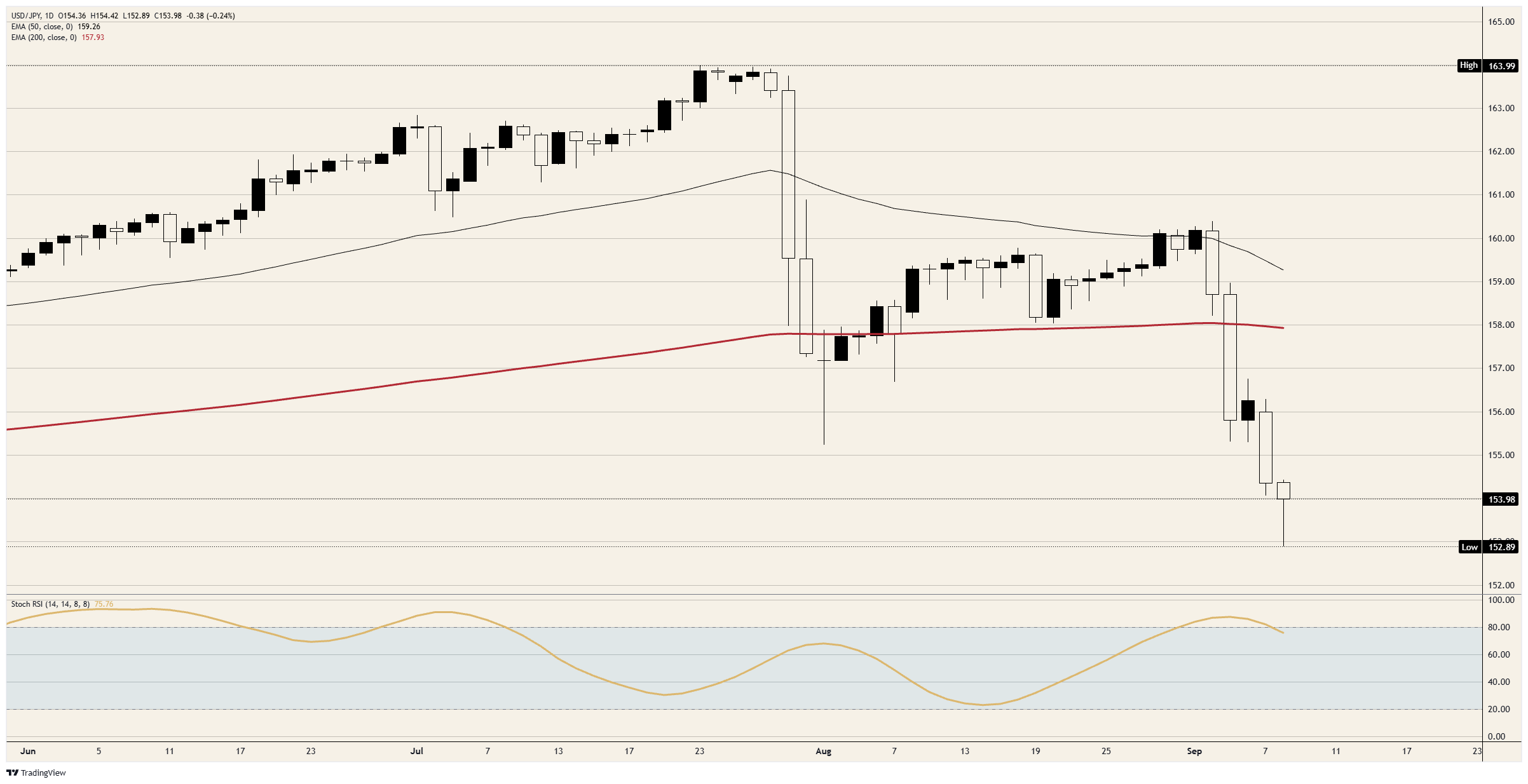
Resistance: The 154.00 handle is the pivot, and Tuesday's recovery stalled a few pips beneath 154.50 twice before fading. Above that, 155.00 capped Monday's bounce, while the 200-day Exponential Moving Average (EMA) near 158.00 caps anything larger and the 50-day EMA sits just under 159.50.
Support: The 153.00 handle is the whole map beneath. Tuesday's low sits a few pips under it and the pair took four hours to reclaim it, which makes it the first level a seller has to hold. The pair has spent no meaningful time below it, so 152.50 and 152.00 are round figures rather than tested levels.
Bias: Bearish while 154.50 caps. The daily Stochastic Relative Strength Index (Stoch RSI) has fallen only to 76 from 87 while the pair lost roughly six Yen off its September high, so no oversold reading is available to support a bounce and the oscillator has its whole range left to give back. The intraday reading near 20 argues the other way over the next few hours, which is what a fade off the high looks like. The Japanese leg of this trade is now fully paid, so the risk that ends the call is American. A firm inflation print on Friday restores the September hike and takes the pair back through 155.00, and a daily close above that level invalidates.
USD/JPY daily chart
Japanese Yen FAQs
The Japanese Yen (JPY) is one of the world’s most traded currencies. Its value is broadly determined by the performance of the Japanese economy, but more specifically by the Bank of Japan’s policy, the differential between Japanese and US bond yields, or risk sentiment among traders, among other factors.
One of the Bank of Japan’s mandates is currency control, so its moves are key for the Yen. The BoJ has directly intervened in currency markets sometimes, generally to lower the value of the Yen, although it refrains from doing it often due to political concerns of its main trading partners. The BoJ ultra-loose monetary policy between 2013 and 2024 caused the Yen to depreciate against its main currency peers due to an increasing policy divergence between the Bank of Japan and other main central banks. More recently, the gradually unwinding of this ultra-loose policy has given some support to the Yen.
Over the last decade, the BoJ’s stance of sticking to ultra-loose monetary policy has led to a widening policy divergence with other central banks, particularly with the US Federal Reserve. This supported a widening of the differential between the 10-year US and Japanese bonds, which favored the US Dollar against the Japanese Yen. The BoJ decision in 2024 to gradually abandon the ultra-loose policy, coupled with interest-rate cuts in other major central banks, is narrowing this differential.
The Japanese Yen is often seen as a safe-haven investment. This means that in times of market stress, investors are more likely to put their money in the Japanese currency due to its supposed reliability and stability. Turbulent times are likely to strengthen the Yen’s value against other currencies seen as more risky to invest in.
추천 기사


