


British Pound edges higher against US Dollar, UK Chancellor Healey’s speech eyed
- The British Pound (GBP) ticks up to around 1.3525 against the US Dollar as the latter edges lower.
- The US Dollar struggles to capitalize on stronger-than-expected US NFP data.
- Investors await UK Chancellor Healey’s speech, likely to be related to the budget announcement next month.
The British Pound (GBP) is marginally higher at around 1.3525 against the US Dollar (USD) during the European trading session on Monday. The GBP/USD pair ticks up as the US Dollar struggles to attract bids despite the United States (US) Bureau of Labor Statistics (BLS) posting strong Nonfarm Payrolls (NFP) figures for August.
At press time, the US Dollar Index (DXY), which gauges the Greenback’s value against six major currencies, trades subduedly near 99.10, but remains inside Friday’s trading range.
The data showed on Friday that the economy created 162K fresh jobs, significantly higher than 56K estimates. July’s NFP data was also revised higher to 21K from -23K.
Upbeat US NFP data has also led to a slight increase in the Federal Reserve’s (Fed) interest rate expectations.
Fed hike odds rise on strong US jobs data
Analysts at Commerzbank note that the “main theme last Friday was a stronger-than-expected US employment report, which revived expectations for a September Fed rate hike.” They highlight that “the Fed funds futures increased the probability of a 25bp hike on 16 September to 62% compared with 51% before the employment report
Meanwhile, investors shift their focus to the US Consumer Price Index (CPI) data for August, which will be published on Friday.
Ahead of the US CPI data, Fed board members New York Fed Bank President John Williams and Governor Christopher Waller have signaled that recent data on inflation has been “encouraging” and inflation expectations are contained.
On the British currency front, investors await speech from United Kingdom (UK) Chancellor of the Exchequer John Healey, which will take place during the day, where he is expected to talk about the state of the economy ahead of next month's Budget, according to BBC News.
The note released by strategists at Brown Brothers Harriman (BBH) indicates that remarks from UK Chancellor Healey are expected to revolve around raising taxes and reducing expenditure, in a way to highlight growing fiscal risks.
UK fiscal buffer drive points to tax rises and spending cuts
BBH said in a note that UK Chancellor John Healey has pledged to build a solid fiscal “buffer against uncertainty” in the October 28 Budget, a commitment they argue will almost inevitably entail a tighter policy mix. BBH highlights that this objective “points to a mix of tax rises and spending cuts” as higher borrowing costs are estimated to have halved the government’s fiscal headroom to around “£12bn,” underscoring the limited room for manoeuvre on the public finances.
GBP/USD Technical Analysis
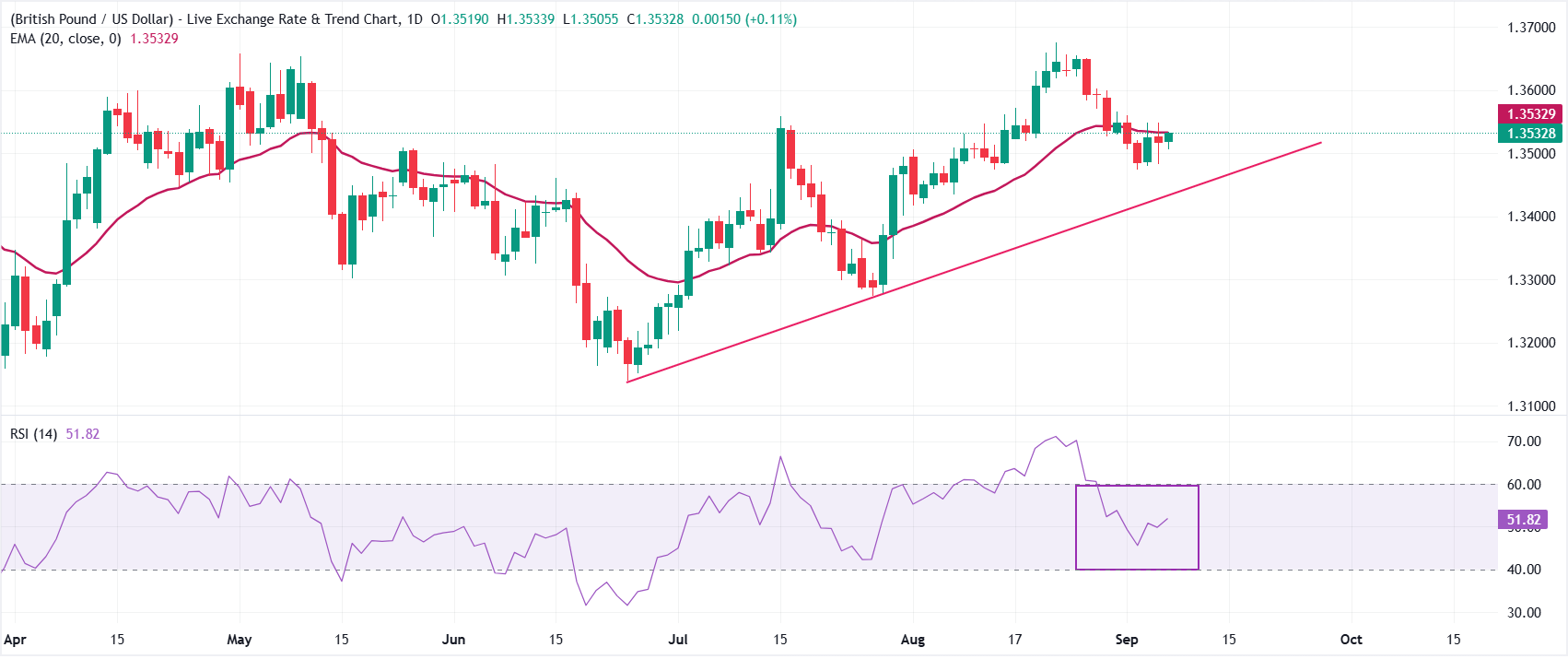
In the daily chart, GBP/USD trades at 1.3533. The pair is virtually glued to the 20-day Exponential Moving Average (EMA) at 1.3533, leaving the near-term bias neutral as price oscillates around this pivot rather than clearly above or below it. The upward-sloping trend-line, last broken near 1.3435, still frames the broader advance, while the Relative Strength Index (RSI) at about 52 hints at balanced momentum after the recent pullback from overbought territory.
On the downside, initial support is seen at the EMA pivot around 1.3533, with the former trend-line break area near 1.3435 acting as a deeper structural floor if sellers extend control. With no immediate overhead levels defined in the current setup, a sustained move away from the 20-day EMA—either a bounce that keeps the pair supported above 1.3533 or a clean break back toward 1.3435—would be needed to re-establish a clearer directional bias.
(The technical analysis of this story was written with the help of an AI tool. Know more.)
Nonfarm Payrolls FAQs
Nonfarm Payrolls (NFP) are part of the US Bureau of Labor Statistics monthly jobs report. The Nonfarm Payrolls component specifically measures the change in the number of people employed in the US during the previous month, excluding the farming industry.
The Nonfarm Payrolls figure can influence the decisions of the Federal Reserve by providing a measure of how successfully the Fed is meeting its mandate of fostering full employment and 2% inflation. A relatively high NFP figure means more people are in employment, earning more money and therefore probably spending more. A relatively low Nonfarm Payrolls’ result, on the either hand, could mean people are struggling to find work. The Fed will typically raise interest rates to combat high inflation triggered by low unemployment, and lower them to stimulate a stagnant labor market.
Nonfarm Payrolls generally have a positive correlation with the US Dollar. This means when payrolls’ figures come out higher-than-expected the USD tends to rally and vice versa when they are lower. NFPs influence the US Dollar by virtue of their impact on inflation, monetary policy expectations and interest rates. A higher NFP usually means the Federal Reserve will be more tight in its monetary policy, supporting the USD.
Nonfarm Payrolls are generally negatively-correlated with the price of Gold. This means a higher-than-expected payrolls’ figure will have a depressing effect on the Gold price and vice versa. Higher NFP generally has a positive effect on the value of the USD, and like most major commodities Gold is priced in US Dollars. If the USD gains in value, therefore, it requires less Dollars to buy an ounce of Gold. Also, higher interest rates (typically helped higher NFPs) also lessen the attractiveness of Gold as an investment compared to staying in cash, where the money will at least earn interest.
Nonfarm Payrolls is only one component within a bigger jobs report and it can be overshadowed by the other components. At times, when NFP come out higher-than-forecast, but the Average Weekly Earnings is lower than expected, the market has ignored the potentially inflationary effect of the headline result and interpreted the fall in earnings as deflationary. The Participation Rate and the Average Weekly Hours components can also influence the market reaction, but only in seldom events like the “Great Resignation” or the Global Financial Crisis.
추천 기사


