


Australian Dollar posts fresh three-month high amid hawkish RBA prospects
- The Australian Dollar rises to near 0.7217 against the US Dollar amid RBA interest rate hike expectations.
- Investors keenly await RBA Deputy Governor Hauser’s comments in an interview with ABC on Tuesday.
- Strong US NFP data fails to bring significant bids for the US Dollar.
The Australian Dollar (AUD) trades 0.13% higher at around 0.7217 against the US Dollar (USD) during the European trading session on Monday, the highest level seen in over three months.
The Australian currency broadly outperforms as market experts seem confident that the Reserve Bank of Australia (RBA) will hike interest rates at the policy meeting later this month, following the release of the stronger-than-projected Aussie Q2 Gross Domestic Product (GDP) data released last week.
Aussie resilience keeps RBA on track
Analysts at Rabobank observe that the Australian economy remains notably resilient, noting that “Aussie Q2 GDP came in better than expected at 0.4% q-o-q and 2.1% y-o-y.” In their view, this stronger-than-anticipated print “likely nails an RBA rate hike this month.”
Meanwhile, investors shift their focus to RBA Deputy Governor Andrew Hauser’s comments in an interview by the ABC on Tuesday evening.
Strategists at the Commonwealth Bank of Australia say the Aussie could remain near 72 cents for most of this week, especially if Hunter sounds hawkish, Reuters reported.
On the US Dollar front, the currency struggles to attract significant bids despite United States (US) Nonfarm Payrolls (NFP) data for August remaining stronger-than-projected and prompting hawkish Federal Reserve (Fed) bets.
Fed hike odds rise as strong US jobs data refocuses attention on inflation
Analysts at Commerzbank note that the “main theme last Friday was a stronger-than-expected US employment report, which revived expectations for a September Fed rate hike.” They highlight that “the Fed funds futures increased the probability of a 25bp hike on 16 September to 62% compared with 51% before the employment report and following Fed Governor Christopher Waller's more dovish comments.” In Commerzbank’s view, the “stronger employment report eases concerns about labour market weakness, leaving this week's PPI and CPI reports as the key remaining inputs ahead of the September FOMC meeting.”
AUD/USD Technical Analysis
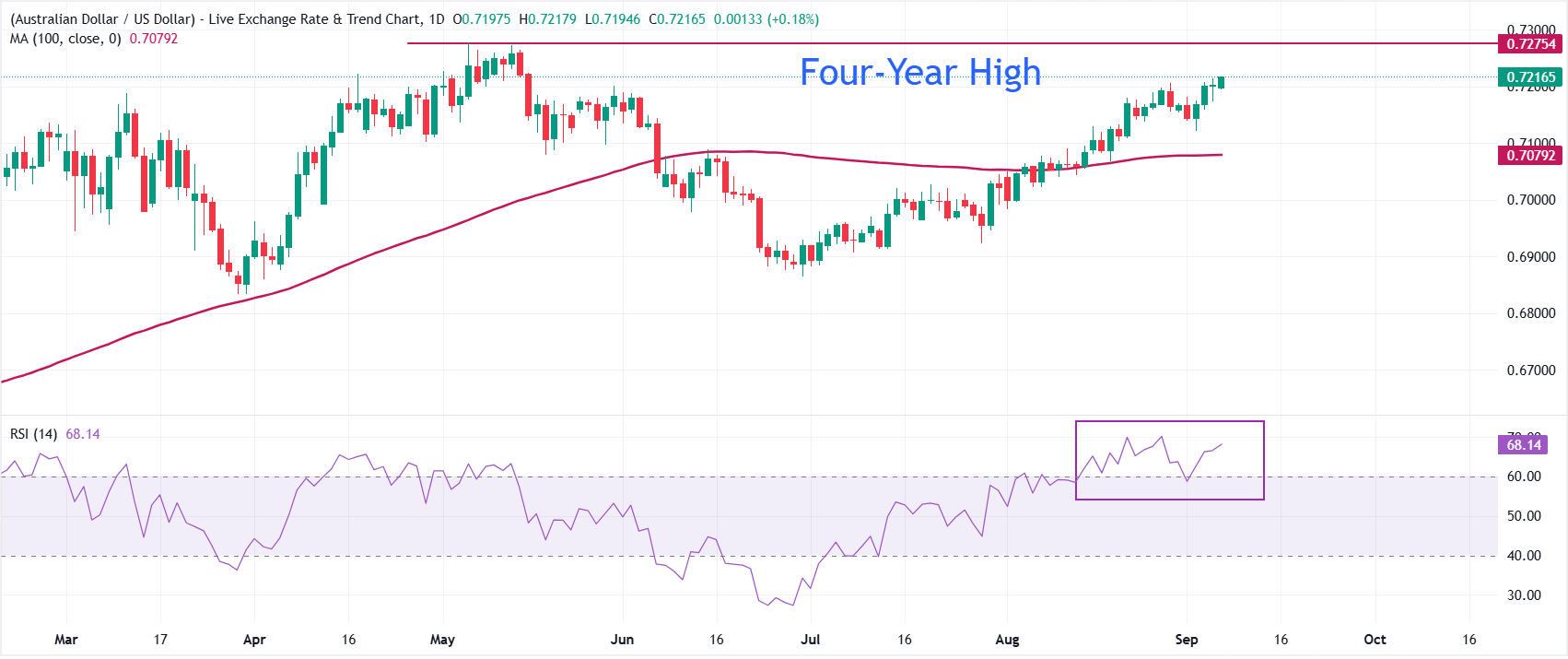
In the daily chart, AUD/USD trades at 0.7217. The pair holds a bullish near-term bias as it extends its advance well above the 100-day simple moving average (SMA) at 0.7079, suggesting buyers remain in control while the medium-term trend backdrop stays supportive. The Relative Strength Index (RSI) at around 68 hovers just below overbought territory, hinting that bullish momentum is strong but could be approaching a consolidation phase if fresh highs fail to materialize.
On the downside, initial support is seen at the 100-day SMA near 0.7079, where a deeper pullback would be expected to attract dip-buying interest as long as this level holds on a closing basis. A sustained break below this moving average would weaken the constructive setup and open the door to a broader corrective phase, while holding above it keeps the focus on higher levels, even if immediate resistance must be inferred from prior swing highs beyond the latest close. Looking up, the pair could extend its advance towards the four-year high at 0.7275.
(The technical analysis of this story was written with the help of an AI tool. Know more.)
RBA FAQs
The Reserve Bank of Australia (RBA) sets interest rates and manages monetary policy for Australia. Decisions are made by a board of governors at 11 meetings a year and ad hoc emergency meetings as required. The RBA’s primary mandate is to maintain price stability, which means an inflation rate of 2-3%, but also “..to contribute to the stability of the currency, full employment, and the economic prosperity and welfare of the Australian people.” Its main tool for achieving this is by raising or lowering interest rates. Relatively high interest rates will strengthen the Australian Dollar (AUD) and vice versa. Other RBA tools include quantitative easing and tightening.
While inflation had always traditionally been thought of as a negative factor for currencies since it lowers the value of money in general, the opposite has actually been the case in modern times with the relaxation of cross-border capital controls. Moderately higher inflation now tends to lead central banks to put up their interest rates, which in turn has the effect of attracting more capital inflows from global investors seeking a lucrative place to keep their money. This increases demand for the local currency, which in the case of Australia is the Aussie Dollar.
Macroeconomic data gauges the health of an economy and can have an impact on the value of its currency. Investors prefer to invest their capital in economies that are safe and growing rather than precarious and shrinking. Greater capital inflows increase the aggregate demand and value of the domestic currency. Classic indicators, such as GDP, Manufacturing and Services PMIs, employment, and consumer sentiment surveys can influence AUD. A strong economy may encourage the Reserve Bank of Australia to put up interest rates, also supporting AUD.
Quantitative Easing (QE) is a tool used in extreme situations when lowering interest rates is not enough to restore the flow of credit in the economy. QE is the process by which the Reserve Bank of Australia (RBA) prints Australian Dollars (AUD) for the purpose of buying assets – usually government or corporate bonds – from financial institutions, thereby providing them with much-needed liquidity. QE usually results in a weaker AUD.
Quantitative tightening (QT) is the reverse of QE. It is undertaken after QE when an economic recovery is underway and inflation starts rising. Whilst in QE the Reserve Bank of Australia (RBA) purchases government and corporate bonds from financial institutions to provide them with liquidity, in QT the RBA stops buying more assets, and stops reinvesting the principal maturing on the bonds it already holds. It would be positive (or bullish) for the Australian Dollar.
추천 기사


