


The Japanese Yen is the reason for its own hike
- USD/JPY trades near 159.00, close to four Yen above its August low.
- July imports rose 27.8% YoY, outpacing exports at 23.2%.
- July core inflation consensus 1.8% YoY, still beneath the 2% target.
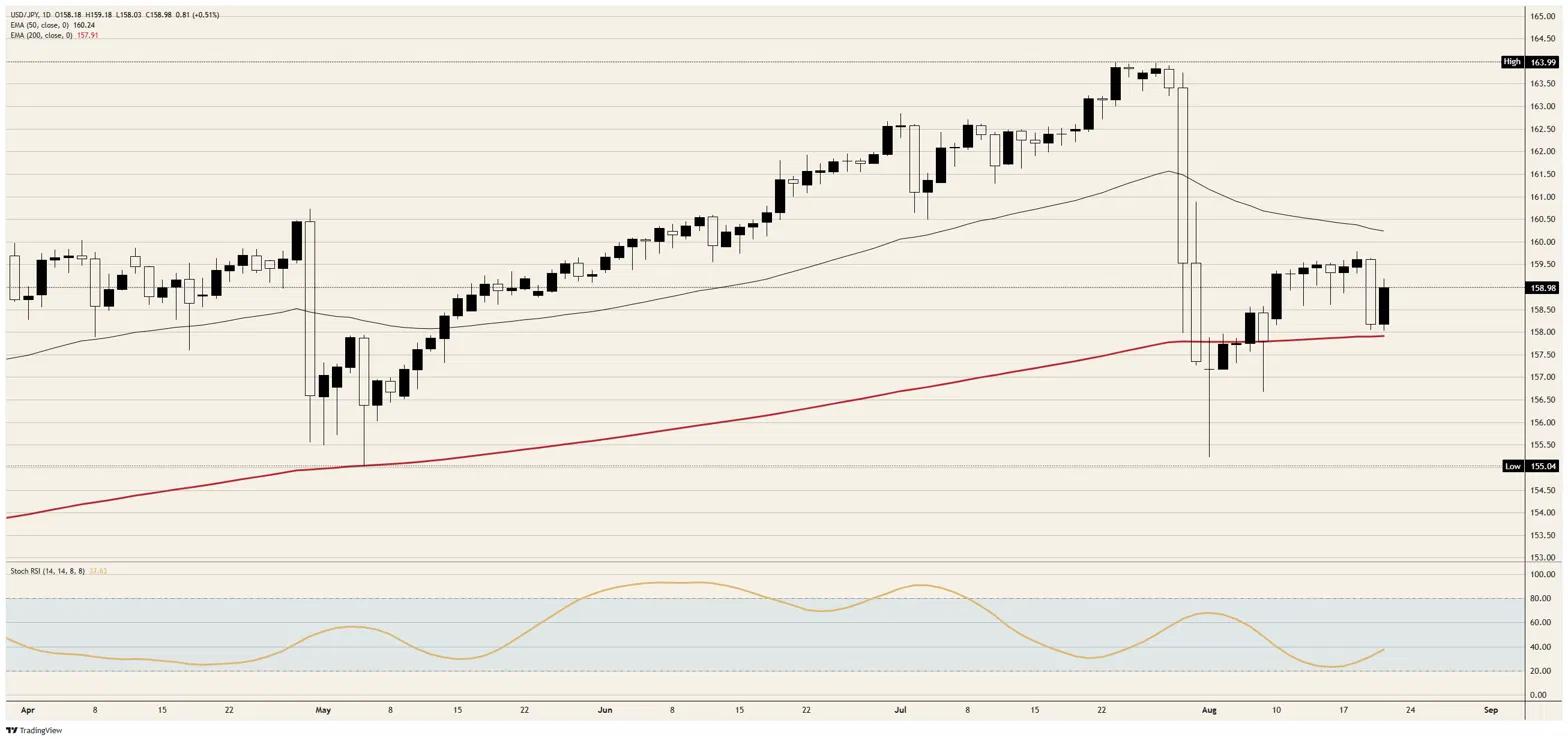
USD/JPY trades near 159.00 late in the session, 0.5% higher on the day and a little over a point clear of a rising 200-day Exponential Moving Average (EMA) near 158.00. The pair has spent three weeks rebuilding what a coordinated intervention took out of it at the turn of the month, with close to half of that move already handed back. Japan's July inflation report lands at 23:30 GMT, Friday morning in Tokyo, and it is not the reason the Bank of Japan is preparing to move.
A level, not a policy
The collapse that produced the current range ran from just under 164.00, a level last seen in the 1980s, into the 155.00 area inside two sessions. The operation behind it was joint, the Ministry of Finance buying Yen alongside the American Treasury in the first coordinated purchase of the currency since 1998, with a single day's spending estimated near 37 billion Dollars.
Three weeks on, the pair has recovered close to four Yen of that and trades roughly five Yen beneath the pre-intervention high. Coordinated purchases move a level without moving a rate differential, which is why the announcement effect decays on a schedule while the flow underneath it does not. The market has now tested that proposition and arrived at the answer the arithmetic implied.
The inflation Japan is holding down
Producer prices rose 7.2% YoY in July while consumer inflation ran near 1.7%, a gap of more than five percentage points between what firms pay and what the index records. That wedge is policy rather than pricing power. Fuel subsidies have been in place since the middle of March, gasoline and utility costs are capped, and free high school tuition introduced in April subtracts directly from the measured basket.
Friday's release carries a further complication, because it is the first print on a rebased index shifted to a 2025 base from 2020, a revision that already trimmed a tenth from the June headline. A central bank whose own outlook calls for core inflation clearly above 2% in the second half of the fiscal year is about to receive a number engineered lower by its own government, on a basket the market has not seen before.
The bill no operation can pay
July trade figures put the flow side beyond argument, and they run against the currency in both directions at once. Imports rose 27.8% YoY against a 26.5% forecast, exports 23.2% against 19.9%, and the merchandise trade balance widened to a deficit near 635 billion Yen from close to 410 billion the month before. An economy importing nearly all of its energy at war prices runs a structural bid for foreign currency every month it stays open.
The part a spot operation cannot reach is the size of that bill. Buying Yen in the market changes the price at which the import bill is paid without changing how large it is, and the Gulf supply disruption that inflated it shows no sign of clearing. For as long as the deficit persists, the intervention defends a level against a flow that rebuilds itself on a monthly cycle.
What Friday actually decides
The national Consumer Price Index (CPI) release at 23:30 GMT carries core excluding fresh food at a 1.8% consensus from 1.6%, with the headline previously at 1.7% and the measure excluding food and energy also at 1.7%. A 1.8% core would be a six-month high and would still sit beneath target, which is the whole problem with reading Friday as a policy trigger.
Pricing has a September increase at close to 80% odds ahead of the September 17-18 meeting, up from roughly 65% in the first week of the month. Reuters sourcing has the Bank of Japan weighing not only an early move but a faster sequence than its recent pace of roughly two a year, citing Middle East price pressure, global demand for artificial intelligence capacity and the currency's own decline. Not one of those three is a domestic demand story, which is the tell in a decision that will be reported as an inflation response.
American flash Purchasing Managers Index (PMI) readings at 13:45 GMT are the only other release of consequence, manufacturing seen at 53.8 from 53.9 and services at 54 from 54.6. The Jackson Hole symposium from August 27 is the next event with the weight to reset the differential outright, which leaves Friday as a Japan-side session in a pair that has spent most of the year trading the other leg.
Technicals
Resistance: The session high just above 159.00 is the first line, 159.50 the next, and the declining 50-day EMA just above 160.00 the level that decides whether the intervention has been fully unwound.
Support: The 158.00 handle sits between a session low just above it and the rising 200-day EMA just beneath, which makes that band the only defence with structure behind it before 157.00.
Bias: Bullish while 158.00 holds, with 159.50 the objective and the 50-day EMA near 160.00 behind it. Daily Stochastic Relative Strength Index (Stoch RSI) near 38 and turning up leaves room above, and a daily close beneath 157.50 puts the pair under the 200-day EMA and hands the next leg back to the Ministry of Finance.
USD/JPY daily chart
Japanese Yen FAQs
The Japanese Yen (JPY) is one of the world’s most traded currencies. Its value is broadly determined by the performance of the Japanese economy, but more specifically by the Bank of Japan’s policy, the differential between Japanese and US bond yields, or risk sentiment among traders, among other factors.
One of the Bank of Japan’s mandates is currency control, so its moves are key for the Yen. The BoJ has directly intervened in currency markets sometimes, generally to lower the value of the Yen, although it refrains from doing it often due to political concerns of its main trading partners. The BoJ ultra-loose monetary policy between 2013 and 2024 caused the Yen to depreciate against its main currency peers due to an increasing policy divergence between the Bank of Japan and other main central banks. More recently, the gradually unwinding of this ultra-loose policy has given some support to the Yen.
Over the last decade, the BoJ’s stance of sticking to ultra-loose monetary policy has led to a widening policy divergence with other central banks, particularly with the US Federal Reserve. This supported a widening of the differential between the 10-year US and Japanese bonds, which favored the US Dollar against the Japanese Yen. The BoJ decision in 2024 to gradually abandon the ultra-loose policy, coupled with interest-rate cuts in other major central banks, is narrowing this differential.
The Japanese Yen is often seen as a safe-haven investment. This means that in times of market stress, investors are more likely to put their money in the Japanese currency due to its supposed reliability and stability. Turbulent times are likely to strengthen the Yen’s value against other currencies seen as more risky to invest in.
추천 기사


