


The British Pound is buying an energy bill, not inflation
- GBP/USD trades just beneath 1.3650, its highest in more than four months.
- UK headline inflation accelerated to 2.9% YoY in July from 2.6%.
- July retail sales consensus -0.5% MoM after a 1% June increase.
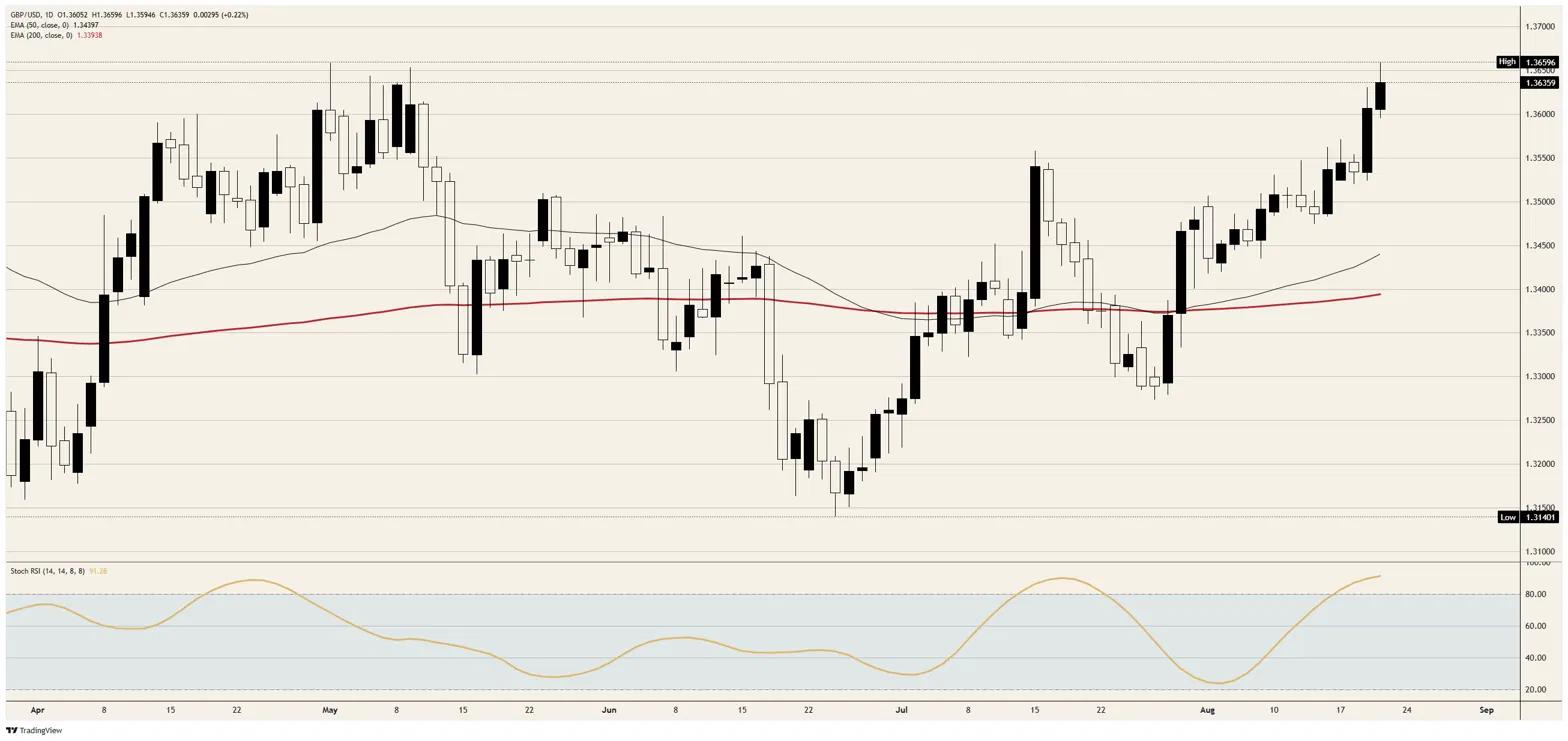
GBP/USD trades just beneath 1.3650 late in the session, 0.2% higher on the day and at its highest level in more than four months. The pair sits close to 200 pips above a rising 50-day Exponential Moving Average (EMA) near 1.3450, with the 200-day near 1.3400 further beneath that and a session low a shade under 1.3600 that never looked like holding the tape down. Three days of British data have landed underneath that advance, and Friday brings the half of the ledger nobody has been asked to price.
The acceleration is an administered price
July headline inflation printed at 2.9% YoY against 2.6% in June, matching consensus, with the monthly rate at 0.3% and core holding 2.6% against a 2.5% forecast. Almost all of that acceleration traces to the household energy price cap, lifted 13% at the start of July, with a second increase already scheduled for October. Services inflation, the gauge the Monetary Policy Committee treats as its domestic persistence tell, eased to 3.4% from 3.6%.
Reading that print as evidence of tightening pressure means reading the wrong line of it. The Bank of England has already told the market it expects headline inflation to peak near 3.2% in the fourth quarter, so the path higher is scheduled rather than discovered, and a regulated bill increase does nothing to the wage and services dynamics a rate decision is built to address. The pipeline detail is more interesting than the headline: core output producer prices firmed to 2.8% YoY from 2.6% while the headline measure decelerated to 3.1% from 3.5%.
The hike premium is thinner than the price
The Monetary Policy Committee held at 3.75% on July 30 by 6-3, with three members voting for a quarter point, and meets again on September 17. Pricing for an increase before year end runs near 30%, and a majority of surveyed economists expect no change at all this year. That is a modest premium to be carrying while the currency prints a four-month high.
Goldman Sachs, which forecasts no increase in 2026, has flagged the gap between market pricing and its own call as a source of downside pressure on the currency in the months ahead. The mechanism does not need a shock to work. A currency holding hike premium against a central bank that never delivers surrenders it in increments, and every in-line print that fails to arm September takes a little of it back.
The Dollar is carrying most of this
Thursday's American data did not cooperate with a weak-Dollar story. Initial jobless claims came in at 206K against a 210K consensus and a 212K prior, and the Philadelphia Fed manufacturing survey printed 47.4 against a forecast of 25, nearly double the expected reading and up from 41.4. Two Federal Reserve policymakers spoke, the first reading neutral and the second hawkish.
The Dollar was sold into all of it, sitting near multi-month lows against the majors after this week's Treasury operation at the long end pulled yields down. That sequence dates the advance to Washington rather than to London, which is the uncomfortable part of a four-month high. The pair has been rising on a bid the British calendar did not create and cannot renew.
Friday hands over the demand side
Consumer confidence for August arrives overnight with the consensus at -18 from -17, and retail sales for July land at 06:00 GMT. Consensus there is -0.5% MoM against a 1% June increase, the annual rate decelerating to 2.2% from 4.2%, and the ex-fuel measure marked at -0.5% from 1.1%. Flash August Purchasing Managers Index (PMI) readings follow at 08:30 GMT, composite forecast at 51.5 from 52.2, manufacturing at 51.5 from 51.9 and services at 51.8 from 52.1.
Every consensus on that page points down, which makes Friday the first session this week the British calendar has been positioned to subtract. The July factory strength flattering those prior readings was partly precautionary stock-building tied to Middle East supply disruption, so a step lower in the August flash is an inventory cycle turning rather than demand breaking. Currency markets are unlikely to draw that distinction inside the first hour.
American flash PMI figures at 13:45 GMT round out the week, manufacturing seen at 53.8 from 53.9 and services at 54 from 54.6. Beyond that the calendar thins until the Jackson Hole symposium from August 27, which leaves the Pound trading its own data in relative isolation for one session before the Dollar reclaims the microphone.
Technicals
Resistance: The session high just above 1.3650 is the immediate line and the only structure the pair has built above 1.3600. A break there leaves 1.3700 as the next round objective with nothing meaningful between.
Support: The session low just beneath 1.3600 is the first line, 1.3550 the next shelf, and the rising 50-day EMA near 1.3450 marks where the August advance becomes a failed breakout.
Bias: Bullish while 1.3600 holds, with 1.3700 the objective. Daily Stochastic Relative Strength Index (Stoch RSI) above 90 leaves the move stretched into a docket where every consensus points lower, so a daily close beneath 1.3600 turns Friday into the reversal and exposes 1.3550 and then the 1.3500 handle.
GBP/USD daily chart
Pound Sterling FAQs
The Pound Sterling (GBP) is the oldest currency in the world (886 AD) and the official currency of the United Kingdom. It is the fourth most traded unit for foreign exchange (FX) in the world, accounting for 12% of all transactions, averaging $630 billion a day, according to 2022 data. Its key trading pairs are GBP/USD, also known as ‘Cable’, which accounts for 11% of FX, GBP/JPY, or the ‘Dragon’ as it is known by traders (3%), and EUR/GBP (2%). The Pound Sterling is issued by the Bank of England (BoE).
The single most important factor influencing the value of the Pound Sterling is monetary policy decided by the Bank of England. The BoE bases its decisions on whether it has achieved its primary goal of “price stability” – a steady inflation rate of around 2%. Its primary tool for achieving this is the adjustment of interest rates. When inflation is too high, the BoE will try to rein it in by raising interest rates, making it more expensive for people and businesses to access credit. This is generally positive for GBP, as higher interest rates make the UK a more attractive place for global investors to park their money. When inflation falls too low it is a sign economic growth is slowing. In this scenario, the BoE will consider lowering interest rates to cheapen credit so businesses will borrow more to invest in growth-generating projects.
Data releases gauge the health of the economy and can impact the value of the Pound Sterling. Indicators such as GDP, Manufacturing and Services PMIs, and employment can all influence the direction of the GBP. A strong economy is good for Sterling. Not only does it attract more foreign investment but it may encourage the BoE to put up interest rates, which will directly strengthen GBP. Otherwise, if economic data is weak, the Pound Sterling is likely to fall.
Another significant data release for the Pound Sterling is the Trade Balance. This indicator measures the difference between what a country earns from its exports and what it spends on imports over a given period. If a country produces highly sought-after exports, its currency will benefit purely from the extra demand created from foreign buyers seeking to purchase these goods. Therefore, a positive net Trade Balance strengthens a currency and vice versa for a negative balance.
추천 기사


