


The Japanese Yen is losing to its own import bill
- USD/JPY holds near 159.50 while the Dollar Index breaks to a June low.
- Swaps price roughly 80% odds of a Bank of Japan hike next month.
- July imports seen up 26.5% YoY against exports at 19.9%.
USD/JPY sat near 159.50 through Monday inside a 75-pip range for a net gain of 10 pips, on the day the Dollar Index broke beneath its 200-day Exponential Moving Average (EMA) to its weakest level since June. Every other major took that decline and ran with it, the Euro to a two-month high and the Pound to three-month peaks. The Yen was the one that would not, which is the more interesting fact on the board.
Monday's driver was the war rather than the data. The 60-day framework meant to end the fight over the Strait of Hormuz expired with nothing agreed and Iran signalling an offensive posture, Crude Oil rose roughly 3% and the 30-year Treasury yield topped 5.31%, its highest since June 2007. For a country importing almost every barrel it burns, that combination is not a headline. It is a bill.
Everything the Yen needs, it already has
The Bank of Japan sits at 1.00% after June's increase, having held on July 31 with a dissent calling for more rather than less. Overnight swaps price roughly 80% odds of a move at next month's meeting, and that pricing survived a weak growth report rather than being unwound by it, with Japanese government bond yields rising on the day and no official pushback from either the ministry or the central bank.
Behind the rate story sits an official bid. The turn of the month brought the largest single-session Yen buying on record and then the first coordinated operation with the US Treasury since 1998, with Washington calling the currency substantially undervalued and pressing Tokyo to tighten faster. A hike, a friendly Treasury and a standing threat to intervene again, and spot has still retraced roughly half the distance from just above 155.00 back toward the July peak in under three weeks.
The second quarter explains part of it
Japan's preliminary second-quarter Gross Domestic Product (GDP) figures landed at 23:50 GMT on Sunday and missed across the board, expanding 0.3% on the quarter against a 0.5% consensus and a 0.5% prior, or 1.1% annualized against 2% and 1.8%. Weak domestic demand did the damage, with capital spending and household consumption both softer than forecast.
The deflator is the detail that complicates the tightening case rather than helping it. At 2.6% YoY against a 2.4% consensus, price pressure is running hotter than expected while output undershoots, which is the combination that makes a quarter point expensive. Tightening into that is a policy choice about the currency, not about the economy.
Wednesday shows where the Yen is actually going
Trade figures at 23:50 GMT on Wednesday are the week's real event for this pair. Imports are seen rising 26.5% YoY against exports at 19.9%, widening the merchandise deficit to 680 billion Yen from 406.9 billion, with the adjusted balance last at a deficit of 881.9 billion Yen. That gap is the Strait of Hormuz written into Japan's national accounts.
An energy importer buying barrels at a war premium in a currency near four-decade lows runs a structural sale of its own money every single month, and no 25 basis points repairs a terms-of-trade shock. Thursday's national inflation figures at 23:30 GMT compound it, with the measure excluding fresh food seen at 1.8% from 1.6%, still beneath the target the tightening is supposed to defend. The price pressure is arriving in the import bill rather than anywhere policy can claim credit for it.
The Dollar leg has its own week
The Federal Open Market Committee (FOMC) publishes minutes from the July 29 meeting on Wednesday at 18:00 GMT, followed by preliminary American Purchasing Managers Index (PMI) readings on Friday at 13:45 GMT, manufacturing seen at 53.8 and services at 54. Beyond the week sits the Jackson Hole symposium on August 27-29, with the chair's keynote 19 days ahead of the September decision.
Both legs of this pair point the same direction for once. A Dollar shedding its rate premium argues the cross lower and a Yen shedding its trade account argues it higher, which is why the range holds and why the resolution is more likely to arrive from an operation than from a data print.
USD/JPY technical levels
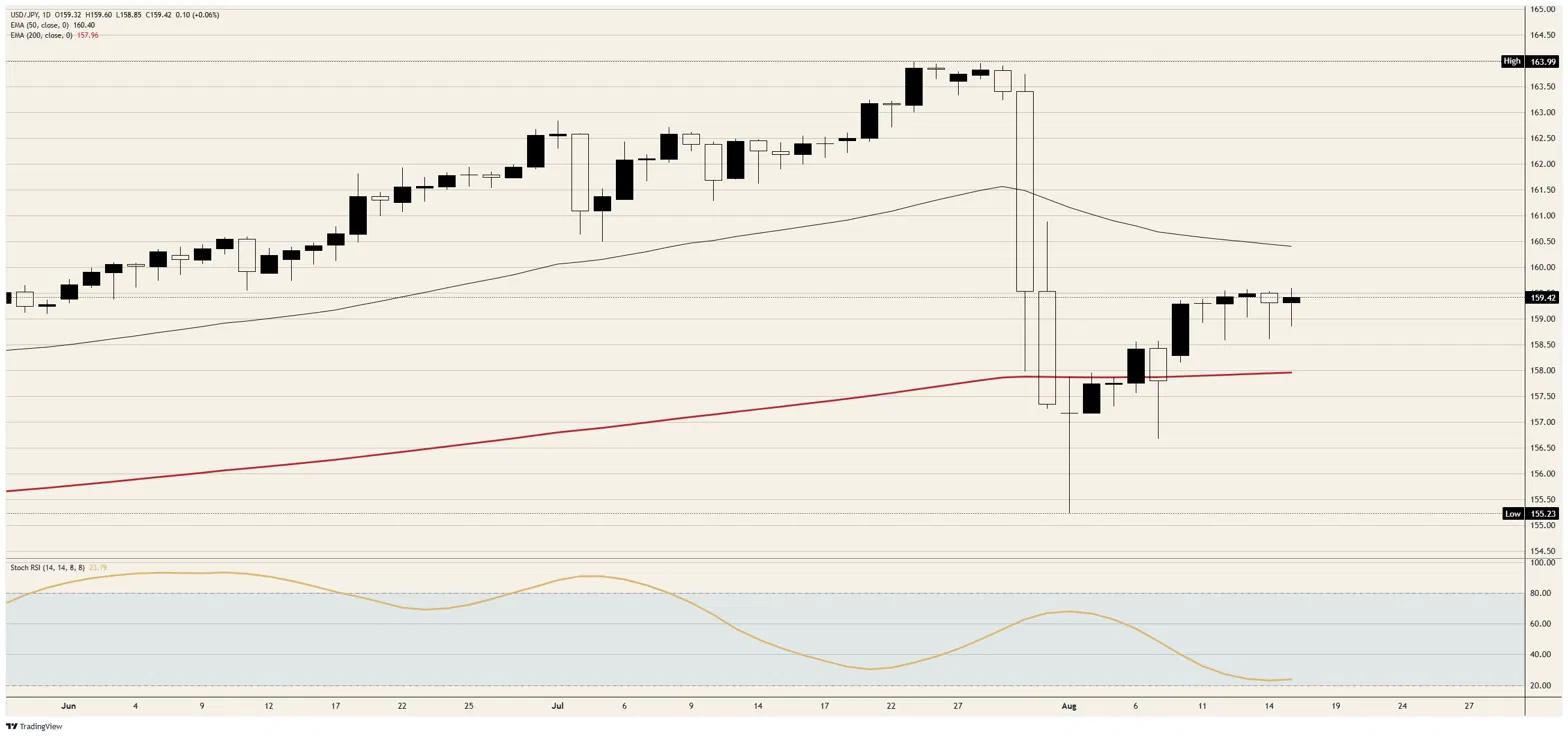
Resistance: The declining 50-day EMA near 160.50 is the immediate cap, with 161.00 above it and the July peak just short of 164.00 beyond, the zone where intervention risk concentrates rather than where sellers do.
Support: Just beneath 159.00 is the session floor, with the rising 200-day EMA near 158.00 the level that defines this consolidation and the spike low just above 155.00 the only reference beneath it.
Bias: Bullish while 158.00 holds, objectives the 50-day EMA near 160.50 then 161.00. A daily Stochastic Relative Strength Index (Stoch RSI) near 24 reads soft, though in a two-week compression between converging averages that is consolidation rather than a turn, and the ceiling above is administrative rather than technical. Invalidation on a daily close beneath 158.00.
USD/JPY daily chart
Japanese Yen FAQs
The Japanese Yen (JPY) is one of the world’s most traded currencies. Its value is broadly determined by the performance of the Japanese economy, but more specifically by the Bank of Japan’s policy, the differential between Japanese and US bond yields, or risk sentiment among traders, among other factors.
One of the Bank of Japan’s mandates is currency control, so its moves are key for the Yen. The BoJ has directly intervened in currency markets sometimes, generally to lower the value of the Yen, although it refrains from doing it often due to political concerns of its main trading partners. The BoJ ultra-loose monetary policy between 2013 and 2024 caused the Yen to depreciate against its main currency peers due to an increasing policy divergence between the Bank of Japan and other main central banks. More recently, the gradually unwinding of this ultra-loose policy has given some support to the Yen.
Over the last decade, the BoJ’s stance of sticking to ultra-loose monetary policy has led to a widening policy divergence with other central banks, particularly with the US Federal Reserve. This supported a widening of the differential between the 10-year US and Japanese bonds, which favored the US Dollar against the Japanese Yen. The BoJ decision in 2024 to gradually abandon the ultra-loose policy, coupled with interest-rate cuts in other major central banks, is narrowing this differential.
The Japanese Yen is often seen as a safe-haven investment. This means that in times of market stress, investors are more likely to put their money in the Japanese currency due to its supposed reliability and stability. Turbulent times are likely to strengthen the Yen’s value against other currencies seen as more risky to invest in.
추천 기사


