


The Bank of Canada shows its work while the Canadian Dollar reads Washington
- USD/CAD holds a range of barely 30 pips just beneath 1.4100, pinned above a rising 50-day average hours before the Federal Reserve decision.
- July 15 deliberations land today, blaming a widening yield spread for Canadian Dollar weakness and pledging to look through higher Crude Oil prices.
- Both risks Governing Council ranked as major have already fired since that meeting, one of them five days later.
A forecast that broke while it was being written
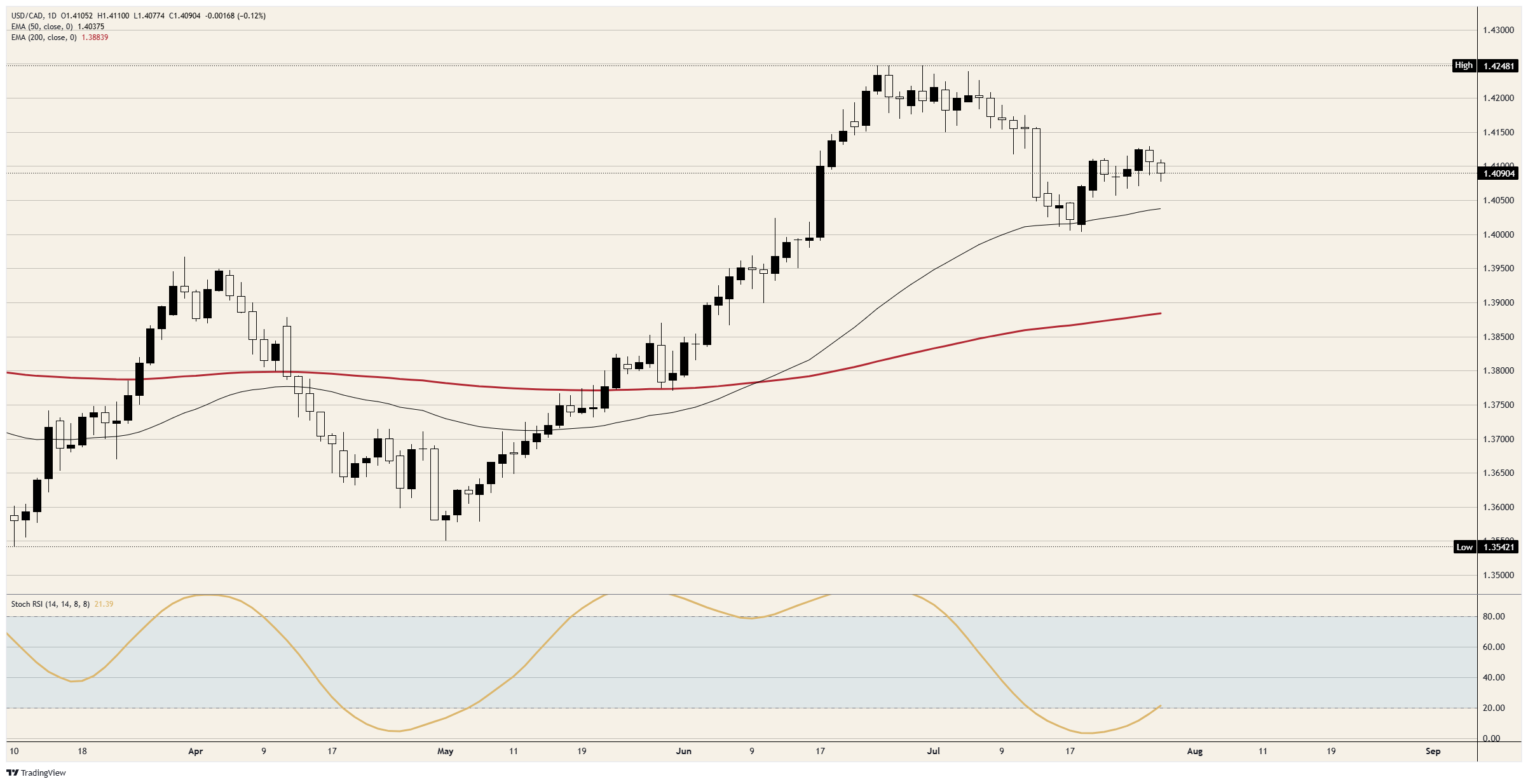
The Bank of Canada published the deliberations behind its July 15 hold this morning, roughly half an hour before the Federal Reserve announces whether it does the same thing. USD/CAD has answered by doing nothing at all, holding a range of barely 30 pips just beneath 1.4100 and sitting a fraction lower on the day. The document is a careful account of a meeting the currency market moved past two weeks ago.
Governing Council opened its policy meetings on July 7 and decided on July 15. Somewhere in between, by the record's own admission, hostilities in the Middle East re-escalated and pushed global Crude Oil prices back up. Members logged the development, wrote down a path in which inflation eases to roughly 2.5% in the second half of the year on the assumption Crude Oil declines, and held at 2.25% anyway.
The pledge attached to that path is the load-bearing part. Policymakers agreed to look through the direct effects of higher energy prices while promising a response if those effects broadened into other goods and services. That is a commitment in both directions, made conditional on a market that has since put Brent through a 16% three-session slide, the steepest such run since 2020, and a bounce of more than 4% today.
Both of the major risks have already fired
The deliberations name two risks above the rest: upside inflation from the war, and downside growth from US trade policy. The second is described as an ever-present possibility of new American tariffs. Five days after the decision, the White House signed an order putting 50% duties on a range of Canadian goods, from wine and dairy through cement and furniture.
Ottawa has answered by intensifying negotiations rather than retaliating, with Prime Minister Mark Carney telling the premiers last week that nothing is being ruled out depending on how the talks land. The war risk fired as well, with the four-day stand-down in the Gulf breaking overnight as US forces intercepted an Iranian missile attack and struck Iran-aligned militias in Iraq alongside Saudi forces.
What the record does not supply is a rate that can respond to either risk. Governing Council describes an economy that produced no growth between the first quarter of 2025 and the first quarter of 2026, unemployment at 6.5% inside the same band it has held for a year, and a labour market members agreed is still soft. The policy rate already sits on the floor of the neutral range the Bank of Canada assumes for itself.
The yield spread is not an Ottawa variable
The most useful line in the whole document is the one where members trace the Canadian Dollar's depreciation to a widening bond-yield differential, US yields having risen on strong data while Canadian yields barely moved. That is a central bank identifying the driver of its own currency and locating it in another country. The July projection assumes the Canadian Dollar averages around 71 US cents over the horizon, and spot is already there rather than above it.
Canadian data since the meeting has run cooler than the deliberations assumed. June inflation eased to 2.8% and the preferred core measures fell to their softest in more than five years, which has thinned market pricing for any further Canadian tightening this year. The rate story that moves this exchange rate is now one-sided, and the side still carrying a live hike tail is the American one.
The only decision that prices this exchange rate today
The Federal Reserve announces at 18:00 GMT with a press conference at 18:30 GMT and no Summary of Economic Projections attached. A hold is the heavy consensus, so the trade sits in the dissent count and in whether the chair leaves September armed. Futures pricing carried a July hike tail near 36% on the July 27 capture, wide enough that a hawkish hold is not fully paid for.
Statistics Canada publishes May Gross Domestic Product (GDP) growth on Friday, with an advance estimate for June attached and a flash reading that pointed to a 0.1% gain. That is the next genuine domestic input for the Canadian Dollar, and it lands two days after the only meeting on this continent that can widen the spread today.
Technical levels
Resistance: The 1.4150 shelf is the reclaim line, the June breakout level that has capped every attempt since the mid-month flush. Through it, the year high near 1.4250 is the only structure left on the frame.
Support: The 50-day exponential moving average (EMA) just beneath 1.4050 is rising into price and has held on every test this month. Under that sits the 1.4000 handle, with the 200-day EMA just below 1.3900 the trend marker that has not been tested since May.
Bias: Bullish above the 50-day EMA. The daily Stochastic Relative Strength Index near 21 is turning up out of the oversold band with price coiled in a 30-pip range, and the differential argument points one way while the Federal Reserve holds a live hike tail and Canadian pricing empties out. A daily close beneath 1.4000 invalidates.
USD/CAD daily chart
Canadian Dollar FAQs
The key factors driving the Canadian Dollar (CAD) are the level of interest rates set by the Bank of Canada (BoC), the price of Oil, Canada’s largest export, the health of its economy, inflation and the Trade Balance, which is the difference between the value of Canada’s exports versus its imports. Other factors include market sentiment – whether investors are taking on more risky assets (risk-on) or seeking safe-havens (risk-off) – with risk-on being CAD-positive. As its largest trading partner, the health of the US economy is also a key factor influencing the Canadian Dollar.
The Bank of Canada (BoC) has a significant influence on the Canadian Dollar by setting the level of interest rates that banks can lend to one another. This influences the level of interest rates for everyone. The main goal of the BoC is to maintain inflation at 1-3% by adjusting interest rates up or down. Relatively higher interest rates tend to be positive for the CAD. The Bank of Canada can also use quantitative easing and tightening to influence credit conditions, with the former CAD-negative and the latter CAD-positive.
The price of Oil is a key factor impacting the value of the Canadian Dollar. Petroleum is Canada’s biggest export, so Oil price tends to have an immediate impact on the CAD value. Generally, if Oil price rises CAD also goes up, as aggregate demand for the currency increases. The opposite is the case if the price of Oil falls. Higher Oil prices also tend to result in a greater likelihood of a positive Trade Balance, which is also supportive of the CAD.
While inflation had always traditionally been thought of as a negative factor for a currency since it lowers the value of money, the opposite has actually been the case in modern times with the relaxation of cross-border capital controls. Higher inflation tends to lead central banks to put up interest rates which attracts more capital inflows from global investors seeking a lucrative place to keep their money. This increases demand for the local currency, which in Canada’s case is the Canadian Dollar.
Macroeconomic data releases gauge the health of the economy and can have an impact on the Canadian Dollar. Indicators such as GDP, Manufacturing and Services PMIs, employment, and consumer sentiment surveys can all influence the direction of the CAD. A strong economy is good for the Canadian Dollar. Not only does it attract more foreign investment but it may encourage the Bank of Canada to put up interest rates, leading to a stronger currency. If economic data is weak, however, the CAD is likely to fall.
추천 기사


