


The Japanese Yen is stuck in a stalemate nobody can afford to break
- USD/JPY holds near 162.50, pinned just below multi-decade highs in a consolidation that refuses to resolve.
- Japan's June trade data lands late Tuesday with an energy-swollen import bill in focus, and national inflation follows Thursday.
- Nine flat-or-higher weekly closes in the past ten keep the drift pointed up even as daily momentum resets.
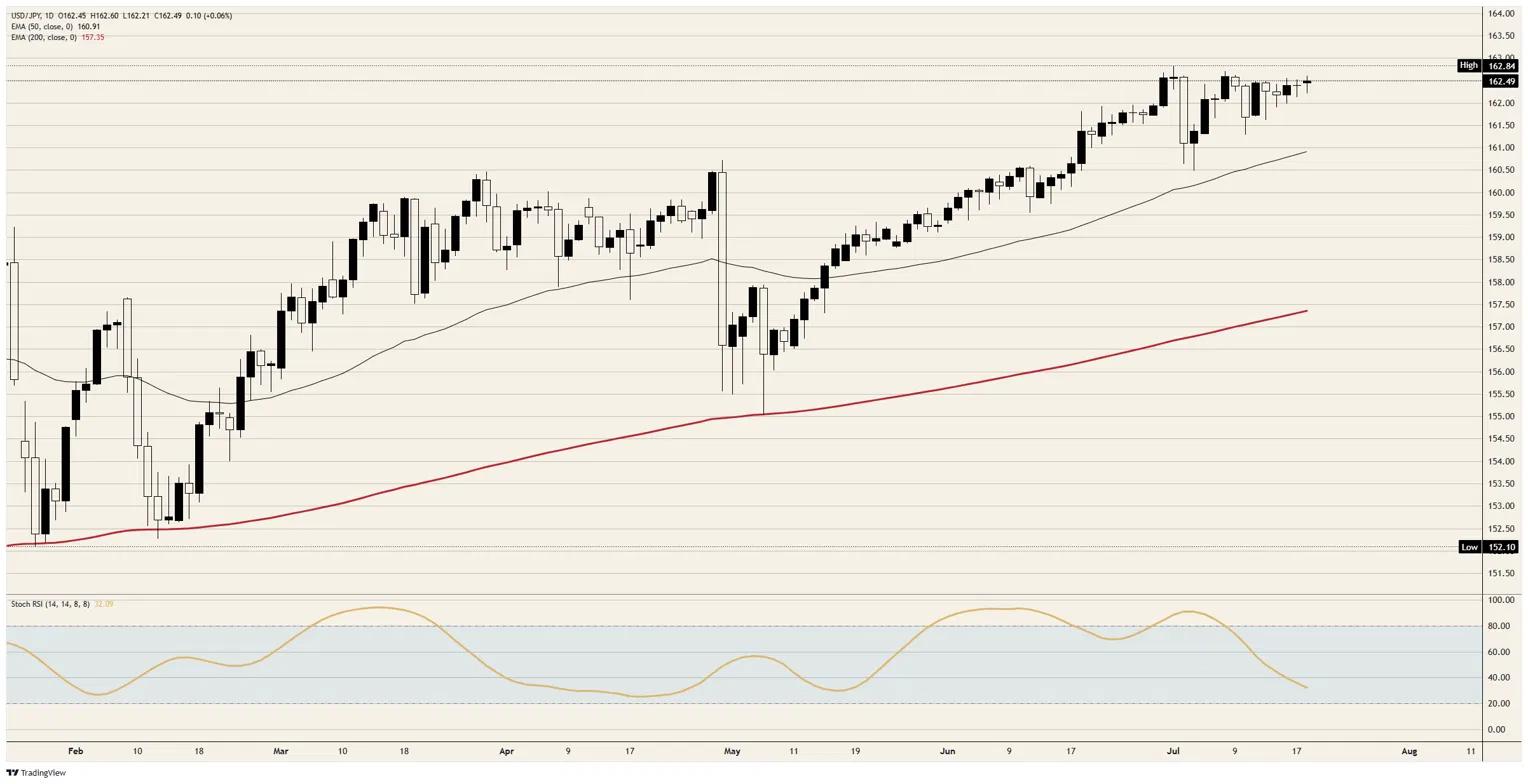
USD/JPY changes hands near 162.50 on Monday after a session range of barely 40 pips, wedged between a floor just above 162.00 and a lid just beyond the half-handle. The pair sits within half a big figure of the cycle top just short of 163.00 and has gone essentially nowhere for two weeks, nailed to the same shelf while the rest of the Dollar complex swings on Gulf headlines.
The paralysis is its own signal, because the drift underneath it runs one way. USD/JPY has printed a flat or higher weekly close in nine of the past ten weeks, and the daily Stochastic Relative Strength Index has reset from overbought to the low-30s without price surrendering a single big figure. That is what consolidation under a cycle high looks like when sellers cannot find a catalyst worth the risk.
A standoff with no referee
Two forces author the stalemate, and both are out of ammunition. The Bank of Japan (BoJ) hiked to 1.00% in June with the pair near 160, and the move changed almost nothing, because the BoJ's own preferred underlying inflation gauge runs near 3% while official prints crawl along near 1.5%, leaving the real policy rate negative on every measure. Against a Federal Reserve (Fed) holding at 3.75%, the rate gap still pays handsomely to stay long the Dollar, and the carry crowd has no reason to leave.
The Ministry of Finance (MoF) built the other wall of the cage, reportedly throwing close to 5.5 trillion Yen at the market in a single spring day to defend 160, the largest operation in two years, then striking again during the May holidays. The pair now trades two and a half big figures above the level that triggered that spending, which is why official warnings no longer move the tape. The market has already called the bluff once. Nobody wants to lean hard enough into 163.00 to invite the next ambush, and nobody wants to hand back the carry either.
The import bill is the story
Tuesday's trade data at 23:50 GMT is the domestic release that matters, and the line to watch is not exports. Consensus looks for import growth to accelerate to 21% YoY from 12.5%, an energy-tax print for a country that ships in nearly all of its oil and gas while Gulf supply stays disrupted. Export growth is seen quickening too, to 18.6% from 16.8%, with the weak Yen doing mechanical flattery, and the total merchandise deficit is expected to narrow to 120 billion Yen from nearly 392 billion.
The structural read stays Yen-negative regardless of the headline, because the war premium in energy flows straight through Japan's external accounts, which is exactly why the MoF keeps losing: it is fighting a valuation problem with reserves while the trade channel bleeds underneath. Thursday's national Consumer Price Index (CPI) at 23:30 GMT then restates the BoJ's bind, with the ex-fresh-food gauge seen at just 1.6%, more than a point below the underlying measures the central bank cites to justify tightening. Soft official prints keep the hiking pace glacial, the real rate negative, and the carry trade fed.
The week ahead
Beyond the Tuesday and Thursday releases out of Tokyo, the docket belongs to the United States, where Friday's flash Purchasing Managers Index (PMI) round at 13:45 GMT is the only red-band American release before the Fed's decision the following Wednesday. The blackout removes Fed speakers from the equation entirely, which strips the pair of its usual rate-differential catalysts for another week.
That leaves the Gulf, where Central Command announced a fresh round of strikes beginning 20:00 GMT Monday, the campaign's tenth consecutive night, while Trump paired a Truth Social revenge vow priced per American casualty with continued hints at talks with Tehran. The Yen, notably, collects no safe-haven bid from any of it, because the same war that spooks equities inflates the energy imports that undermine the currency from inside. In an oil-shock conflict the old refuge trade runs backward, and the market has spent four months quietly proving it.
Technical levels to watch
Resistance: The cycle top just short of 163.00 is the only line that matters overhead. A daily close through it puts the pair in territory untouched in decades, with 163.50 and the 164.00 handle as the next measured steps.
Support: The 162.00 handle floors the two-week range, with the 50-day Exponential Moving Average (EMA) near 161.00 as the first real test below and the early-July shelf in the 160.50 area behind it.
Bias: Bullish above 162.00. Nine up-or-flat weekly closes in ten, a momentum reset that cost the bulls nothing, and a carry backdrop the BoJ refuses to disturb all argue the consolidation resolves through 163.00. Only a daily close below the 50-day EMA near 161.00 breaks the drift and hands the MoF a rally it did not have to buy.
USD/JPY daily chart
Japanese Yen FAQs
The Japanese Yen (JPY) is one of the world’s most traded currencies. Its value is broadly determined by the performance of the Japanese economy, but more specifically by the Bank of Japan’s policy, the differential between Japanese and US bond yields, or risk sentiment among traders, among other factors.
One of the Bank of Japan’s mandates is currency control, so its moves are key for the Yen. The BoJ has directly intervened in currency markets sometimes, generally to lower the value of the Yen, although it refrains from doing it often due to political concerns of its main trading partners. The BoJ ultra-loose monetary policy between 2013 and 2024 caused the Yen to depreciate against its main currency peers due to an increasing policy divergence between the Bank of Japan and other main central banks. More recently, the gradually unwinding of this ultra-loose policy has given some support to the Yen.
Over the last decade, the BoJ’s stance of sticking to ultra-loose monetary policy has led to a widening policy divergence with other central banks, particularly with the US Federal Reserve. This supported a widening of the differential between the 10-year US and Japanese bonds, which favored the US Dollar against the Japanese Yen. The BoJ decision in 2024 to gradually abandon the ultra-loose policy, coupled with interest-rate cuts in other major central banks, is narrowing this differential.
The Japanese Yen is often seen as a safe-haven investment. This means that in times of market stress, investors are more likely to put their money in the Japanese currency due to its supposed reliability and stability. Turbulent times are likely to strengthen the Yen’s value against other currencies seen as more risky to invest in.
추천 기사


