


British Pound Sterling buckles as Trump builds the Hormuz toll booth he swore would never exist
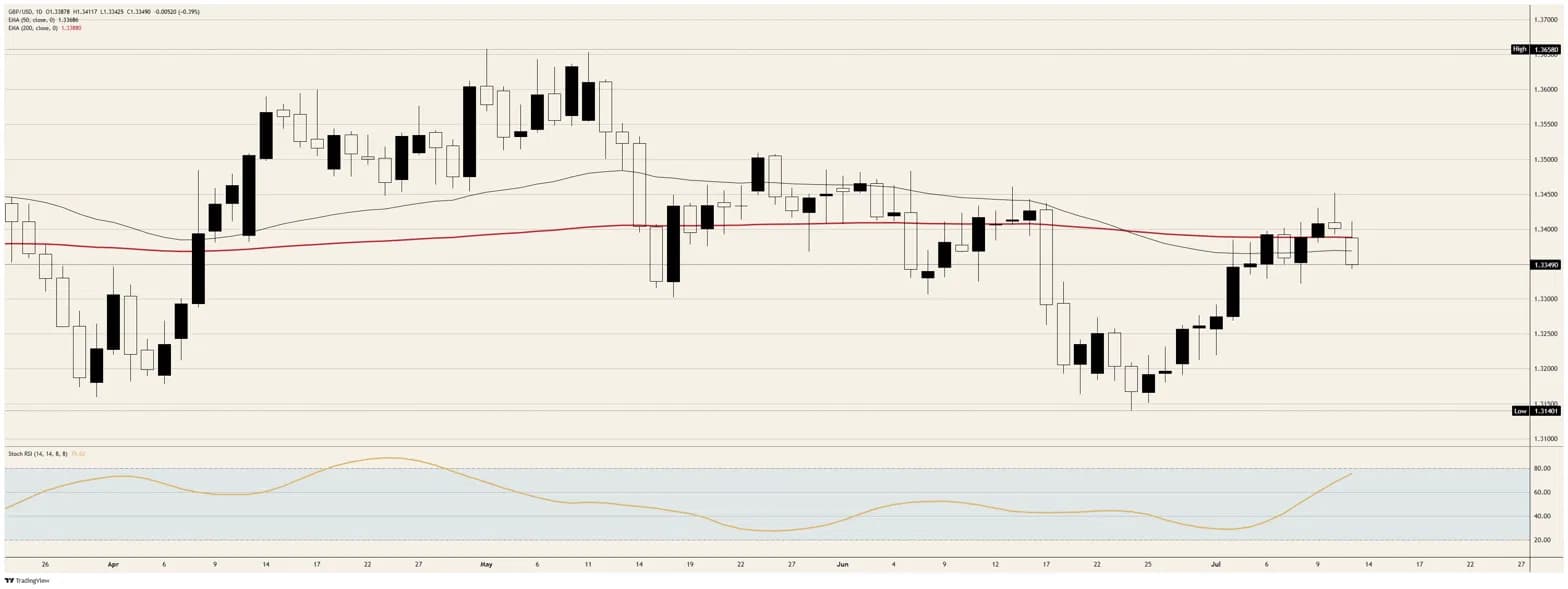
- GBP/USD trades at 1.3349, down 0.39% on the day, after a rejection at the 200-day EMA guarding the 1.3400 handle.
- Trump moves to re-shutter the Strait of Hormuz behind a blockade and a 20% transit fee; the Dollar hoovers up the haven flow.
- Rate futures make a Fed hike by September better than even money; June's US CPI lands Tuesday at 12:30 GMT.
The British Pound Sterling is spending Monday learning the difference between a recovery and a reprieve. GBP/USD opened the week flush against its 200-day Exponential Moving Average (EMA), probed the 1.3400 area through the Asian hours, and has been sold methodically ever since; the pair now changes hands at 1.3349, leaning on the 1.3350 shelf with the session low a few pips beneath.
Little of the damage is native to Sterling, because the Dollar is being bought against the entire major-currency board on two stories that landed within hours of each other. The first turns the world's most important Crude Oil chokepoint into a toll plaza; the second comes from a Federal Reserve (Fed) official who spent last year arguing for cuts and now warns about hikes.
The Strait of Hormuz gets a cover charge
President Trump announced Monday that Washington will reinstate its blockade of Iran and re-shutter the Strait of Hormuz, barring Iranian vessels and any ship trading with Tehran while everyone else buys passage under a 20% transit fee collected by the waterway's self-appointed guardian. The plan lands less than a week after renewed American strikes on Iran and Tehran's attacks on commercial shipping killed off last month's ceasefire, and it converts a security corridor into a revenue line.
The authorship is the richest detail in the story: a tolled Strait was precisely the outcome the President spent June insisting nobody would tolerate, complete with a publicized Iranian assurance of no tolls, no insurance add-ons, and no charges of any sort, plus a State Department ruling that such fees are illegal on an international waterway. Crude Oil is bid, tanker cover is repricing, and the Dollar is collecting the haven flow while the fee schedule gets drafted.
A dove rediscovers its talons
Running alongside the geopolitics, a Fed Governor long counted among the committee's most reliable doves used a Monday speech in New York to warn that the next policy move may need to be a hike, describing policy as sitting at a crossroads and naming Tuesday's inflation report as the deciding evidence. The same official spent last year lobbying for cuts on labour-market grounds; by his own telling those risks have inverted, with employment stable and price pressures broadening.
Rate futures did not wait for corroboration before repricing the curve: a quarter-point hike by the September meeting is now better than even money, with roughly three-in-four odds that the target band sits above the current 3.50% to 3.75% range by then. The July 29 meeting itself carries better than 40% odds of a move, and by December the single most likely outcome is a band a full half-point higher.
None of this repricing even requires the Strait to stay shut; a supply shock run through a tolled Hormuz is textbook inflation, and a committee that revised its projections hawkishly in calmer conditions is unlikely to look through one at sea.
The week ahead: June inflation arrives pre-expired
The calendar hands the Dollar its verdict almost immediately. June's Consumer Price Index (CPI) prints Tuesday at 12:30 GMT, and consensus expects the headline to fall 0.1% MoM after May's 0.5% surge, dragging the YoY rate down to 3.8% from 4.2%; the core reading is seen holding at 0.2% MoM and 2.9% YoY. On paper that is disinflation, and exactly the print a Dollar bear would order.
The trap is in the timing: June's survey window predates any talk of a 20% levy on a fifth of the world's seaborne Crude Oil, which makes Tuesday's number a photograph of a world that no longer exists. The hawkish Governor explicitly tied the hike debate to the core figure, so a hot core print does far more damage than a soft headline does good; the Fed Chair then begins two days of Congressional testimony at 14:00 GMT Tuesday, giving markets a same-day read on how the leadership wants the number spun.
Sterling's own docket is thinner and arrives later: the Bank of England (BoE) Governor speaks Tuesday at 20:00 GMT, having spent early July arguing that rate cuts stay off the table while the war's energy effects work through household bills, and May's UK growth and production figures land Thursday at 06:00 GMT, with consensus looking for a 0.1% MoM expansion after April's contraction. US Retail Sales on Thursday and Friday's preliminary July consumer sentiment survey round out a week in which the Dollar holds every high card.
Technical levels and bias
Resistance: The 1.3400 handle is the wall that matters, reinforced from below by the 200-day and 50-day EMAs compressed between spot and the figure; Monday's rejection came from just above it. Behind that, 1.3450 caps the chart as the ceiling of last week's recovery run.
Support: Bids are under live examination at 1.3350, with the session low a handful of pips beneath; if the shelf gives way, 1.3300 is the next level of consequence, and losing it would put the whole July recovery on notice.
Bias: Lower. The rejection arrived at trend resistance with the daily Stochastic Relative Strength Index stretched near 76; the Dollar holds both the haven bid and the rate-differential bid; and Tuesday's CPI is likelier to be dismissed as stale than traded as salvation. A sustained break of 1.3350 opens 1.3300, and rallies into 1.3400 are for selling until either the Strait reopens untolled or the hike pricing unwinds.
GBP/USD daily chart
Pound Sterling FAQs
The Pound Sterling (GBP) is the oldest currency in the world (886 AD) and the official currency of the United Kingdom. It is the fourth most traded unit for foreign exchange (FX) in the world, accounting for 12% of all transactions, averaging $630 billion a day, according to 2022 data. Its key trading pairs are GBP/USD, also known as ‘Cable’, which accounts for 11% of FX, GBP/JPY, or the ‘Dragon’ as it is known by traders (3%), and EUR/GBP (2%). The Pound Sterling is issued by the Bank of England (BoE).
The single most important factor influencing the value of the Pound Sterling is monetary policy decided by the Bank of England. The BoE bases its decisions on whether it has achieved its primary goal of “price stability” – a steady inflation rate of around 2%. Its primary tool for achieving this is the adjustment of interest rates. When inflation is too high, the BoE will try to rein it in by raising interest rates, making it more expensive for people and businesses to access credit. This is generally positive for GBP, as higher interest rates make the UK a more attractive place for global investors to park their money. When inflation falls too low it is a sign economic growth is slowing. In this scenario, the BoE will consider lowering interest rates to cheapen credit so businesses will borrow more to invest in growth-generating projects.
Data releases gauge the health of the economy and can impact the value of the Pound Sterling. Indicators such as GDP, Manufacturing and Services PMIs, and employment can all influence the direction of the GBP. A strong economy is good for Sterling. Not only does it attract more foreign investment but it may encourage the BoE to put up interest rates, which will directly strengthen GBP. Otherwise, if economic data is weak, the Pound Sterling is likely to fall.
Another significant data release for the Pound Sterling is the Trade Balance. This indicator measures the difference between what a country earns from its exports and what it spends on imports over a given period. If a country produces highly sought-after exports, its currency will benefit purely from the extra demand created from foreign buyers seeking to purchase these goods. Therefore, a positive net Trade Balance strengthens a currency and vice versa for a negative balance.
추천 기사


