


Indian Rupee edges lower against the US Dollar at the start of FOMC Minutes week
- The Indian Rupee ticks down to near 95.32 as the US Dollar edges higher.
- Lower oil prices will likely limit the Indian Rupee’s downside.
- FIIs turned out to be net buyers on Friday.
The Indian Rupee (INR) opens marginally lower against the US Dollar (USD) at the start of the week. The USD/INR pair ticks up to near 95.32 as the US Dollar edges higher after a negative week, with investors awaiting the Federal Open Market Committee (FOMC) Minutes of the June monetary policy meeting, which will be released on Wednesday.
At the time of writing, the US Dollar Index (DXY), which gauges the Greenback’s value against six major currencies, trades 0.1% higher to near 101.00. Some buying interest has been reflected in the USD Index after sliding to near 100.55 last week.
Investors will pay close attention to the FOMC minutes as Federal Reserve (Fed) Chair Kevin Warsh didn’t deliver any forward-looking remarks on the monetary policy. In the policy meeting, the Fed left interest rates unchanged in the range of 3.50%-3.75%, as expected, and the dot plot showed that nine of 19 policymakers advocated an interest rate hike by the year-end.
Lower oil prices to support Indian Rupee
Oil prices remaining lower due to the normalization of traffic near the Strait of Hormuz, a critical chokepoint for almost 20% of the global energy supply, are expected to offer support to the Indian Rupee.
Lower oil prices bode well for currencies from economies, such as India, that rely heavily on oil imports to meet their energy needs.
In the opening session, the MCX Crude Oil contract expiring on July 20 trades 0.2% lower to near 6,550, close to its multi-month low of 6,426 posted on Thursday.
Analysts at Citi expect that oil prices could decline further as fundamentals are rapidly reasserting themselves, with Hormuz disruptions fading and shipping flows normalizing. The investment banking firm sees Brent Crude Oil sliding further to $60 by the year-end, which is currently near $71.50.
FIIs turned out to be net buyers on Friday
On Friday, Foreign Institutional Investors (FIIs) turned out to be net buyers in the Indian stock market after remaining sellers in the previous four trading days. The amount of investment by overseas investors in the Indian equity market was Rs. 1,355.33 crore. The sentiment of foreign investors toward Indian equities appears to be improving ahead of the start of the earnings season of the first quarter of Financial Year (FY) 2026-27.
India’s tech giant Tata Consultancy Services (TCS) will be the first company out of the Nifty50 basket to report its quarterly earnings, which are scheduled for Thursday.
Technical Analysis: USD/INR holds Descending Triangle breakout
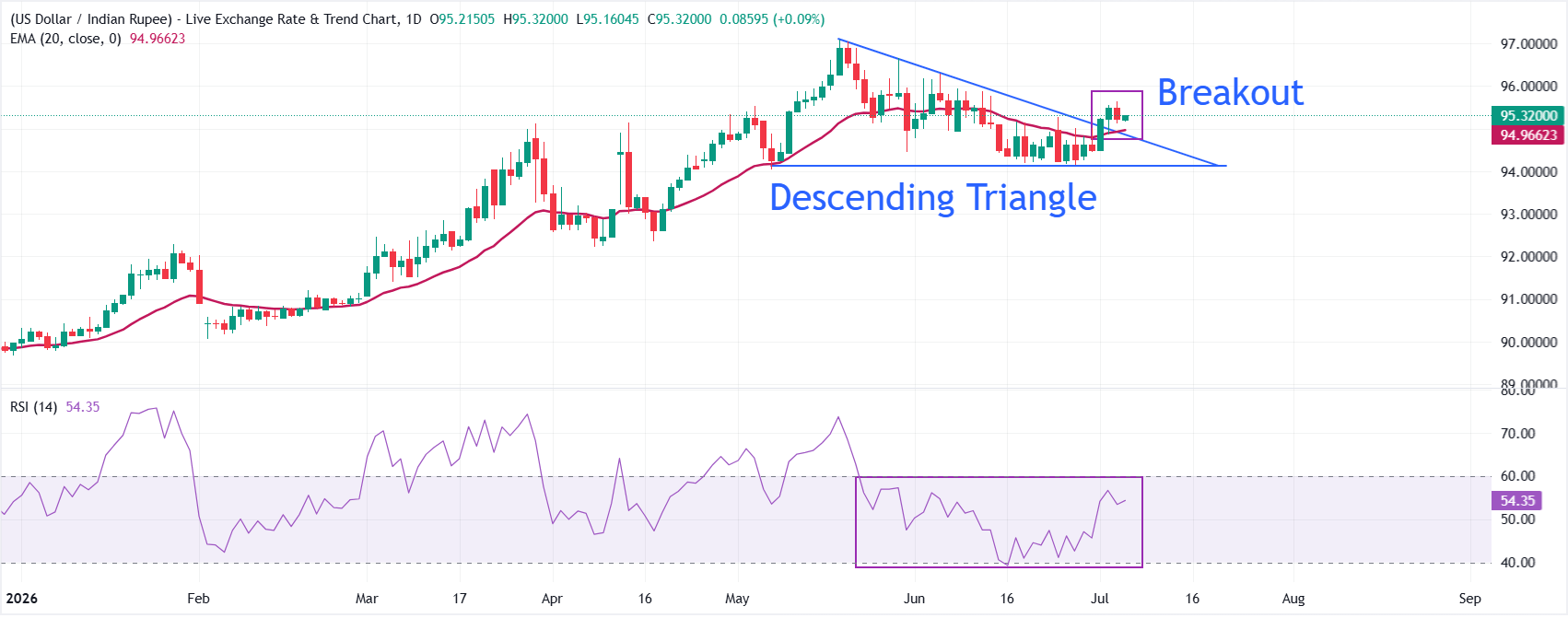
USD/INR trades marginally higher at around 95.32, holding a bullish bias as it sits above the 20-period exponential moving average (EMA) at roughly 94.97 and the breakout of the Descending Triangle pattern.
The Relative Strength Index (RSI) hovers just above the neutral 50 mark near 54, hinting that upside momentum is positive but not overstretched as the pair consolidates after reclaiming these structural levels.
On the downside, immediate support is seen at the 20-period EMA around 94.97, reinforced by the reclaimed trend-line break zone near 94.83, where buyers would be expected to defend the short-term upbias. Below 94.83, the May 7 low at 94.03 will be the key support zone. On the topside, the next notable resistance comes in near the origin of the prevailing downward trend line around 97.11, and a daily close above that barrier would push the pair into uncharted territory.
(The technical analysis of this story was written with the help of an AI tool.)
Indian Rupee FAQs
The Indian Rupee (INR) is one of the most sensitive currencies to external factors. The price of Crude Oil (the country is highly dependent on imported Oil), the value of the US Dollar – most trade is conducted in USD – and the level of foreign investment, are all influential. Direct intervention by the Reserve Bank of India (RBI) in FX markets to keep the exchange rate stable, as well as the level of interest rates set by the RBI, are further major influencing factors on the Rupee.
The Reserve Bank of India (RBI) actively intervenes in forex markets to maintain a stable exchange rate, to help facilitate trade. In addition, the RBI tries to maintain the inflation rate at its 4% target by adjusting interest rates. Higher interest rates usually strengthen the Rupee. This is due to the role of the ‘carry trade’ in which investors borrow in countries with lower interest rates so as to place their money in countries’ offering relatively higher interest rates and profit from the difference.
Macroeconomic factors that influence the value of the Rupee include inflation, interest rates, the economic growth rate (GDP), the balance of trade, and inflows from foreign investment. A higher growth rate can lead to more overseas investment, pushing up demand for the Rupee. A less negative balance of trade will eventually lead to a stronger Rupee. Higher interest rates, especially real rates (interest rates less inflation) are also positive for the Rupee. A risk-on environment can lead to greater inflows of Foreign Direct and Indirect Investment (FDI and FII), which also benefit the Rupee.
Higher inflation, particularly, if it is comparatively higher than India’s peers, is generally negative for the currency as it reflects devaluation through oversupply. Inflation also increases the cost of exports, leading to more Rupees being sold to purchase foreign imports, which is Rupee-negative. At the same time, higher inflation usually leads to the Reserve Bank of India (RBI) raising interest rates and this can be positive for the Rupee, due to increased demand from international investors. The opposite effect is true of lower inflation.
추천 기사


