


Indian Rupee gains at open, supported by further decline in oil prices
- The Indian Rupee rises against the US Dollar as progress in US-Iran talks has offered support to the former.
- FIIs turned out to be net sellers at the start of July.
- Investors await the US NFP data for June.
The Indian Rupee (INR) opens higher against the US Dollar (USD) on Thursday after a sharp decline the previous day. The USD/INR pair declines to near 95.00 as lower oil prices due to progress in talks between the United States (US) and Iran have improved the appeal of the Indian Rupee.
In the opening session, the MCX Crude Oil contract expiring on July 20 trades 1% down to near 6,450, the lowest level seen in months.
Currencies from economies, such as India, which rely heavily on oil imports to meet their energy needs, tend to outperform in a low oil price environment.
However, the upbeat US Dollar and US Treasury Yields amid firm expectations that the next move by the Federal Reserve (Fed) on interest rates will be on the upside could lift the pair again.
Meanwhile, a Reuters report has shown that the Indian central bank likely sold US Dollars in pre-market open to shore up the Indian Rupee.
Qatar says US-Iran talks remain positive
Qatar’s Foreign Ministry spokesperson said that “positive progress” was made on issues related to the Memorandum of Understanding (MoU) between the US and Iran, following a separate meeting of Qatari and Pakistani mediators in Doha, CNN reported on Wednesday. The meeting was expected to be centered on the future of the Strait of Hormuz, unfreezing Iran’s funds, and Tehran’s nuclear ambitions.
The spokesperson also said that both sides confirmed that they would continue talks, which are expected after funeral processions for Iran’s former Supreme Leader, planned for July 4 through July 9.
US Dollar and bond yields remain firm amid hawkish Fed bets
According to the CME FedWatch tool, traders see an almost 85% chance that the Fed will deliver at least one interest rate hike. Such a scenario bodes well for interest-bearing assets and the US Dollar.
At press time, 10-year US Treasury Yields are up 0.13% to near 4.49%. US bond yields have gained over 2.5% from Monday’s closing price at 4.37%. The US Dollar Index (DXY), which tracks the Greenback’s value against six major currencies, trades marginally lower to near 101.35, but is close to its over-a-year high of 101.80 posted last week.
Meanwhile, investors await the US Nonfarm Payrolls (NFP) data for June, which will be published at 12:30 GMT. Investors will pay close attention to the NFP report to get fresh cues regarding the Fed’s monetary policy outlook.
The US NFP report is expected to show that the economy created 110K fresh jobs, lower than 172K in May. The Unemployment Rate is seen remaining steady at 4.3%.
FIIs remain net sellers on first trading day of July
Foreign Institutional Investors turned out to be net sellers on the first day of July, offloading their stake worth Rs. 1,140.50 crore. Overseas investors continue to remain net sellers despite oil prices having returned to pre-Middle East war levels.
Technical Analysis: USD/INR returns above 20-day EMA
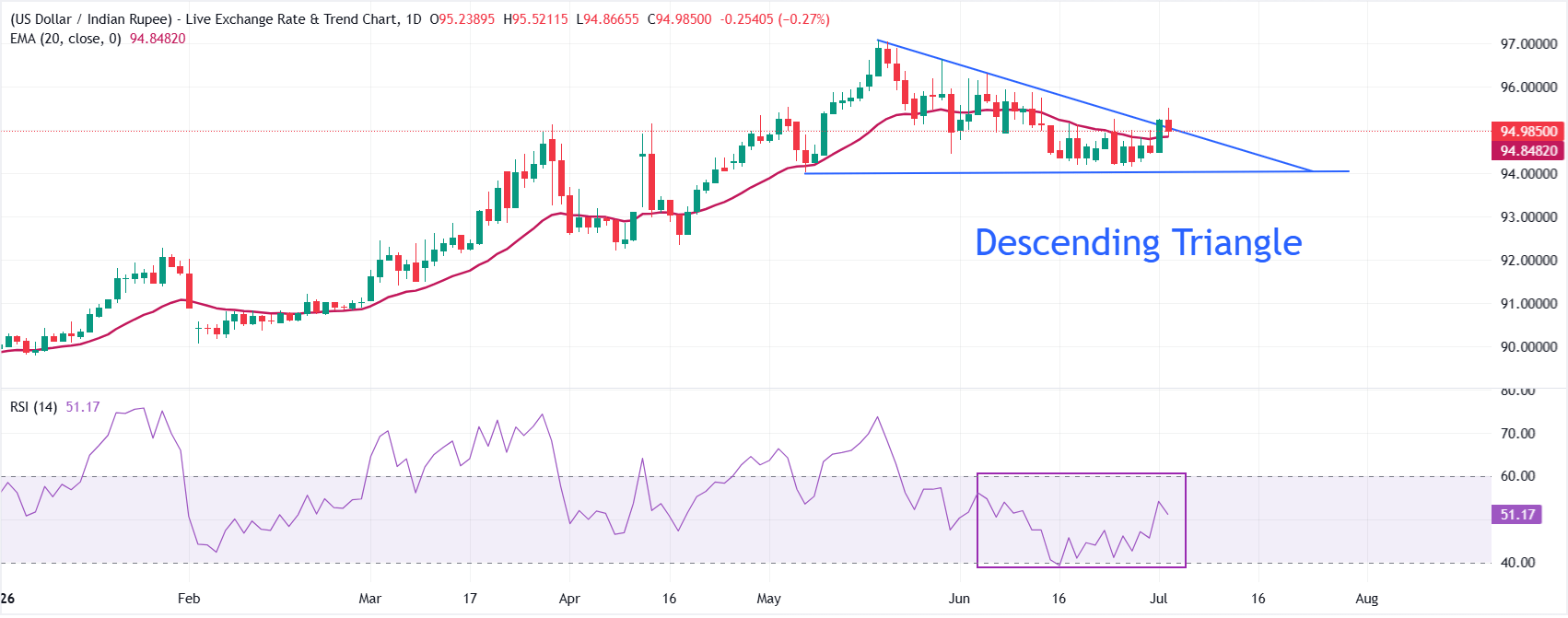
USD/INR trades lower at around 94.98 at press time. However, the near-term bias appears to be turning bullish as the pair has returned above the 20-day exponential moving average (EMA), which is at 94.84.
The Relative Strength Index (RSI) around 51 indicates neutral-to-positive momentum rather than exhaustion, hinting that dips could still attract buying interest as long as price stays above the short-term EMA.
On the downside, immediate support is seen at the 20-day EMA at 94.85 and then the structural trend-line base near 93.99. On the topside, the primary hurdle is the July 1 high at 95.52, followed by the June 4 high at 96.30.
(The technical analysis of this story was written with the help of an AI tool.)
Indian Rupee FAQs
The Indian Rupee (INR) is one of the most sensitive currencies to external factors. The price of Crude Oil (the country is highly dependent on imported Oil), the value of the US Dollar – most trade is conducted in USD – and the level of foreign investment, are all influential. Direct intervention by the Reserve Bank of India (RBI) in FX markets to keep the exchange rate stable, as well as the level of interest rates set by the RBI, are further major influencing factors on the Rupee.
The Reserve Bank of India (RBI) actively intervenes in forex markets to maintain a stable exchange rate, to help facilitate trade. In addition, the RBI tries to maintain the inflation rate at its 4% target by adjusting interest rates. Higher interest rates usually strengthen the Rupee. This is due to the role of the ‘carry trade’ in which investors borrow in countries with lower interest rates so as to place their money in countries’ offering relatively higher interest rates and profit from the difference.
Macroeconomic factors that influence the value of the Rupee include inflation, interest rates, the economic growth rate (GDP), the balance of trade, and inflows from foreign investment. A higher growth rate can lead to more overseas investment, pushing up demand for the Rupee. A less negative balance of trade will eventually lead to a stronger Rupee. Higher interest rates, especially real rates (interest rates less inflation) are also positive for the Rupee. A risk-on environment can lead to greater inflows of Foreign Direct and Indirect Investment (FDI and FII), which also benefit the Rupee.
Higher inflation, particularly, if it is comparatively higher than India’s peers, is generally negative for the currency as it reflects devaluation through oversupply. Inflation also increases the cost of exports, leading to more Rupees being sold to purchase foreign imports, which is Rupee-negative. At the same time, higher inflation usually leads to the Reserve Bank of India (RBI) raising interest rates and this can be positive for the Rupee, due to increased demand from international investors. The opposite effect is true of lower inflation.
추천 기사


