


Yen erases the rescue as carry math wins out
- The Yen has clawed back roughly 80% of its post-intervention gains as carry positioning quietly rebuilds.
- BoJ rhetoric continues to fall short of derailing the broader uptrend.
- Thursday brings US PCE and Tokyo CPI, the two key calendar risks for the pair.
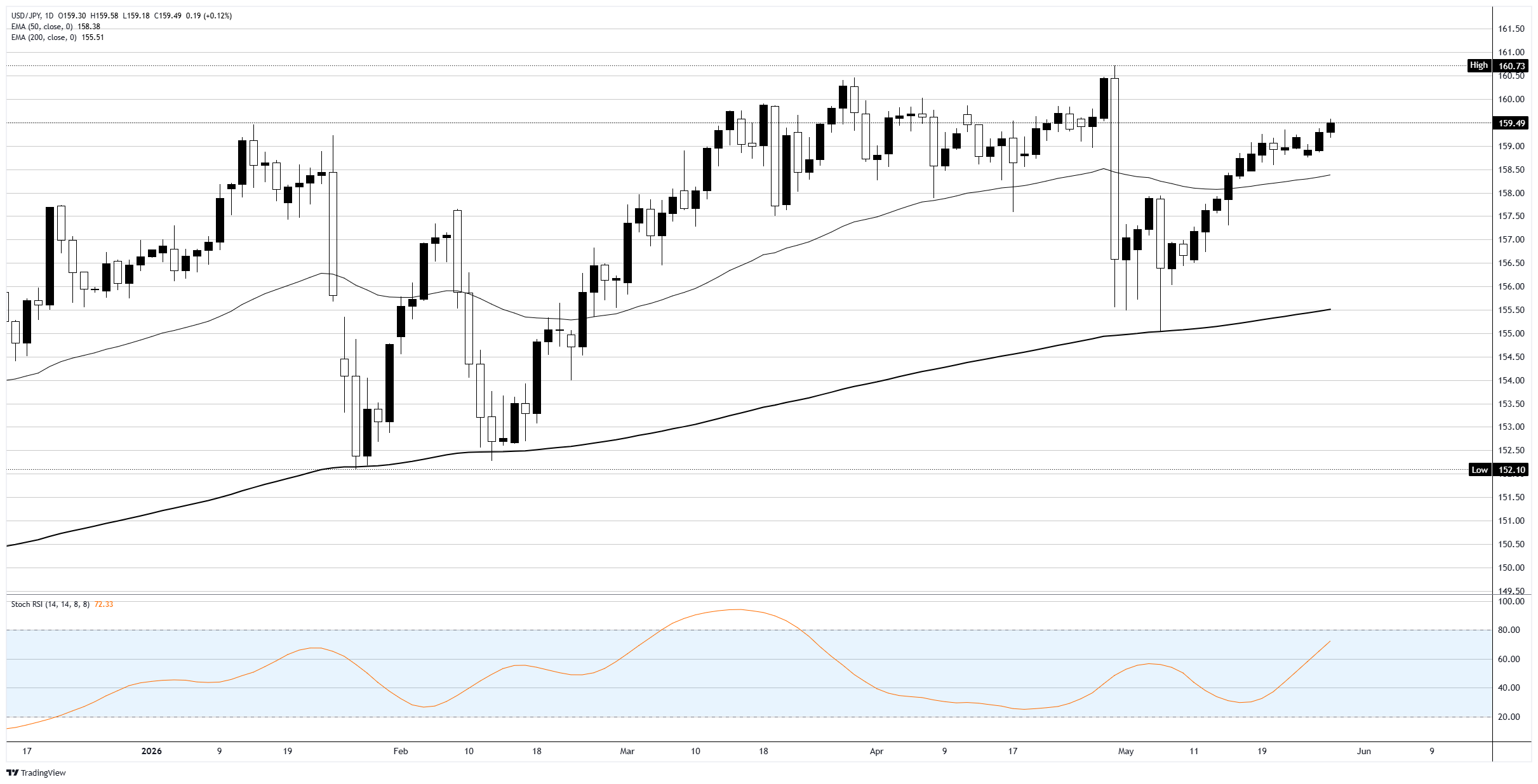
The Bank of Japan (BoJ) and Ministry of Finance bought themselves three weeks of breathing room. A combined intervention effort reportedly worth more than $60 billion across late April and early May shoved USD/JPY out of the politically sensitive 160.00 zone, briefly dragging the pair down toward 156.00. The rebound since has been steady, methodical, and almost mathematical. Price now trades around 159.50, leaving roughly 80% of that selloff erased. Carry traders have stitched themselves back into the positioning they were forced out of, with the patience of people who have read this script before.
That patience is the entire story. Nothing about the post-intervention environment fundamentally favors the Yen. The Federal Reserve (Fed) sits at 3.50% to 3.75% while the BoJ holds at 0.75%, leaving a roughly 300 basis point gap that pays carry every single day the pair does not collapse. Until that math shifts, every intervention buys Tokyo time, not direction.
Ueda walks the same tightrope, smaller now
Governor Kazuo Ueda spoke earlier in the session, and the price action since suggests the market was not particularly impressed. The framing problem is now well-rehearsed. April's Tokyo Consumer Price Index (CPI) print came in soft across the board, with the core-core measure slowing to 1.9% YoY against a 2.3% expectation. That single miss has already pushed June rate hike pricing further out, leaving the Governor with a sequencing problem. Jawbone hawkishly enough to discourage another run at 160.00, but not so hawkishly that markets call the bluff if the next CPI print disappoints again.
Carry math wins by default
Strategists have long argued that intervention without policy follow-through is theatre. The price action since early May has done little to contradict that view. Each successive grind higher tells positioning desks the 160.00 handle is back in play, and the Ministry of Finance now faces an uncomfortable question. A second round of intervention at the same scale, with the same half-life, would invite serious doubts about strategic coherence. A smaller round risks looking like cosmetics. A larger round drains reserves materially.
Technicals back the bid
Daily structure has fully reclaimed the post-intervention damage. Price now trades above the 50-period Exponential Moving Average (EMA) near 158.50, with the 200 EMA further below close to 155.50. The Stochastic Relative Strength Index (Stoch RSI) on the daily chart is climbing into the upper half of its range without flashing overbought. A clean break above 160.00 reopens the broader uptrend and forces another intervention decision. A rejection there sets up a retest of 158.50.
Data preview: Thursday owns the calendar
Two prints define the back half of the week. US Personal Consumption Expenditures Price Index (PCE) lands at 12:30 GMT, with core PCE expected at 0.3% MoM and 3.3% YoY. A hot print firms the Dollar, supports the carry, and likely drives the pair through 160.00. A cool print does the opposite and gives the Yen a reason to defend itself organically.
Tokyo CPI follows at 23:30 GMT, with the headline ex-fresh-food measure expected to hold at 1.5% YoY. Another sub-2% print extends the BoJ's next-hike timeline and quietly removes one of the few remaining non-intervention supports under the Yen. A surprise upside print would be the cleanest setup for a Yen rally seen in weeks.
Bias
Above 160.00, the carry trade reasserts cleanly and the political pressure shifts firmly back to Tokyo. Below 158.50, the post-intervention regime begins to creak, but only a cool PCE paired with a hot Tokyo CPI delivers a genuine reversal. Until then, dips remain bids and the path of least resistance stays higher.
USD/JPY daily chart
Japanese Yen FAQs
The Japanese Yen (JPY) is one of the world’s most traded currencies. Its value is broadly determined by the performance of the Japanese economy, but more specifically by the Bank of Japan’s policy, the differential between Japanese and US bond yields, or risk sentiment among traders, among other factors.
One of the Bank of Japan’s mandates is currency control, so its moves are key for the Yen. The BoJ has directly intervened in currency markets sometimes, generally to lower the value of the Yen, although it refrains from doing it often due to political concerns of its main trading partners. The BoJ ultra-loose monetary policy between 2013 and 2024 caused the Yen to depreciate against its main currency peers due to an increasing policy divergence between the Bank of Japan and other main central banks. More recently, the gradually unwinding of this ultra-loose policy has given some support to the Yen.
Over the last decade, the BoJ’s stance of sticking to ultra-loose monetary policy has led to a widening policy divergence with other central banks, particularly with the US Federal Reserve. This supported a widening of the differential between the 10-year US and Japanese bonds, which favored the US Dollar against the Japanese Yen. The BoJ decision in 2024 to gradually abandon the ultra-loose policy, coupled with interest-rate cuts in other major central banks, is narrowing this differential.
The Japanese Yen is often seen as a safe-haven investment. This means that in times of market stress, investors are more likely to put their money in the Japanese currency due to its supposed reliability and stability. Turbulent times are likely to strengthen the Yen’s value against other currencies seen as more risky to invest in.
추천 기사


