


Indian Rupee bounces back due to RBI’s intervention, sharp correction in oil prices
- The Indian Rupee gains ground against the US Dollar, following the RBI’s intervention and a decline in oil prices.
- US President Trump expressed confidence that negotiations with Iran are in “final stages”.
- India’s HSBC Manufacturing PMI arrives lower at 54.3 in May vs. 54.7 in April.
The Indian Rupee (INR) extends its recovery against the US Dollar (USD) on Thursday after underperforming for almost two weeks. The USD/INR corrects to near 96.30 from its historic highs slightly above 97.00, as the Indian Rupee bounces back due to synergic support from a sharp decline in oil prices and the Reserve Bank of India’s (RBI) intervention.
According to a Reuters report, traders point to strong central bank intervention to shore up the INR, which has hit successive record lows over recent sessions. Traders added that the RBI’s intervention was likely intended to cool the persistent bearish bias on INR.
There have been numerous events of the RBI's intervention through offshore and Non-Deliverable Forwards (NDFs) since the Middle East war started to counter excessive one-way moves against the Indian Rupee.
Currencies from economies, such as India, which rely heavily on oil imports to meet their energy needs, attract bids following a sharp correction in oil prices.
Steep correction in oil prices support Indian Rupee
During the press time, the WTI Oil price trades with caution near Wednesday’s low of around $96.30. The oil price faced a sharp selling pressure on Wednesday after United States (US) President Donald Trump said that Washington is in the “final stages” of finalizing a deal with Iran.
"We’re in the final stages of Iran. We’ll see what happens. Either have a deal or we’re going to do some things that are a little bit nasty, but hopefully that won’t happen,” Trump said, Bloomberg reported.
FIIs continue to offload stake in Indian stock market
On Wednesday, Foreign Institutional Investors (FIIs) emerged as net sellers again and offloaded their stake worth Rs. 1,597.35 crore. Overseas investors also remained net sellers on Tuesday and pared their stake worth Rs. 2,457.49 crore.
The sentiment of FIIs toward the Indian stock market remains grim as elevated oil prices have raised concerns over India Inc.’s earnings projections. Also, increased government payments toward high energy products have diminished their spending power toward infrastructure, employment generation, power, and other critical areas.
Correcting US Treasury yields also push USD/INR under pressure
A sharp correction in the US Treasury yields, following the decline in oil prices, has also weighed on USD/INR. 10-year US Treasury yields drop to near 4.59% from 4.69%, the highest level seen since the subprime crisis posted on Tuesday.
US bond yields surged as elevated oil prices have lifted US inflation expectations, forcing traders to price out the possibility of the Federal Reserve’s (Fed) interest rate cuts this year. While hawkish Fed bets are still intact, as the US headline inflation has already increased to 3.8% Year-on-Year (YoY) in April, the highest level seen in almost three years.
According to the CME FedWatch tool, the odds of the Fed delivering at least one interest rate hike this year are 51%, while the rest favor that benchmark lending rates will remain unchanged in the current range of 3.50%-3.75%.
India's HSBC Composite PMI expands moderately in May
India's HSBC Composite Purchasing Managers' Index (PMI) came in lower at 58.1 in May, down from 58.2 in April. A mild growth slowdown in the overall business activity came in regard to soft Manufacturing PMI, while the service sector activity expanded at a faster pace. The Manufacturing PMI drops to 54.3 in May vs. 54.7 in April. The Services PMI has come in higher at 58.9 from the previous reading of 58.8.
Technical Analysis: USD/INR rally hits pause around 97.00
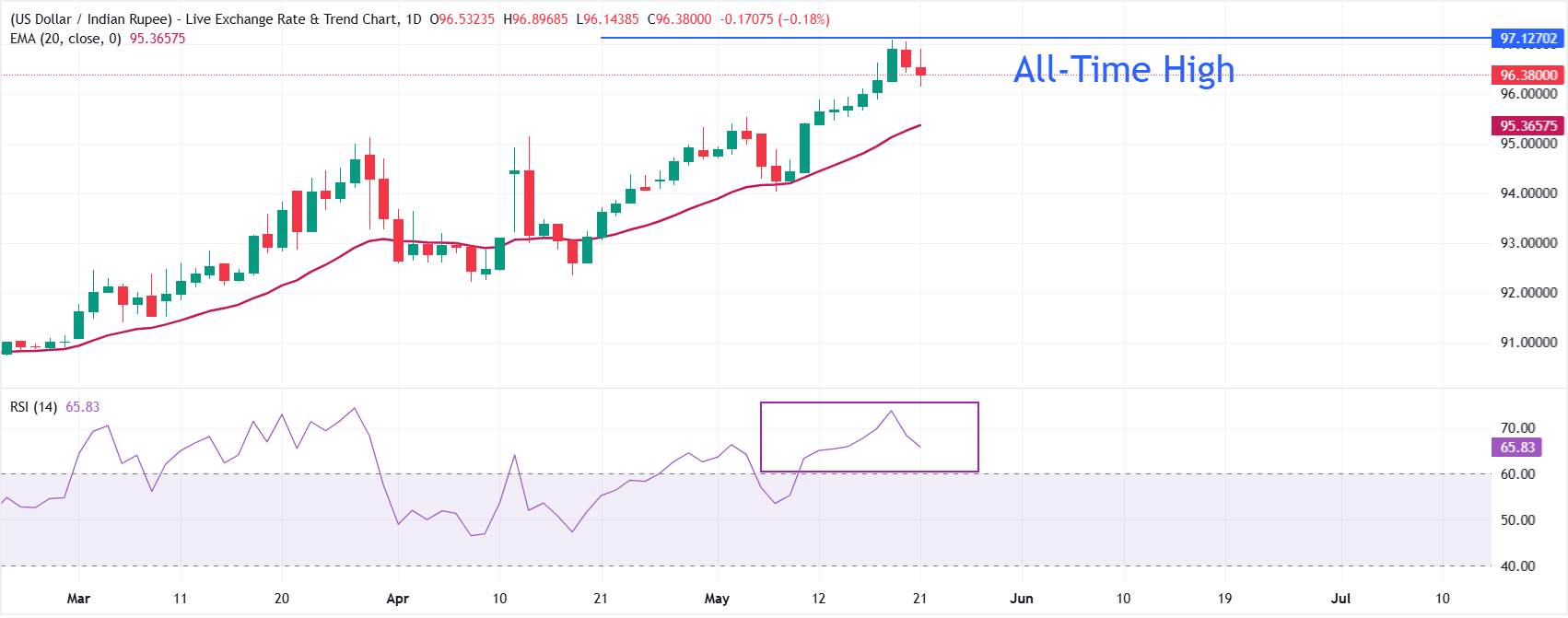
USD/INR trades lower at around 96.30 at the press time. However, the pair holds a clear bullish bias as spot remains above the 20-day Exponential Moving Average (EMA) at 95.36.
The Relative Strength Index (RSI) drops to around 66 after hitting overbought levels, hinting that upside momentum has cooled down but not yet exhausted.
On the downside, initial support is located at the 20-day EMA near 95.37, where a daily close below would signal waning bullish pressure and open room for a deeper correction toward 95.00. Looking up, the pair could extend its advance toward 98.00 if it manages to recover above 97.00.
(The technical analysis of this story was written with the help of an AI tool.)
Indian Rupee FAQs
The Indian Rupee (INR) is one of the most sensitive currencies to external factors. The price of Crude Oil (the country is highly dependent on imported Oil), the value of the US Dollar – most trade is conducted in USD – and the level of foreign investment, are all influential. Direct intervention by the Reserve Bank of India (RBI) in FX markets to keep the exchange rate stable, as well as the level of interest rates set by the RBI, are further major influencing factors on the Rupee.
The Reserve Bank of India (RBI) actively intervenes in forex markets to maintain a stable exchange rate, to help facilitate trade. In addition, the RBI tries to maintain the inflation rate at its 4% target by adjusting interest rates. Higher interest rates usually strengthen the Rupee. This is due to the role of the ‘carry trade’ in which investors borrow in countries with lower interest rates so as to place their money in countries’ offering relatively higher interest rates and profit from the difference.
Macroeconomic factors that influence the value of the Rupee include inflation, interest rates, the economic growth rate (GDP), the balance of trade, and inflows from foreign investment. A higher growth rate can lead to more overseas investment, pushing up demand for the Rupee. A less negative balance of trade will eventually lead to a stronger Rupee. Higher interest rates, especially real rates (interest rates less inflation) are also positive for the Rupee. A risk-on environment can lead to greater inflows of Foreign Direct and Indirect Investment (FDI and FII), which also benefit the Rupee.
Higher inflation, particularly, if it is comparatively higher than India’s peers, is generally negative for the currency as it reflects devaluation through oversupply. Inflation also increases the cost of exports, leading to more Rupees being sold to purchase foreign imports, which is Rupee-negative. At the same time, higher inflation usually leads to the Reserve Bank of India (RBI) raising interest rates and this can be positive for the Rupee, due to increased demand from international investors. The opposite effect is true of lower inflation.
추천 기사


