


EUR/USD edges higher as US shutdown fears weigh on the Dollar
- Euro holds above 1.1720 as Democrats reject Republican bill, fueling concerns over US government shutdown.
- Fed’s Musalem and Hammack stress inflation risks, Williams notes gradual labor market cooling.
- Eurozone Consumer Sentiment improves but remains below average, limiting momentum despite broad US Dollar weakness.
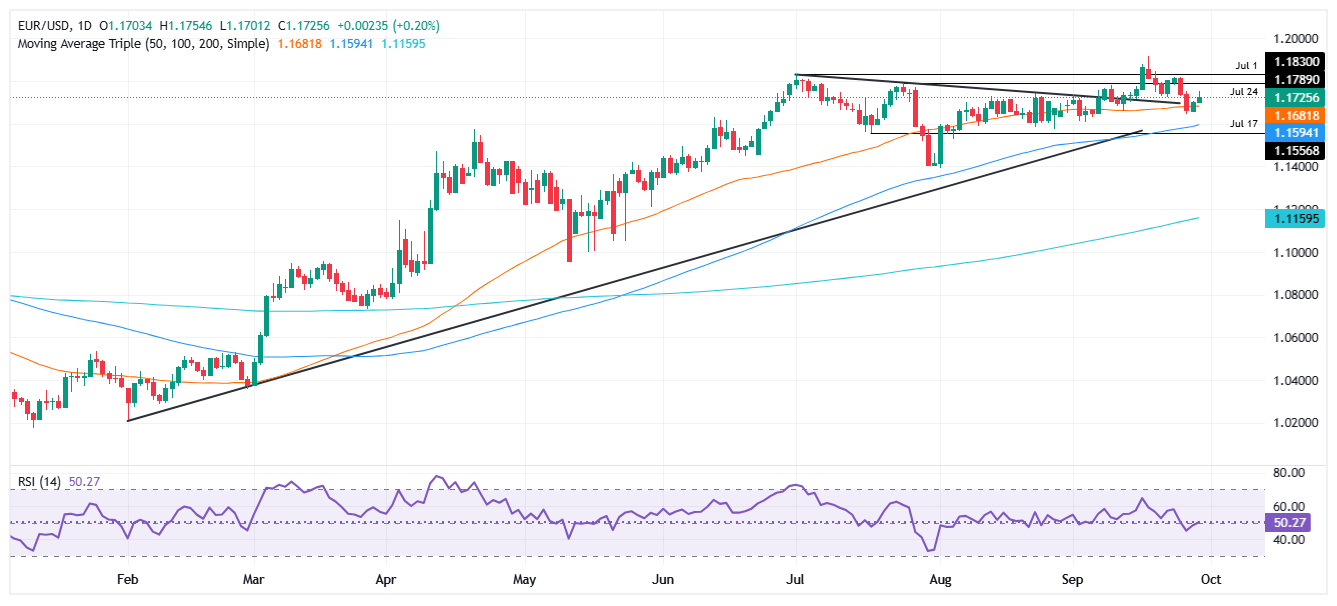
EUR/USD registers gains of over 0.20% on Monday amid worries of a possible government shutdown in the US, while data in the Eurozone, showed that sentiment improved but failed to propel the shared currency higher. At the time of writing, the pair trades at 1.1726 after hitting a daily low of 1.1701.
Shared currency gains modestly as political gridlock in Washington undermines sentiment
The Greenback is on the backfoot against most G10 FX currencies as US President Donald Trump met with the two leaders of the Democrats of the House of Representatives and the Senate.
US Senate Democrat leaders Schumer met with Trump, said “We have large differences.” Democratic House of Representatives leader Jefferies said that they would not support a partisan republican bill that hurts healthcare.
In the meantime, Vice President Vance said that the US headed for shutdown after talks with democrats, revealed a Bloomberg headline.
US housing data was upbeat earlier, while Federal Reserve officials delivered mixed remarks. St. Louis Fed President Alberto Musalem was hawkish, said that inflation expectations are “somewhat high” and recognized the labor market softened. Cleveland’s Fed Beth Hammack said that inflation is too high and that the trend is in the wrong direction.
New York Fed John Williams said that policy is restrictive, but in a position to put downward pressure on inflation, and that the resilient labor market is gradually softening.
in the European session, Consumer Sentiment improved in the Eurozone but remained below the historical average.
Ahead this week, the docket will feature ADP National Employment Change, the ISM Manufacturing PMI, Initial Jobless Claims and Nonfarm Payrolls for September.
Daily market movers: EUR/USD climbs despite solid US housing data
- US Pending Home Sales rebounded strongly in August, rising 4% MoM after July’s upwardly revised -0.3% contraction, handily beating expectations for a 0.3% gain. Last week’s core PCE data came in line with estimates, reinforcing expectations for further Fed easing.
- Fed funds rate futures point to an 89% probability of a 25-basis-point cut in October, with just an 11% chance priced for a larger 50-bps move, according to Prime Market Terminal’s rate probability tool.
- In the Eurozone, September Consumer Confidence improved modestly to -14.9 from -15.5, while Industrial Confidence slipped slightly to -10.3 from -10.2, though still better than forecasts of -10.9. Services Sentiment weakened to 3.6 from 3.8, missing consensus at 3.7.
Technical outlook: EUR/USD recovers and hovers 1.1740
EUR/USD post back-to-back bullish days, yet it is poised to consolidate at around current levels, near the 20-day Simple Moving Average (SMA) at 1.1740 The Relative Strength Index (RSI) turned flat around neutral levels, suggesting that the pair might consolidate at around current levels.
If EUR/USD clears 1.1740, the next resistance would be 1.1800 ahead of the yearly high of 1.1918. Conversely, a drop below 1.1700 will expose 1.1650, before challenging the 100-day SMA At 1.1599.
Euro FAQs
The Euro is the currency for the 19 European Union countries that belong to the Eurozone. It is the second most heavily traded currency in the world behind the US Dollar. In 2022, it accounted for 31% of all foreign exchange transactions, with an average daily turnover of over $2.2 trillion a day. EUR/USD is the most heavily traded currency pair in the world, accounting for an estimated 30% off all transactions, followed by EUR/JPY (4%), EUR/GBP (3%) and EUR/AUD (2%).
The European Central Bank (ECB) in Frankfurt, Germany, is the reserve bank for the Eurozone. The ECB sets interest rates and manages monetary policy. The ECB’s primary mandate is to maintain price stability, which means either controlling inflation or stimulating growth. Its primary tool is the raising or lowering of interest rates. Relatively high interest rates – or the expectation of higher rates – will usually benefit the Euro and vice versa. The ECB Governing Council makes monetary policy decisions at meetings held eight times a year. Decisions are made by heads of the Eurozone national banks and six permanent members, including the President of the ECB, Christine Lagarde.
Eurozone inflation data, measured by the Harmonized Index of Consumer Prices (HICP), is an important econometric for the Euro. If inflation rises more than expected, especially if above the ECB’s 2% target, it obliges the ECB to raise interest rates to bring it back under control. Relatively high interest rates compared to its counterparts will usually benefit the Euro, as it makes the region more attractive as a place for global investors to park their money.
Data releases gauge the health of the economy and can impact on the Euro. Indicators such as GDP, Manufacturing and Services PMIs, employment, and consumer sentiment surveys can all influence the direction of the single currency. A strong economy is good for the Euro. Not only does it attract more foreign investment but it may encourage the ECB to put up interest rates, which will directly strengthen the Euro. Otherwise, if economic data is weak, the Euro is likely to fall. Economic data for the four largest economies in the euro area (Germany, France, Italy and Spain) are especially significant, as they account for 75% of the Eurozone’s economy.
Another significant data release for the Euro is the Trade Balance. This indicator measures the difference between what a country earns from its exports and what it spends on imports over a given period. If a country produces highly sought after exports then its currency will gain in value purely from the extra demand created from foreign buyers seeking to purchase these goods. Therefore, a positive net Trade Balance strengthens a currency and vice versa for a negative balance.
추천 기사


