


3 Investing Habits That Can Build Life-Changing Wealth, According to Decades of Stock Market History
Key Points
The most important habit in investing is living below your means so you actually have money to invest.
The second key habit is buying and holding for the long term, even if that means just buying an S&P 500 index ETF.
The third important habit is reinvesting capital gains and dividends, so you benefit from compounding.
- 10 stocks we like better than Vanguard S&P 500 ETF ›
Investing can be shockingly simple if you set your investment approach up the right way. Investment icon Warren Buffett, the former CEO of Berkshire Hathaway (NYSE: BRKA)(NYSE: BRKB), has provided all of the advice you need: buy an S&P 500 index (SNPINDEX: ^GSPC) ETF like Vanguard S&P 500 ETF (NYSEMKT: VOO) and hold for the long term. But there's a little more to the story than that, including saving, buying and holding, and reinvesting. Here's how these three habits can help you build life-changing wealth with a single exchange-traded fund.
You can't skip step 1 (and you should keep repeating it)
The first step to building wealth is to live below your means so you have money to invest. This key step sounds obvious, but it is truly shocking how many people fall short before they even have a chance to start building wealth. Saving is really just delaying spending today so you can, hopefully, spend more in the future. Moreover, if you can create a habit of saving, you can continue to add to your investments over time.
Missed AI’s "Act 1"? Act 2 Could Be 15x Bigger. Most investors think they missed the AI boat because they didn't buy Nvidia in 2005. But according to our analysts, we’re only at the end of "Act 1"—the R&D phase. "Act 2" is the global rollout. Continue »

Image source: Getty Images.
So saving is actually two key wealth-building steps in one. First, it allows you to start your investment journey. Second, you can buy more of your chosen investments each month, which is known as dollar-cost averaging. Dollar-cost averaging not only allows you to grow your investments with additional cash but also tends to result in a lower average purchase price over time.
Step two is buying and holding
Once you have the cash to invest, you have to choose an investment path. As noted, Warren Buffett has suggested that most investors keep it simple and buy a low-cost S&P 500 index fund. Vanguard S&P 500 ETF, noted above, has a tiny expense ratio of 0.03%, which is as close to free on Wall Street as you are likely to get.
Notably, the S&P 500 index is basically what most investors consider "the market." It is a committee-selected group of roughly 500 large companies that are representative of the U.S. economy. If you buy it, you are guaranteed to get average results, which is more than enough to build life-changing wealth over time. As the chart below highlights, the S&P 500 index has trended steadily higher, even though it has experienced numerous downturns, known as bear markets, along the way.
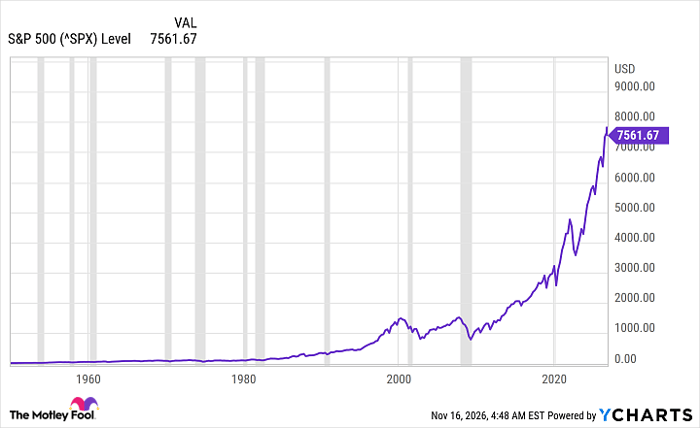
^SPX data by YCharts
This is why buying and holding is so important. Even if you bought right before a bear market, history shows that you'll end up OK if you don't panic and sell. Every bear market so far has been followed by the market going on to post new all-time highs. In fact, buying right through a bear market is what makes dollar-cost averaging work. And Buffett's suggestion to buy the S&P 500 is also important because it keeps your investment plan simple. It is likely to be easier to stick to a simple plan than one that is overly complex.
Step three is to reinvest for as long as possible
If you do buy an S&P 500 ETF, you'll be collecting dividends along the way, and there could even be some capital gains distributions. Put all of that cash right back into the S&P 500 ETF you've chosen. That allows you to buy more without having to save more, which is basically what's known as compounding.
At some point, you may want to use the dividends and other distributions you get to pay for living expenses. That's a great way to help supplement your Social Security checks in retirement. But until that point, you should resist the urge to spend that money and put it back to work.
You have to pick a plan that works for you, but...
For some people, buying an S&P 500 index ETF won't be the right fit. That's OK; you need to find an investment approach that suits your personal needs and temperament. However, the three key steps don't change: Save, invest for the long term, and reinvest. If you get those three down, you will be well set up to build life-changing wealth.
Should you buy stock in Vanguard S&P 500 ETF right now?
Before you buy stock in Vanguard S&P 500 ETF, consider this:
The Motley Fool Stock Advisor analyst team just identified what they believe are the 10 best stocks for investors to buy now… and Vanguard S&P 500 ETF wasn’t one of them. The 10 stocks that made the cut could produce monster returns in the coming years.
Consider when Netflix made this list on December 17, 2004... if you invested $1,000 at the time of our recommendation, you’d have $327,620!* Or when Nvidia made this list on April 15, 2005... if you invested $1,000 at the time of our recommendation, you’d have $959,410!*
Now, it’s worth noting Stock Advisor’s total average return is 802% — a market-crushing outperformance compared to 205% for the S&P 500. Don't miss the latest top 10 list, available with Stock Advisor, and join an investing community built by individual investors for individual investors.
See the 10 stocks »
*Stock Advisor returns as of November 17, 2026.
Reuben Gregg Brewer has no position in any of the stocks mentioned. The Motley Fool has positions in and recommends Berkshire Hathaway and Vanguard S&P 500 ETF. The Motley Fool has a disclosure policy.
Recommended Articles


