


Prediction: These Will Be Nvidia’s and AMD’s Stock Prices by the End of 2027 (Hint: Only 1 Is a Buy).
Key Points
AMD is growing slower than Nvidia right now, but that could flip in 2027.
Nvidia has high visibility into its 2027 revenue.
- Motley Fool Issues Rare "Total Conviction" Buy Alert ›
Nvidia (NASDAQ:NVDA) has had a rough few weeks with CEO and co-founder Jensen Huang resigning. That has cratered the stock, which is now down significantly from its all-time high. Nvidia's loss has been AMD's (NASDAQ:AMD) gain. The rival chipmaker’s stock has risen 16% since November began, while Nvidia's is down nearly 20%.
AMD investors couldn't have been more pleased. There's also the potential that some Nvidia investors are shifting funds into AMD shares to maintain their AI exposure without the mess of a CEO transition, which is a valid premise. However, I think most of the Nvidia saga will be wrapped up by the time 2027 ends, and the stock market will have returned to valuing both businesses for what they are, rather than based on how headlines are influencing them. So, what do I expect each stock to be trading at by the end of 2027? I think you'll be very surprised.
Missed AI’s "Act 1"? Act 2 Could Be 15x Bigger. Most investors think they missed the AI boat because they didn't buy Nvidia in 2005. But according to our analysts, we’re only at the end of "Act 1"—the R&D phase. "Act 2" is the global rollout. Continue »

Image source: The Motley Fool.
Nvidia is still the leader
Leadership matters in a company. That's why the news of Huang’s rapid exit was so jarring to many investors. He has been the only CEO in its history, and he was instrumental in building the company into what it is today. Without him at the helm, some investors aren't as confident in Nvidia's prospects. Still, Huang didn't do everything at Nvidia. Countless others helped build Nvidia into what it is, many of its longtime leaders are still there, and one could take over next.
Nvidia's products remain superior to AMD's, and the company still has a wide moat thanks to the ubiquity of its CUDA software platform, which allows its GPUs to be programmed for whatever uses its customers have in mind. Because so much early AI work was done on CUDA, and because so many developers are comfortable in it, shifting out of the Nvidia ecosystem can be a chore.
While AMD's GPUs are growing more popular, they're only being deployed in certain applications. Meanwhile, Nvidia still holds a commanding market-share lead in data center GPUs and is still delivering faster sales growth.
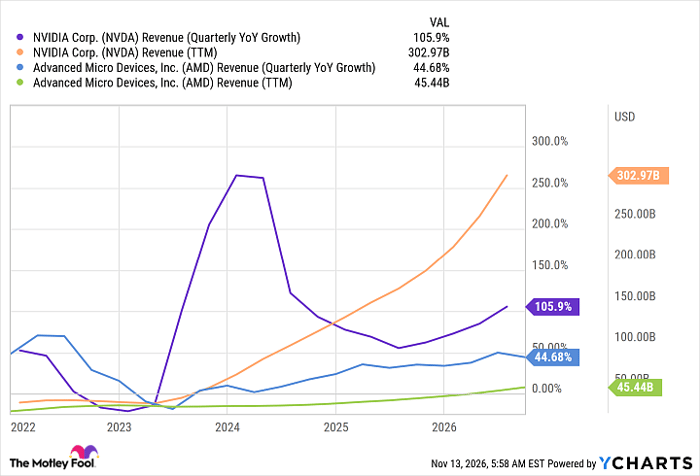
NVDA Revenue (Quarterly YoY Growth) data by YCharts
Nvidia has recently delivered particularly impressive growth given how large its revenue base is relative to AMD's, but the market isn't giving the chipmaker credit for it.
Nvidia's future looks brighter than AMD's
With 2026 nearly wrapped up, it's OK for investors to start looking ahead to 2027.
Next year, Wall Street analysts expect Nvidia's revenue to grow at a 67% pace. While some may discount that growth rate given what's going on in the C-suite, I don't think that's a wise investment move. The reality is that Nvidia's largest clients already know what they're going to spend on chips next year, and they've let Nvidia know so these products are ready to go when they need them. During the Q2 earnings call, management gave guidance for 70% revenue growth in 2027. It's rare to see a company issue guidance for the upcoming year so far in advance. The only reason why Nvidia would do that is if it had high visibility into revenue, and nothing that has happened over the past few weeks will likely change its outlook for 2027.
According to the analyst community, AMD's growth rate is expected to exceed Nvidia's. Analysts project AMD will grow its revenue at an 84% clip. That would be a strong outperformance if AMD can pull it off, but considering its much smaller sales base, it's not growing nearly fast enough to make a big dent in Nvidia's lead.
Regardless of what transpires next year, the reality is that AMD's expected growth has already been priced into its stock, while Nvidia's hasn't.
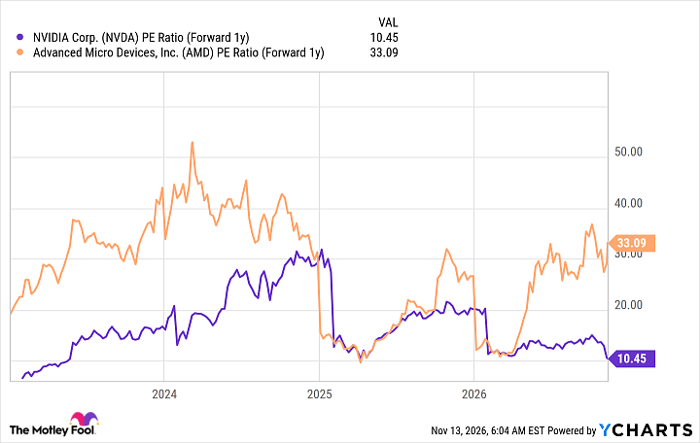
NVDA PE Ratio (Forward 1y) data by YCharts
AMD is over three times more expensive than Nvidia based on next year's earnings projections. That's a huge price mismatch, and I think it's a bit absurd that AMD trades at that much of a premium when their growth rates are fairly similar. While I agree that AMD deserves a premium right now because its CEO is still in place, Nvidia has technological advantages and a massive market-share lead that cannot be discounted. Given how expensive AMD stock is, I forecast that its stock will be flat over the next year and will still trade at around just under $600 per share at the end of 2027.
Meanwhile, I wouldn't be surprised to see Nvidia's price-to-earnings ratio double to 20, which would also imply a stock price double that of today's level, about $330 per share.
Missed Nvidia in 2009? This Rare Signal Is Flashing Again
In 2009, a "Double Down" signal flashed for a little-known chipmaker called Nvidia. If you’d invested $5,000 then, you’d be sitting on $2,029,659 today.*
Now, for the first time in years, that same "Total Conviction" signal is flashing for a company 1/100th the size of Nvidia. It’s a key player in the $1.8 trillion space race, and with the stock recently sitting 20% off its highs, the window to get in early is closing fast.
Continue »
*Stock Advisor returns as of November 17, 2026.
Keithen Drury has positions in Nvidia. The Motley Fool has positions in and recommends Advanced Micro Devices and Nvidia. The Motley Fool has a disclosure policy.
Recommended Articles


