


Prediction: $10,000 Equally Split Between Eli Lilly and Novo Nordisk Will Be Worth This Much by the End of 2027
Key Points
Eli Lilly is surging, with revenue up 39% in the third quarter and a retatrutide filing planned for early 2027.
Novo is bouncing back on oral Wegovy, with a CagriSema decision due soon.
Given the fast-growing weight loss market, both leaders can win.
- Motley Fool Issues Rare "Total Conviction" Buy Alert ›
Eli Lilly (NYSE:LLY) and Novo Nordisk (NYSE:NVO) are leading the fast-growing market for weight loss drugs, but they have had very different fortunes over the past year. Eli Lilly's shares have gained 41%, while Novo's have dropped 15%. Both could make significant progress in the next year, especially since they have important clinical candidates in Phase 3 studies.
However, they could also face headwinds, including increased competition in the weight-loss space. With that said, should investors consider putting their hard-earned cash into Eli Lilly and Novo? Let's find out how much $10,000, invested equally in both stocks, could be worth by the end of 2027.
Missed Nvidia in 2009? This Rare Signal Is Flashing Again. In 2009, a "Double Down" signal flashed for a little-known chipmaker called Nvidia. For the first time in years, that same "Total Conviction" signal is flashing for a company 1/100th the size of Nvidia. Continue »
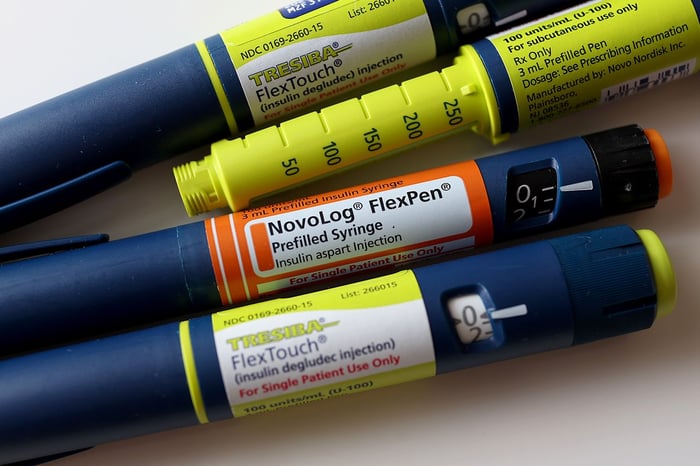
Image source: Getty Images.
Eli Lilly is firing on all cylinders
Eli Lilly's financial results have been excellent recently. In the third quarter, the company's revenue increased by 39% year over year to $24.4 billion, beating analyst estimates. The drugmaker's earnings per share jumped 16% year over year to $7.22. Eli Lilly's core GLP-1 products, Mounjaro for diabetes and Zepbound for obesity, posted excellent sales growth.
They should continue their outstanding performance over the next year, potentially helping Eli Lilly maintain its recent momentum. But several other catalysts could matter for the stock. For instance, Eli Lilly is gearing up to submit a regulatory application for retatrutide, a next-gen diabetes and obesity medicine. Management is planning to do so in the first quarter of 2027.
Retatrutide has posted excellent Phase 3 clinical trial results. In my view, this medicine's approval is already factored into Eli Lilly's share price, so any clinical or regulatory setback could sink the stock. Eli Lilly could also announce important clinical trial results that may support label expansions for Zepbound, Foundayo -- its oral weight-loss medicine -- and several other products in other areas, such as Kisunla for Alzheimer's disease. The stock could jump on excellent clinical trial data across the board.
Is Novo finally bouncing back?
Novo's third-quarter results jolted the stock. The company's net sales grew by 6% year over year to 79.2 billion Danish kroner (about $11.7 billion). Although Novo's adjusted net profit dropped 12% year over year to 25.6 billion DKK (about $3.77 billion), the stock jumped post-earnings after it outperformed expectations. The most important reason for that was oral Wegovy.
This weight-loss pill, the first of its kind to be approved, has been driving Novo's sales higher. In the third quarter, oral Wegovy's revenue came in at 5.4 billion DKK (about $796 million). This medicine isn't just cannibalizing sales of the original Wegovy. It is attracting mostly new patients. And it could help Novo perform relatively well over the next year if it continues to beat expectations.
Novo could also launch new products, including CagriSema, a next-gen medicine for diabetes and weight loss. CagriSema beat Wegovy in a head-to-head trial, so this is Novo's chance to gain a larger share of the weight loss market. CagriSema could earn approval by year-end and help Novo's sales improve in 2027. Further, Novo has promising clinical trial readouts on the horizon.
CagriSema, oral Wegovy, and several other products could post important clinical trial results that may strengthen the Denmark-based pharmaceutical giant's position in diabetes and obesity.
The investment could pay off
Several drugmakers could release Phase 2 or Phase 3 clinical trial readouts within the next 12 months. That may not affect Eli Lilly and Novo's financial results next year, but it will impact their prospects in the weight loss market. However, their larger, stronger pipelines may establish them as even stronger leaders, especially if the weight-loss market continues to grow rapidly.
So, I expect both to perform relatively well through the end of 2027, although it's always hard to predict stock market movements over such short periods. How much could a $10,000 split equally between both companies be worth? Let's start with Eli Lilly. It expects $91.5 billion in revenue at the midpoint this year, while analysts project $106.49 billion on average next year (according to Yahoo! Finance). Assuming that's correct, and Eli Lilly's price-to-sales ratio drops to 14.2 from its current 14.9, the stock could gain about 10.91% by the end of 2027, turning $5,000 into $5,546.
As far as Novo is concerned, with its recent wins in the oral weight-loss market and a much-improved pipeline that could make progress next year, the market may have increased confidence in its outlook. Analysts expect the company to generate 309.47 billion DKK (about $45.63 billion) in revenue this year and 313.08 billion DKK (about $46.16 billion) next year. If Novo's price-to-sales ratio goes from its current 3.56 to 4, the stock could jump 13.67%, turning $5,000 into $5,684. So, investing $10,000 in both stocks could yield $11,230 by the end of 2027. Of course, there is plenty of uncertainty.
And it's also important for investors to focus more on the long term than on whatever happens over the next 12 months or so. Looking ahead over the next decade, Eli Lilly and Novo appear to be attractive healthcare stocks to buy.
Should you buy stock in Eli Lilly right now?
Before you buy stock in Eli Lilly, consider this:
The Motley Fool Stock Advisor analyst team just identified what they believe are the 10 best stocks for investors to buy now… and Eli Lilly wasn’t one of them. The 10 stocks that made the cut could produce monster returns in the coming years.
Consider when Netflix made this list on December 17, 2004... if you invested $1,000 at the time of our recommendation, you’d have $335,171!* Or when Nvidia made this list on April 15, 2005... if you invested $1,000 at the time of our recommendation, you’d have $1,000,640!*
Now, it’s worth noting Stock Advisor’s total average return is 823% — a market-crushing outperformance compared to 208% for the S&P 500. Don't miss the latest top 10 list, available with Stock Advisor, and join an investing community built by individual investors for individual investors.
See the 10 stocks »
*Stock Advisor returns as of November 15, 2026.
Prosper Junior Bakiny has positions in Eli Lilly and Novo Nordisk. The Motley Fool has positions in and recommends Eli Lilly and Novo Nordisk. The Motley Fool has a disclosure policy.
Recommended Articles


