


How These 6 Natural Gas Stocks Make Money
Key Points
Cheniere Energy earns its money by converting gas into liquefied natural gas (LNG), which it exports through its terminals, typically under long-term contracts.
EQT, Expand Energy, and Antero Resources make money by producing gas, which they typically sell at prevailing market prices.
Kinder Morgan and Williams operate gas pipelines and other infrastructure that typically generate fee-based income.
- Motley Fool Issues Rare "Total Conviction" Buy Alert ›
Natural gas stocks Cheniere Energy (NYSE: LNG), EQT (NYSE: EQT), Expand Energy (NASDAQ: EXE), Antero Resources (NYSE: AR), Kinder Morgan (NYSE: KMI), and Williams (NYSE: WMB) all focus on the same fuel. However, they don't make money the same way. One liquefies it and ships it overseas, a few drill it out of the ground, and others operate pipelines and gas-related infrastructure. This difference matters.
Here's a look at how these top natural gas stocks make money.
Missed Nvidia in 2009? This Rare Signal Is Flashing Again. In 2009, a "Double Down" signal flashed for a little-known chipmaker called Nvidia. For the first time in years, that same "Total Conviction" signal is flashing for a company 1/100th the size of Nvidia. Continue »
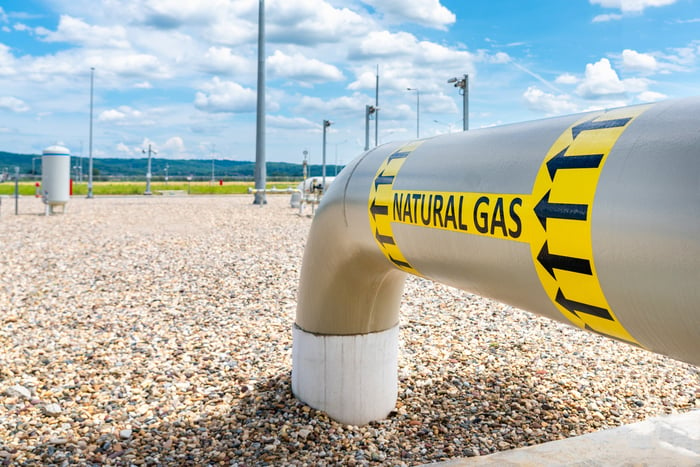
Image source: Getty Images.
Cashing in on export demand
Cheniere Energy is the U.S. leader in liquefied natural gas (LNG). It has invested $50 billion to develop two LNG export facilities along the U.S. Gulf Coast, with 16 LNG trains currently operating, totaling about 55 million tonnes per annum (mtpa) of LNG production capacity. It's the country's top LNG producer and the second-largest globally.
The company makes money by liquefying natural gas and exporting it through its LNG terminals, primarily under long-term, take-or-pay contracts (covering 95% of its capacity). Those contracts provide it with very stable, predictable cash flows. That supplies the company with steady cash to invest in expanding its LNG capacity, repay debt, and return cash to shareholders. The stability of its cash flows makes it a lower-risk way to invest in natural gas.
Making money from growing gas demand
EQT, Expand Energy, and Antero Resources are three of the largest pure-play U.S. gas producers. They produce gas from wells and typically sell it at the prevailing market price. Gas prices can be highly volatile, significantly impacting cash flows. That's why many gas producers use hedging contracts to lock in pricing on a portion of their contracts. Low-cost operations enable a gas producer to earn more money than their higher-cost peers at lower gas prices.
EQT is about to become the country's largest and lowest-cost producer after agreeing to buy Range Resources in a deal that will create a $50 billion gas giant. The merger will lower EQT's cash flow breakeven level to less than $2 per MMBtu, giving it a peer-leading cost structure. The company also stands out for its vertical integration, as it also owns meaningful midstream infrastructure. Add in its leading marketing platform and strong balance sheet, and it stands out among gas producers.
Expand Energy is currently the country's largest independent gas producer, though it will fall to second place once EQT closes its purchase of Range Resources. Expand Energy recently completed a meaningful acquisition, buying Twin Eagle to create the country's leading integrated gas company. However, instead of operating midstream infrastructure like EQT, Twin Eagle is a leading gas marketer. By combining companies, Expand Energy will have greater capacity to capture the highest value from its gas production by selling more of it into premium markets.
Antero Resources is more of a pure-play gas producer. It has a low-cost structure, higher natural gas liquids (NGL) production, and a strong hedging program, which helps reduce cash flow volatility. The company has contracts with midstream service providers to export a significant portion of its NGL production, as well as LNG export contracts, which enable it to obtain premium prices for its output.
Collecting steady cash from natural gas infrastructure
Kinder Morgan and Williams are leading natural gas pipeline stocks. They operate pipelines that gather gas from wells and transport it to processing facilities. Additionally, they own long-haul gas pipelines, gas storage terminals, and other related infrastructure. Most of these assets operate under fixed-fee contracts or government-regulated rate structures that provide them with very stable cash flows.
Kinder Morgan gets 96% of its cash flows from take-or-pay contracts, fee-based agreements, or natural gas hedges. The company uses its stable cash flow to pay a growing dividend and invest in new growth capital projects ($14.4 billion secured through the early 2030s, primarily new and expanded natural gas pipelines).
Williams also primarily generates stable cash flows from take-or-pay contracts, fee-based agreements, and hedges. It also uses its stable cash flow to pay a growing dividend and invest in expanding its operations. In addition to building more gas pipeline capacity, Williams is investing in an LNG export terminal along the U.S. Gulf Coast and in several natural gas power-generating facilities. These additional growth drivers will fuel robust earnings growth over the next several years.
Three different ways to cash in on gas
Demand for natural gas is growing due to rising global export demand and surging power needs from AI data centers. Investors have many ways to make money from this powerful growth trend. Producers provide the most upside to rising gas demand and prices, while gas infrastructure companies like Cheniere, Kinder Morgan, and Williams generate steadier cash flow from long-term contracts. Given these differences, investors should know how a gas stock makes money before adding it to their portfolio.
Should you buy stock in Cheniere Energy right now?
Before you buy stock in Cheniere Energy, consider this:
The Motley Fool Stock Advisor analyst team just identified what they believe are the 10 best stocks for investors to buy now… and Cheniere Energy wasn’t one of them. The 10 stocks that made the cut could produce monster returns in the coming years.
Consider when Netflix made this list on December 17, 2004... if you invested $1,000 at the time of our recommendation, you’d have $335,171!* Or when Nvidia made this list on April 15, 2005... if you invested $1,000 at the time of our recommendation, you’d have $1,000,640!*
Now, it’s worth noting Stock Advisor’s total average return is 823% — a market-crushing outperformance compared to 208% for the S&P 500. Don't miss the latest top 10 list, available with Stock Advisor, and join an investing community built by individual investors for individual investors.
See the 10 stocks »
*Stock Advisor returns as of November 15, 2026.
Matt DiLallo has positions in EQT and Kinder Morgan. The Motley Fool has positions in and recommends Cheniere Energy, EQT, and Kinder Morgan. The Motley Fool has a disclosure policy.
Recommended Articles


