


1 ETF That Can Turn $500 Monthly Into a $600,000 Portfolio That Pays Out $18,000 Annually
Key Points
The Schwab U.S. Dividend Equity ETF (SCHD) has averaged 13.7% annual total returns since its inception.
Eleven of SCHD's 102 holdings are dividend kings.
Using a dividend reinvestment plan can speed up the pace to reaching the $600,000 mark.
- 10 stocks we like better than Schwab U.S. Dividend Equity ETF ›
Ask almost anyone how an extra $1,500 a month sounds, and I'm sure they'll say it sounds great. Ask them how it would sound to have it come in with no extra work, and I'm sure they'll tell you it sounds really great.
Getting to $1,500 in monthly dividends won't happen overnight for most investors, but history shows that consistently investing in the Schwab U.S. Dividend Equity ETF (NYSEMKT:SCHD) can put you well on your way.
Missed Nvidia in 2009? This Rare Signal Is Flashing Again. In 2009, a "Double Down" signal flashed for a little-known chipmaker called Nvidia. For the first time in years, that same "Total Conviction" signal is flashing for a company 1/100th the size of Nvidia. Continue »
At its historical growth rate, $500 invested monthly into SCHD could grow into a $600,000 portfolio that pays out $4,500 a quarter, or $1,500 a month. Let’s take a look at how.

Image source: Getty Images.
The math behind $600,000
Since it began trading in October 2011, SCHD has averaged a 13.7% annual total return (including dividends). If it sustains that average, $500 monthly investments could reach $600,000 in about 21 years. Realistically, that could be tough to maintain, so we'll use a more modest 10.2%, its annual average excluding dividends.
With those returns, $500 monthly investments could grow to $600,000 in 25 years. And aside from having $600,000 to your name, one of the best parts is that you would've invested only $150,000 over that time, highlighting the power of compound earnings.
Right now, SCHD's dividend yield is 2.9%, but its average over the past decade has been around 3.2%. If we meet in the middle and assume a 3% yield, $600,000 invested in SCHD would pay out $18,000 annually ($4,500 quarterly).
Past results don't guarantee future performance, so we shouldn't assume SCHD will continue at its historical rate. However, its structure gives me confidence in its ability to sustain growth.
SCHD vets companies for you
Many ETFs focus mainly on grouping stocks with high dividend yields. Yes, the higher the yield, the higher the payout, but not all high-yield stocks are worth holding. Plenty of stocks have high yields because their stock price has struggled due to poor business performance.
SCHD helps investors avoid those situations by focusing more on business quality and financial health. To be considered, a company must check all of the following boxes:
- 10 consecutive years of dividend payments,
- At least five consecutive years of annual dividend increases,
- Good cash flow relative to its debt, and
- A dividend yield that's at least in the top half of eligible stocks
Most companies that check those boxes are mature and reliable, so you shouldn't have to worry about one-hit wonders or sudden dividend cuts.
What you're getting with SCHD
Most of SCHD's holdings come from the consumer staples, healthcare, and energy sectors, which checks out, given how cash-generative they tend to be. Its top 10 holdings are:
- Texas Instruments: 4.58%
- Procter & Gamble: 4.44%
- Home Depot: 4.28%
- Coca-Cola: 4.27%
- Amgen: 4.08%
- PepsiCo: 3.97%
- Qualcomm: 3.97%
- UnitedHealth Group: 3.94%
- Abbott Laboratories: 3.89%
- Chevron: 3.88%
SCHD isn't weighted by market cap like most indexes and popular ETFs; it uses a modified method. This is how you get companies like Texas Instruments ahead of Procter & Gamble and Home Depot ahead of Coca-Cola. Holding weights aside, of SCHD's 102 holdings, 11 are Dividend Kings (companies with at least 50 consecutive years of increases):
- Procter & Gamble
- Coca-Cola
- PepsiCo
- Abbott Laboratories
- Altria
- Automatic Data Processing
- Target
- Kimberly-Clark
- Archer-Daniels-Midland
- Cincinnati Financial
- Marzetti
Having nearly 11% of its holdings in Dividend Kings is a testament to SCHD's commitment to holding shareholder-friendly companies that have stood the test of time.
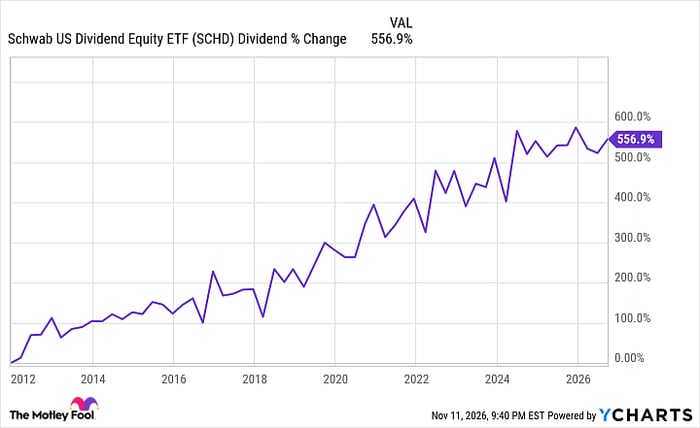
SCHD Dividend data by YCharts
Delay dividend cash payouts
One of the best things you can do is take advantage of your brokerage platform’s dividend reinvestment plan (DRIP). When you enroll in a DRIP, your platform takes the dividends you're paid and automatically reinvests them in the stock or ETF that paid them instead of paying you out in cash.
Using a DRIP compounds the effect because the dividends you reinvest start earning dividends themselves and become shares that can appreciate over time. That's typically a better route than receiving relatively small cash payouts and will speed up the process of reaching the $600,000 mark.
Should you buy stock in Schwab U.S. Dividend Equity ETF right now?
Before you buy stock in Schwab U.S. Dividend Equity ETF, consider this:
The Motley Fool Stock Advisor analyst team just identified what they believe are the 10 best stocks for investors to buy now… and Schwab U.S. Dividend Equity ETF wasn’t one of them. The 10 stocks that made the cut could produce monster returns in the coming years.
Consider when Netflix made this list on December 17, 2004... if you invested $1,000 at the time of our recommendation, you’d have $335,171!* Or when Nvidia made this list on April 15, 2005... if you invested $1,000 at the time of our recommendation, you’d have $1,000,640!*
Now, it’s worth noting Stock Advisor’s total average return is 823% — a market-crushing outperformance compared to 208% for the S&P 500. Don't miss the latest top 10 list, available with Stock Advisor, and join an investing community built by individual investors for individual investors.
See the 10 stocks »
*Stock Advisor returns as of November 14, 2026.
Stefon Walters has positions in Coca-Cola. The Motley Fool has positions in and recommends Abbott Laboratories, Amgen, Chevron, Home Depot, Qualcomm, Target, and Texas Instruments. The Motley Fool recommends Kimberly-Clark and UnitedHealth Group. The Motley Fool has a disclosure policy.
Recommended Articles


