


Nvidia Stock Falls Below $165 After Its CEO Resigns: Is It a Bargain Buy?
Key Points
Nvidia shares fell after co-founder Jensen Huang resigned as CEO, effective immediately.
The company says its operations, customer commitments, and product roadmap won't be interrupted.
The stock is now about a third below its high, but the Nov. 17 earnings report is the next big test.
- Motley Fool Issues Rare "Total Conviction" Buy Alert ›
Nvidia (NASDAQ:NVDA) shares fell to roughly $165 this week, after the company announced that co-founder Jensen Huang had resigned as president and CEO, effective immediately. He also left the board. CFO Colette Kress will serve as the interim CEO of the tech giant, while the board searches for a permanent replacement. The search will include both internal and external candidates.
The SEC filing announcing Huang's resignation doesn't give a reason, but the board was reportedly considering ousting Huang over several recently revealed personal conduct issues, including reports of an affair with a woman whom U.S. intelligence officials reportedly suspected of working for Chinese intelligence, allegations China has denied. I won't rehash the recent news too much, but wanted to focus on one question that is likely on many investors' minds. After the recent drop, Nvidia trades about 33% below its all-time high, set less than six weeks ago. Is this a buying opportunity?
Missed Nvidia in 2009? This Rare Signal Is Flashing Again. In 2009, a "Double Down" signal flashed for a little-known chipmaker called Nvidia. For the first time in years, that same "Total Conviction" signal is flashing for a company 1/100th the size of Nvidia. Continue »
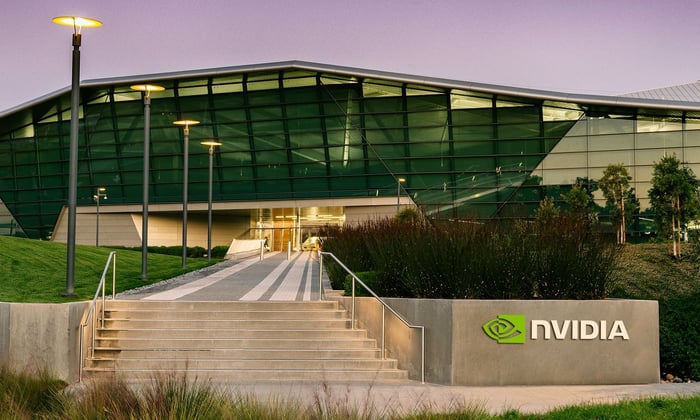
Image source: Nvidia.
Nvidia's business hasn't changed
Nvidia's board says it expects operations, customer commitments, and the product roadmap to continue without interruption. And to put it mildly, Nvidia's business is in great shape. In the second quarter of fiscal 2027, revenue rose 106% year over year to $96.2 billion, and data center revenue jumped 117%. Management guided for about $108 billion in third-quarter revenue.
Speaking of third-quarter revenue, Nvidia is set to report its latest results on Tuesday (Nov. 17) after the market's close, and its leadership will hold its conference call at 5 p.m. ET. So, we'll have updated numbers in the very near future.
A big leadership shake-up
Of course, Huang wasn't just any CEO. He co-founded Nvidia and led it for more than three decades, and its early bet on AI computing was largely his vision. He was the face of Nvidia's success and arguably the public face of the entire AI boom.
Nvidia's board moved quickly to fill the gap. CFO Colette Kress is now serving as interim CEO and will keep her CFO duties until the board names a permanent leader. Kress has led Nvidia's finance organization since 2013, and before that she spent nearly 25 years in finance roles at technology companies such as Cisco (NASDAQ:CSCO) and Microsoft (NASDAQ:MSFT).
The board also named Harvey Jones, the former CEO and executive chairman of chip-design software company Synopsys (NASDAQ:SNPS), as its first-ever chair. That's a big change for a company so closely tied to its founder, and appointing a chair from outside management could give the board more oversight as it looks for Huang's replacement.
As mentioned in the last section, the first major test comes on Nov. 17, when Nvidia reports third-quarter results. I'll be listening closely for any change in tone about demand, the product roadmap, and the CEO search.
Is Nvidia a bargain?
Here's the million-dollar question, and it's a difficult one to answer.
On the surface, Nvidia's stock looks remarkably cheap. At a share price of about $163, Nvidia trades at roughly 11 times forward earnings, and this is for a wildly profitable company that just doubled its revenue. Nvidia also has a $235 billion buyback authorization in place, and the new lower share price makes each dollar it spends on repurchases go further.
On the other hand, it's fair for the market to put a discount on a company that just lost its founder without warning. Plus, the market has obviously been pricing in an eventual deceleration in revenue growth. In simple terms, at some point the numbers become too large for 100% year-over-year growth to be sustainable. And even after falling more than 30%, Nvidia is still worth nearly $4 trillion.
In short, there are solid cases to be made for and against buying the stock right now. Nvidia is on my watch list, and the recent plunge in the stock has my attention. But I'm in no rush to buy. I want to hear what management says on Nov. 17 and see how the CEO search starts to take shape before I make a decision. The bottom line is that if the business keeps executing as it has, today's price could look like a bargain in hindsight, but I'm happy to wait a few days for the dust to settle.
Should you buy stock in Nvidia right now?
Before you buy stock in Nvidia, consider this:
The Motley Fool Stock Advisor analyst team just identified what they believe are the 10 best stocks for investors to buy now… and Nvidia wasn’t one of them. The 10 stocks that made the cut could produce monster returns in the coming years.
Consider when Netflix made this list on December 17, 2004... if you invested $1,000 at the time of our recommendation, you’d have $338,083!* Or when Nvidia made this list on April 15, 2005... if you invested $1,000 at the time of our recommendation, you’d have $1,021,163!*
Now, it’s worth noting Stock Advisor’s total average return is 830% — a market-crushing outperformance compared to 209% for the S&P 500. Don't miss the latest top 10 list, available with Stock Advisor, and join an investing community built by individual investors for individual investors.
See the 10 stocks »
*Stock Advisor returns as of November 14, 2026.
Matt Frankel, CFP® has no position in any of the stocks mentioned. The Motley Fool has positions in and recommends Cisco Systems, Microsoft, Nvidia, and Synopsys. The Motley Fool has a disclosure policy.
Recommended Articles


