


Should You Really Buy Nvidia Stock After CEO Jensen Huang's Exit? Wall Street Has a Clear Answer for Investors.
Key Points
Jensen Huang resigned from his position as CEO of Nvidia following revelations of extramarital affairs, including one with an alleged Chinese spy.
Several Wall Street analysts lowered their price targets substantially after news broke regarding the affairs, but most think Nvidia stock is deeply undervalued.
- Motley Fool Issues Rare "Total Conviction" Buy Alert ›
Nvidia (NASDAQ:NVDA) has dominated the headlines in recent days. CEO Jensen Huang resigned from his position after revelations of extramarital affairs, including a relationship with a businesswoman that U.S. intelligence officials suspect was spying for China.
Nvidia's board of directors launched an investigation into the potential national security implications of the news, and Huang officially resigned on Thursday, Oct. 12, leaving the semiconductor company he co-founded more than three decades earlier. The board also appointed longtime CFO Colette Kress as interim CEO while it searches for a permanent successor.
Missed Nvidia in 2009? This Rare Signal Is Flashing Again. In 2009, a "Double Down" signal flashed for a little-known chipmaker called Nvidia. For the first time in years, that same "Total Conviction" signal is flashing for a company 1/100th the size of Nvidia. Continue »
Huang has been praised regularly for visionary leadership in recent years, and has become one of the most influential figures in the artificial intelligence revolution. Some investors worry his departure will have devastating repercussions for Nvidia. Indeed, the stock is down nearly 20% this month, and it currently sits 32% below its record high.
Read on to see what certain Wall Street analysts have to say on the topic.
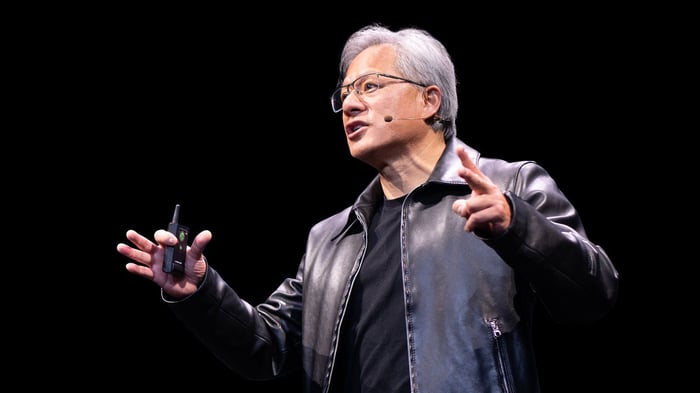
Jensen Huang. Image source: Nvidia.
Several Wall Street analysts cut their target prices substantially
Stacy Rasgon at Bernstein cut his target price in half. He now believes Nvidia is worth $200 per share, down from $400 per share. Rasgon is less concerned about the near-term consequences of Jensen Huang's departure, and more worried about how his absence might impact the company in the long run, given how closely he managed business operations and his level of involvement with customers, suppliers, and the broader AI industry.
"We aren't really worried about the near-term impacts to the business as a result of the events of the past week, and of course the shares screen extremely cheap," said Rasgon. But he does not necessarily advocate buying the dip. "We see considerable uncertainty around further news flow that is probably going to be coming down the pipe, as well as the ability of any new CEO to truly fill Jensen's shoes."
Rasgon was not the only analyst to reduce their target price substantially after Huang's exit. Ben Reitzes at Melius Research cut his target to $185 per share, down from $315, citing uncertainty beyond fiscal 2027. Tristan Gerra at Blair cut his target to $200 per share, down from $500, highlighting uncertainty about Nvidia's leadership and a potential slowdown in AI infrastructure spending in 2027.
The most severe revision came from Mark Lipacis at Evercore, who slashed his target to $186 per share, down from $465. Nvidia currently trades around 12 times forward earnings, the cheapest valuation in 15 years. But Lipacis thinks the multiple will drop further because "Nvidia has no obvious succession plan or number two operational executive." Additionally, he believes the semiconductor boom associated with the AI revolution is now in the later innings.
Most Wall Street analysts think Nvidia stock is undervalued
Several analysts maintained their target prices following news of Huang's resignation. That includes Simon Leopold at Raymond James, who reiterated his strong buy rating and target price of $515 per share. He explained his rationale in a note to clients:
"We see modest risk to fundamentals and believe the market overreacted to the recent U.S. elections. While Jensen Huang has been a standout CEO closely associated with the company, we argue that Nvidia is more than just its CEO. The AI evolution continues and Nvidia remains an important player."
Meanwhile, Matt Bryson at Wedbush reiterated his outperform rating and maintained his target price of $345 per share. He acknowledged the uncertainty surrounding the executive transition, but said strong demand for AI infrastructure coupled with Nvidia's very cheap valuation means "almost any level of uncertainty is already baked into the stock."
Finally, Joseph Moore at Morgan Stanley and Timothy Arcuri at UBS maintained their target prices of $300 per share. However, Arcuri described Jensen as a "singular force" who kept Nvidia far ahead of peers in terms of supply chain security. He also believes the national security ramifications of the situation could prompt the government to impose even tighter export controls, perhaps in regions like Singapore and Malaysia.
Here's the big picture: While some Wall Street analysts lowered their target prices following news of Huang's resignation, most still believe the stock is deeply undervalued. Indeed, Nvidia currently has a median target price of $277.50 per share, which implies 70% upside from its current share price of $163. Long-term investors should consider buying a small position today.
Should you buy stock in Nvidia right now?
Before you buy stock in Nvidia, consider this:
The Motley Fool Stock Advisor analyst team just identified what they believe are the 10 best stocks for investors to buy now… and Nvidia wasn’t one of them. The 10 stocks that made the cut could produce monster returns in the coming years.
Consider when Netflix made this list on December 17, 2004... if you invested $1,000 at the time of our recommendation, you’d have $338,083!* Or when Nvidia made this list on April 15, 2005... if you invested $1,000 at the time of our recommendation, you’d have $1,021,163!*
Now, it’s worth noting Stock Advisor’s total average return is 830% — a market-crushing outperformance compared to 209% for the S&P 500. Don't miss the latest top 10 list, available with Stock Advisor, and join an investing community built by individual investors for individual investors.
See the 10 stocks »
*Stock Advisor returns as of November 14, 2026.
Trevor Jennewine has positions in Nvidia. The Motley Fool has positions in and recommends Evercore and Nvidia. The Motley Fool has a disclosure policy.
Recommended Articles


