

Cerebras Q3 Earnings Preview: OpenAI Compute Delivery and Margins in Focus as Wall Street's Highest Price Target Hits $325

Source Tradingkey

TradingKey - Cerebras (CBRS) will report its third-quarter 2026 financial results after the market close on November 12, Eastern Time, and host a conference call at 5:00 p.m.

Cerebras is an AI chip company with wafer-scale processors and high-performance computing systems at its core, providing compute power for large model training and inference.

On November 12, as of press time, Cerebras shares were down 1.2% at $99.87 in premarket trading. The market is focused on whether the company can continue to expand its AI inference service revenue and the impact of data center expansion on profit margins.
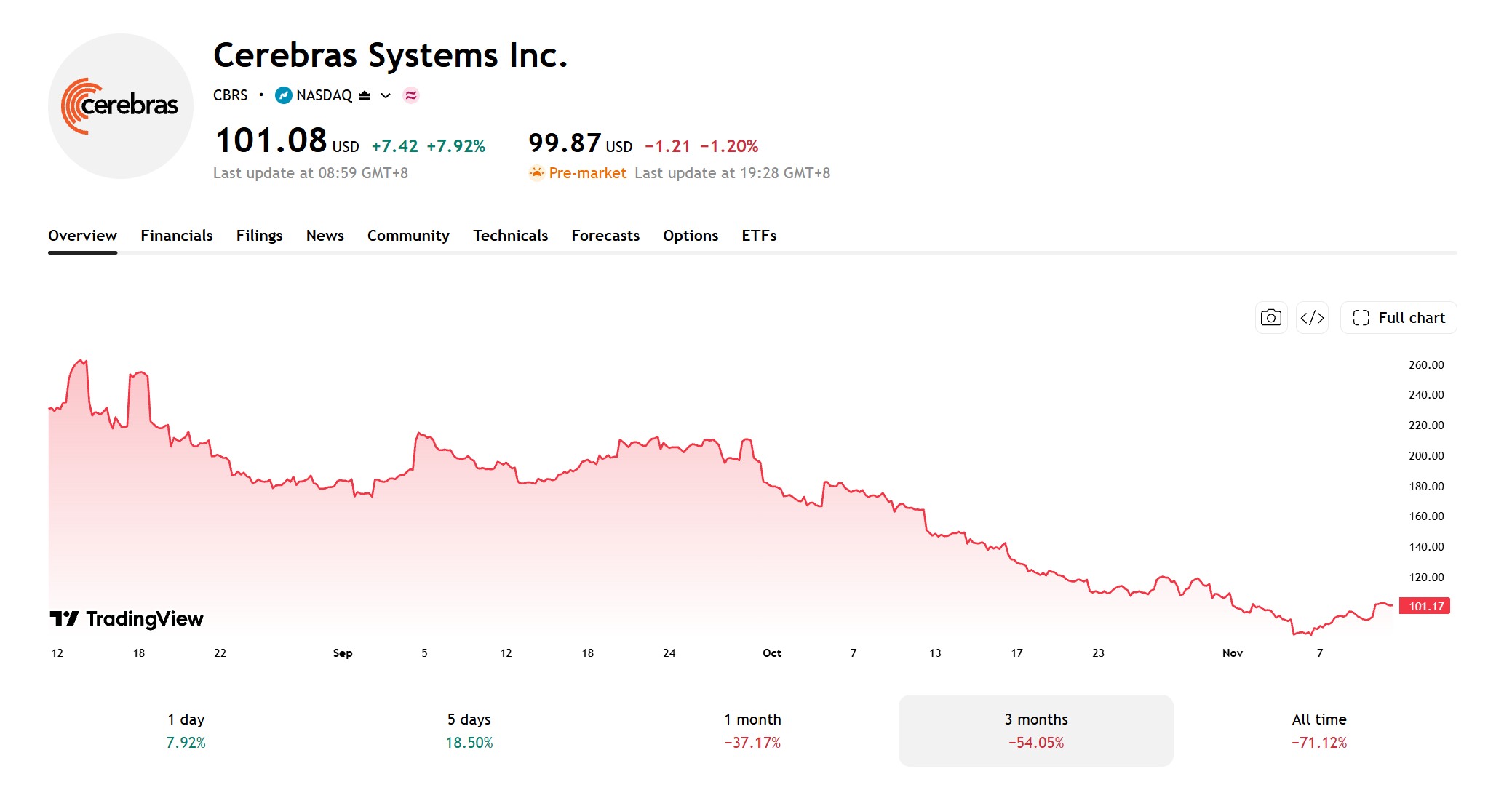
crbs-1-2-a9e4e424a229479396b047cc9d5d7a20

[Source: TradingView]

Market Expectations Near High End of Company Guidance

Cerebras expects third-quarter core revenue of $214 million to $216 million. Market consensus compiled by Zacks stands at $215.82 million, near the upper end of the company's guidance.

In the second quarter, Cerebras reported GAAP revenue of $180 million, up 74% year-over-year, and core revenue of $210 million, up 103% year-over-year.

Of that total, GAAP revenue from cloud and other services was $126 million, up 281% year-over-year. However, the company posted a GAAP net loss of $450.5 million for the quarter, continuing to face significant profitability pressure.

OpenAI Compute Delivery and Margin Performance in Focus for Q3 Earnings

In the second quarter, Cerebras' core gross margin was 40.6%, and its core operating margin was -16%. The company expects the two metrics to decline to 38%–40% and -25% to -23%, respectively, in the third quarter, with the core operating margin projected to deteriorate further.

CFO Bob Komin stated that the third quarter may be the trough for core gross margin, and margins are expected to improve in the fourth quarter as proprietary compute systems are brought online.

Delivery of OpenAI orders is another major highlight. OpenAI has committed to purchasing 750 megawatts of AI inference compute capacity. As of June 30, Cerebras' remaining performance obligations reached $25.4 billion, a substantial portion of which comes from the OpenAI contract.

Data center capacity that is already operational, under contract, and scheduled for delivery by the end of 2027 exceeds 600 megawatts, with subsequent revenue realization still dependent on the pace of compute deployment.

In terms of partnerships, the disaggregated inference solution co-developed with AMD is expected to enter production in the fourth quarter of 2026, while the collaboration project with AWS is scheduled to connect to Amazon Bedrock in the first quarter of 2027.

The company also raised its full-year 2026 core revenue guidance to $880 million to $890 million. Key points to watch on this call include whether full-year targets can be sustained and whether new capacity and partnership projects can be converted into revenue as planned.

Wall Street's Highest Price Target at $325

According to data compiled by StockAnalysis, 11 analysts have assigned Cerebras an average 12-month price target of $245.18, representing an upside of approximately 142.56% from its November 11 closing price of $101.08. The highest price target stands at $325 and the lowest at $170, with an overall rating of "Strong Buy."
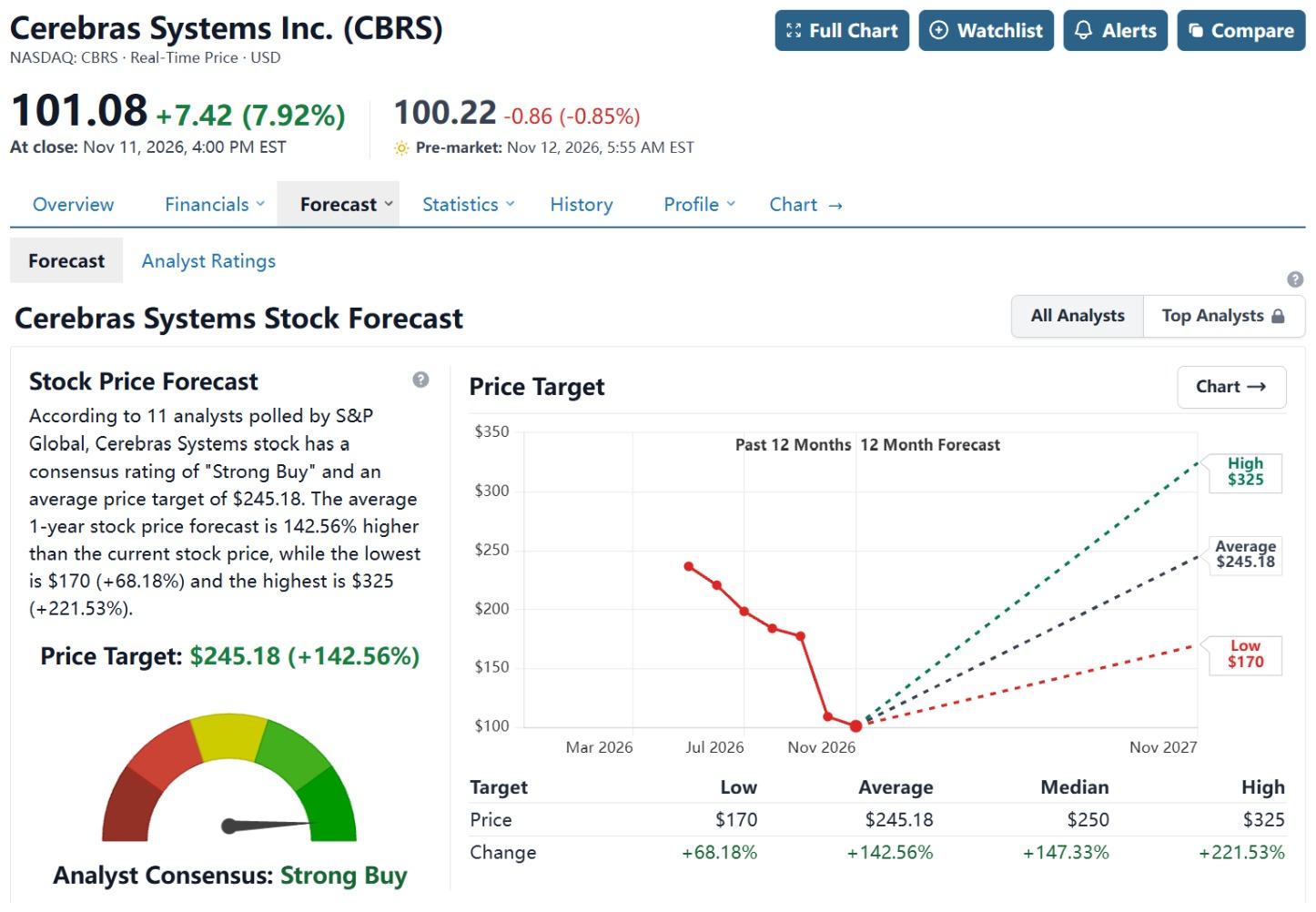
crbs-1-1-464339768e184cabaac8dc89de9d2ae3

[Source: StockAnalysis]

Recently, Morgan Stanley, UBS, and Wedbush all lowered their price targets on Cerebras to $178, $250, and $190, respectively, while maintaining their bullish ratings.

UBS remains optimistic about growth opportunities driven by OpenAI orders, CS-4 chip shipments, and partnerships with AWS, Oracle, and others. Meanwhile, Wedbush views valuation compression across the semiconductor sector as the primary reason for lowering its price target, noting that some market concerns regarding wafer-scale chip lifespan, OpenAI orders, and AI inference demand are overblown, and projecting that the company's third-quarter results could beat expectations.

If core revenue meets guidance, gross margin remains within the 38% to 40% range, and the OpenAI project delivery timeline remains unchanged, the stock price could find support. Conversely, if margins fall short of guidance or data center deployment is delayed, the market may revise down expectations for future revenue growth.

Disclaimer: For information purposes only. Past performance is not indicative of future results.
placeholder
Gold Price Analysis Today | Forex Gold Analysis | XAU/USD Analysis - November 11, 2026Get the latest gold price analysis, forex gold insights, and XAU/USD analysis for November 11, 2026. Read on for the details.
Author  Mitrade
Nov 11, Wed
Get the latest gold price analysis, forex gold insights, and XAU/USD analysis for November 11, 2026. Read on for the details.
placeholder
Bitcoin lost its 200-day average — but the exit started three sessions before the CPIBitcoin fell 2.5% to about $73,400 on 11 November, an 11-week low, breaking its 200-day moving average near $73,100. The 24-hour liquidation tally reached $632 to $705 million, roughly 82% of it longs. But spot ETF outflows began three sessions earlier and USDT's market cap has shrunk $6.6 billion in 60 days — the leveraged length left before the inflation print did. A double top at 81,890 and 81,080 leaves a measured target of 69,366.
Author  Suzie
Nov 11, Wed
Bitcoin fell 2.5% to about $73,400 on 11 November, an 11-week low, breaking its 200-day moving average near $73,100. The 24-hour liquidation tally reached $632 to $705 million, roughly 82% of it longs. But spot ETF outflows began three sessions earlier and USDT's market cap has shrunk $6.6 billion in 60 days — the leveraged length left before the inflation print did. A double top at 81,890 and 81,080 leaves a measured target of 69,366.
placeholder
Nvidia slid 7.7% after hours while AMD and Broadcom rose — the AI trade changed hands, it didn't breakNvidia closed Wednesday at 173.73, up 2.87%, then fell as much as 8.1% to 159.44 after reports that its board was preparing for a possible leadership change. The same session, the Philadelphia Semiconductor Index rose 5.7% with all 30 components higher, CoreWeave jumped 24.7% on 168% revenue growth, and Micron added 11.9%. If AI demand were being repriced, AMD and Broadcom would not be bid. This is a governance discount on one name, and 204.54 — the 200-day average — is the level that settles it.
Author  Irene Q.
Nov 12, Thu
Nvidia closed Wednesday at 173.73, up 2.87%, then fell as much as 8.1% to 159.44 after reports that its board was preparing for a possible leadership change. The same session, the Philadelphia Semiconductor Index rose 5.7% with all 30 components higher, CoreWeave jumped 24.7% on 168% revenue growth, and Micron added 11.9%. If AI demand were being repriced, AMD and Broadcom would not be bid. This is a governance discount on one name, and 204.54 — the 200-day average — is the level that settles it.
placeholder
Gold hit a one-year low while central banks bought 321 tonnes — the sellers were never the ones you thinkSpot gold closed at 3,876 on Thursday, down 2.8% and its lowest close in more than a year, with an intraday low near 3,852. The dollar is at a 19-month high of 103.21 and the 10-year yield is at 5.10%, so the price move is easy to explain. What is harder to explain is who sold: central banks bought 321 tonnes in Q3, the PBoC added for a 24th straight month, ETF holdings are near a record 4,256 tonnes, and roughly 95% of the futures selling came from non-reportable and sovereign-type accounts rather than hedge funds. This piece separates the two books that have to balance.
Author  Irene Q.
Yesterday 02: 40
Spot gold closed at 3,876 on Thursday, down 2.8% and its lowest close in more than a year, with an intraday low near 3,852. The dollar is at a 19-month high of 103.21 and the 10-year yield is at 5.10%, so the price move is easy to explain. What is harder to explain is who sold: central banks bought 321 tonnes in Q3, the PBoC added for a 24th straight month, ETF holdings are near a record 4,256 tonnes, and roughly 95% of the futures selling came from non-reportable and sovereign-type accounts rather than hedge funds. This piece separates the two books that have to balance.
placeholder
Brent rose 3.3% and US crude stocks built 4.66 million barrels in the same weekBrent January settled at 95.82, up 3.3%, and WTI at 88.74, up 2.55%, after the US signalled it would not pursue a deal with Iran and attacks on Gulf shipping continued. In the same week, EIA data showed US crude inventories rising 4.657 million barrels against expectations of a 1.1 million draw, with gasoline up another 1.799 million. OPEC output also rebounded 1.96 million barrels a day to 27.16 million in October, led by Saudi Arabia at 10.56 million. This piece separates the geopolitical premium from the physical balance and lays out where each side of the trade is anchored.
Author  Irene Q.
Yesterday 03: 06
Brent January settled at 95.82, up 3.3%, and WTI at 88.74, up 2.55%, after the US signalled it would not pursue a deal with Iran and attacks on Gulf shipping continued. In the same week, EIA data showed US crude inventories rising 4.657 million barrels against expectations of a 1.1 million draw, with gasoline up another 1.799 million. OPEC output also rebounded 1.96 million barrels a day to 27.16 million in October, led by Saudi Arabia at 10.56 million. This piece separates the geopolitical premium from the physical balance and lays out where each side of the trade is anchored.
goTop
quote