


CoreWeave Q3 Earnings Preview: Revenue Expected to Grow 159%, Debt and Financing Costs in Focus, Wall Street's Top Price Target at $278
TradingKey - CoreWeave (CRWV) will report its third-quarter 2026 financial results after the market close on November 10, Eastern Time, and host a conference call at 5:00 p.m. on the same day. As of the close on November 6, the company's shares stood at $46.40.
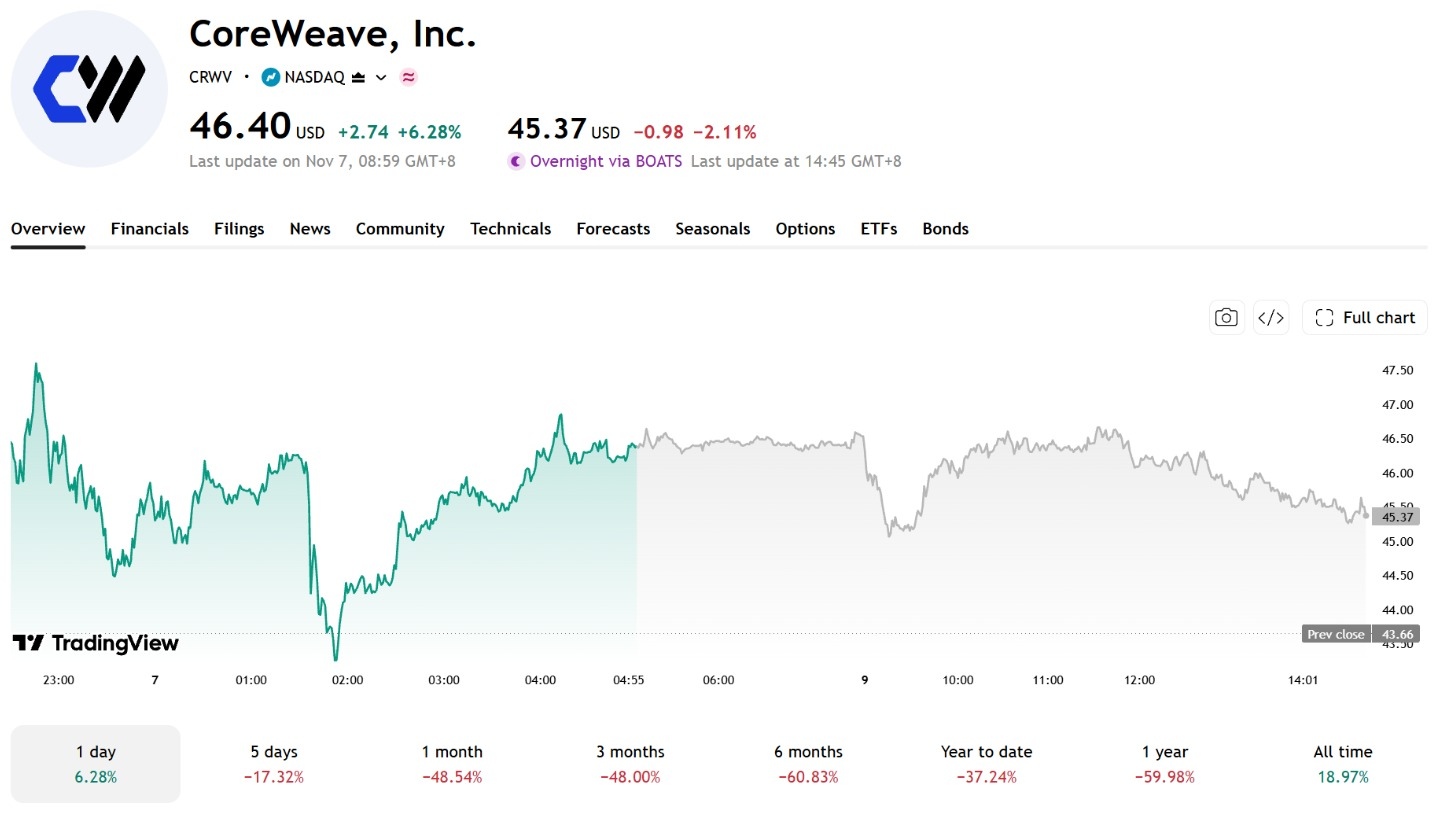
[Source: TradingView]
CoreWeave is a cloud service provider focused on artificial intelligence and high-performance computing, primarily building and operating data centers to provide GPU computing power, cloud computing infrastructure, and related software services to AI enterprises and large institutions, supporting AI model training and inference.
The market expects CoreWeave's third-quarter revenue to continue its rapid growth; however, as data center construction and compute deployment accelerate, capital expenditures, interest expenses, and subsequent financing needs are also steadily increasing.
The key to this earnings report lies in whether the company can convert its massive customer orders into actual revenue while controlling the financing costs stemming from its expansion.
Market Expectations Near Company Revenue Guidance
According to data released by Zacks on November 3, analysts expect CoreWeave's third-quarter revenue to be approximately $3.54 billion, up 159.2% year-over-year, with a loss per share of about $1.17.
The company previously provided third-quarter revenue guidance of $3.45 billion to $3.6 billion, with market consensus close to the midpoint of the range. Therefore, this earnings report requires attention not only to whether revenue meets expectations, but also to trends in compute delivery, profit margins, and financing costs.
In the second quarter, CoreWeave's revenue grew 112.5% year-over-year to $2.575 billion, but its net loss widened to $626 million, while net interest expense surged approximately 140% year-over-year to $640 million, reflecting financing cost pressures from rapid expansion.
Operationally, CoreWeave added nearly 500 megawatts of active power capacity in the second quarter, reaching 1.5 gigawatts by the end of the period, which provides support for subsequent compute delivery and revenue growth. Annualized revenue from its managed AI inference services has surpassed $100 million and is projected to reach $250 million by year-end, signaling the company's steady expansion into AI inference.
On the bookings front, as of June 30, CoreWeave's revenue backlog reached $104 billion, up 246% year-over-year. Early in the third quarter, the company secured more than $25 billion in additional customer commitments. While this massive order backlog supports future revenue growth, actual revenue remains contingent on the progress of data center construction, compute delivery, and service deployment.
Capex and Interest Expense Remain Earnings Focus
CoreWeave expects third-quarter capital expenditures of $11.5 billion to $13.5 billion, interest expense of $860 million to $940 million, and adjusted operating income of $200 million to $260 million. Meanwhile, the company raised its full-year 2026 capital expenditure guidance to $35 billion to $39 billion.
The company expects third-quarter adjusted operating income of $200 million to $260 million, lower than the projected interest expense of $860 million to $940 million for the same period. Although the accounting bases of the two metrics differ, this gap reflects the pressure high financing costs exert on the company's profitability.
Debt repayment will also test the company's liquidity management capabilities. As of the end of June, CoreWeave's total future principal repayments amounted to approximately $35.55 billion, of which about $4.413 billion matures in the second half of 2026, with the remaining approximately $31.14 billion coming due in 2027 and beyond.
In terms of cash flow, in the first half of 2026, the company generated net cash inflows from operating activities of $3.663 billion, net cash outflows from investing activities of $14.874 billion, and net cash inflows from financing activities of $13.985 billion.
Of this amount, cash expenditures for the purchase of property and equipment, including capitalized internal-use software, reached $14.117 billion, approximately 3.9 times the net cash inflow from operating activities over the same period.
This indicates that the company's existing operating cash flow is insufficient to cover its large-scale capital expenditures, leaving it reliant on debt, equity financing, and other financing arrangements to support data center expansion. As capital expenditures continue to increase, the scale and cost of subsequent financing will directly impact the company's cash flow and profitability.
Wall Street Highest Target Price Seen at $278
As of November 9, according to StockAnalysis data, the average price target of 42 analysts for CoreWeave was $131.53, about 183.5% above its November 6 closing price, with a price target range of $39 to $278.
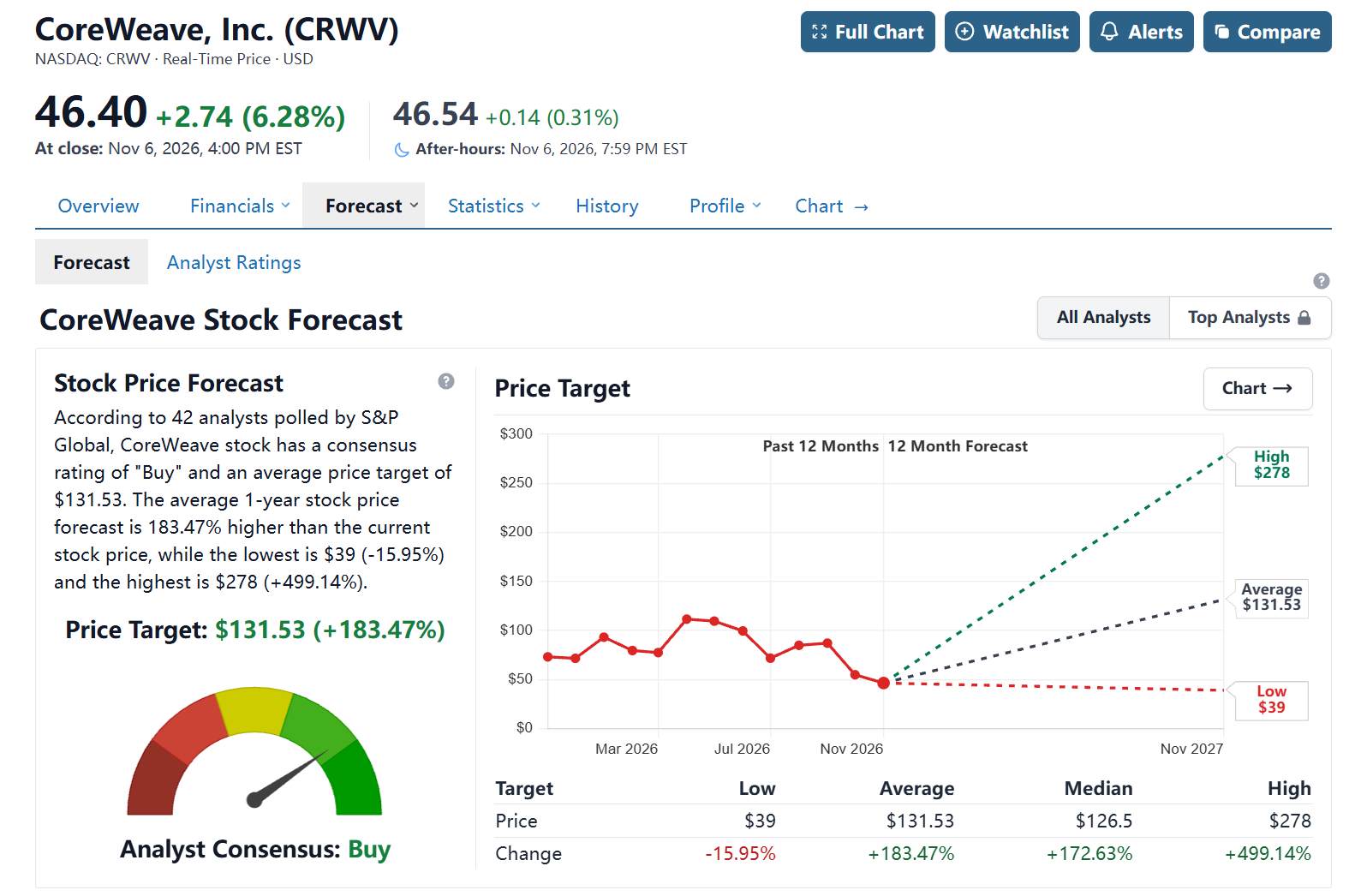
[Source: StockAnalysis]
In terms of institutional ratings, Goldman Sachs maintained a "Buy" rating with a price target of $106, estimating that the company may need an additional $20 billion to $23 billion in debt financing to fulfill existing customer orders. Meanwhile, HSBC maintained a "Sell" rating with a price target of $39.
There is a clear divergence between the two institutions: Goldman Sachs places greater emphasis on the company's order backlog and long-term business growth potential, though it also notes that fulfilling existing orders will require substantial new financing; HSBC, by contrast, remains more cautious regarding the high debt load and future profitability.
Fluctuations in the bond market also reflect financing pressures. Reuters reported on October 16 that yields on some CoreWeave bonds briefly rose to 15% to 16%, signaling rising investor concerns over the company's credit risk and debt financing model.
Overall, CoreWeave's third-quarter revenue is expected to maintain rapid growth, but the market is focusing more on the capital requirements and earnings quality behind that growth.
Whether the company can deliver computing power as planned, gradually convert its $104 billion revenue backlog into actual revenue, and simultaneously control capital expenditures and debt costs will be key to its future stock performance.
If computing power delivery lags behind schedule or new financing costs continue to rise, the company's cash flow and earnings expectations could come under pressure, thereby weighing on its stock price.
Recommended Articles


