


Rocket Lab Earnings Preview: Neutron Progress and Government Orders in Focus, Wall Street High Target at $132
TradingKey - Rocket Lab (RKLB) will report its third-quarter 2026 financial results after the U.S. market close on November 9 and host a conference call at 5:00 p.m. ET.
Unlike traditional space launch companies, Rocket Lab's business encompasses Electron small rocket launches, satellite manufacturing, spacecraft components, optical systems, and space infrastructure services.
As the U.S. government and commercial customers increase their demand for satellite deployment, the company's Space Systems business continues to expand and has become an important revenue source, supporting company growth alongside its rocket launch business.
The company has adjusted its target for the Neutron rocket's maiden flight to 2027. In addition to quarterly revenue, the outlook for the next quarter, rocket testing, and the execution timeline of government contracts will influence market expectations for growth in 2027.
On November 4, Rocket Lab shares closed at $45.99 for the day, down nearly 70% from the interim high of $151 reached on May 27, giving back most of their prior gains.
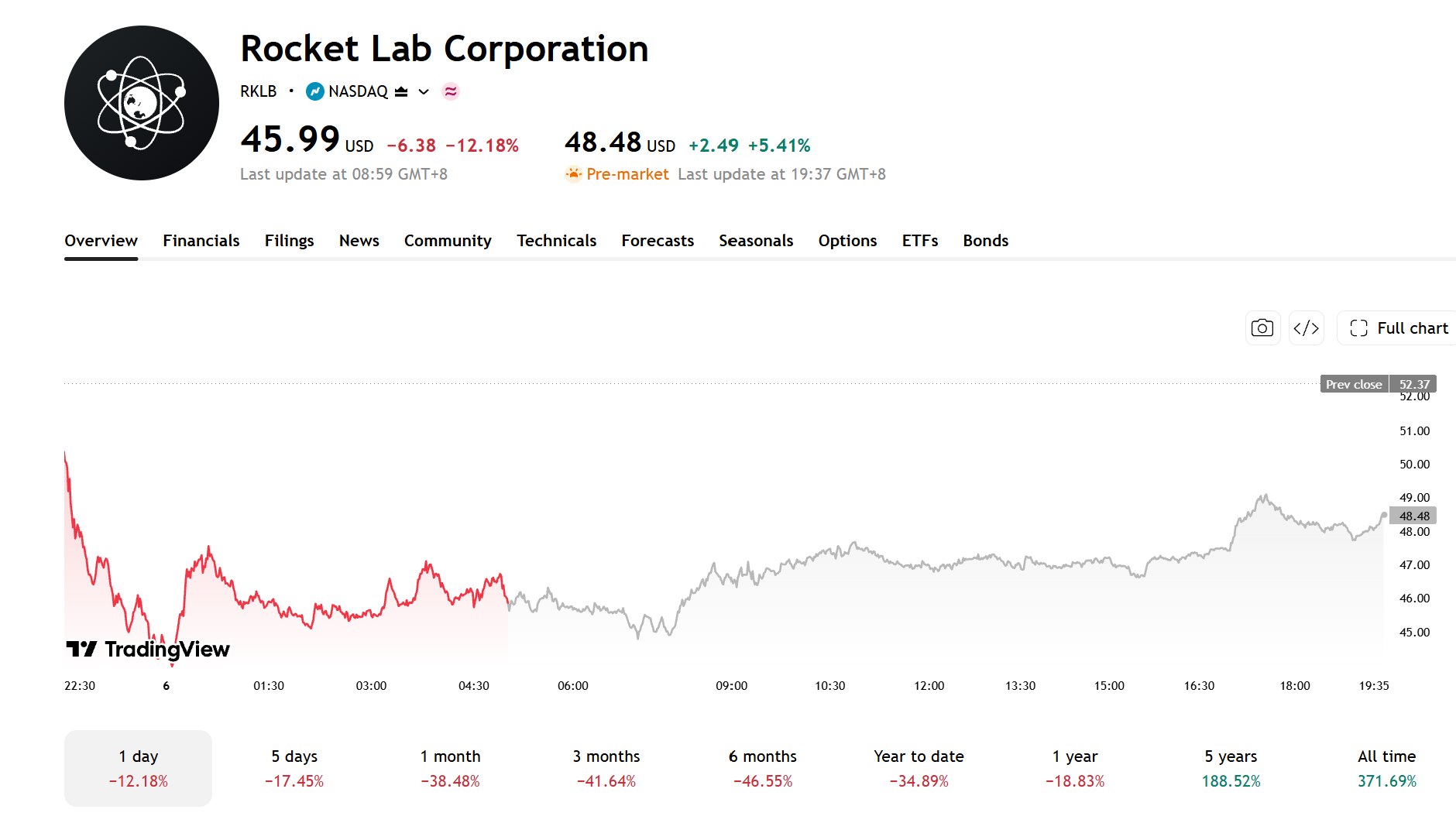
[Source: TradingView]
Market Expectations Largely in Line With Company Guidance
According to MarketBeat data, analysts expect Rocket Lab's third-quarter revenue to reach approximately $257 million, representing a year-over-year increase of about 66%, with a loss per share of around $0.07. The company provided revenue guidance of $250 million to $265 million, with a midpoint of $257.5 million, broadly in line with market expectations.
In terms of profitability, the company expects its third-quarter GAAP gross margin to range between 29% and 31%, down from 36.1% in the second quarter, while projecting an adjusted EBITDA loss of $17 million to $23 million. Therefore, beyond whether revenue meets expectations, gross margin trends and progress in narrowing losses are also critical metrics to watch in this earnings report.
Looking back at the second quarter, Rocket Lab posted revenue of $234 million, up 62% year over year, and ended the period with a backlog of $2.36 billion, up 137% year over year. Of this backlog, approximately 45% is expected to be recognized as revenue over the next 12 months, though the actual pace remains contingent on project deliveries and launch schedules.
By business segment, product revenue was approximately $181 million, up about 96% year over year, primarily driven by satellite manufacturing and spacecraft components, while service revenue was approximately $52.7 million, up about 2% year over year, comprising rocket launches and related space services.
In addition, the company secured a satellite program contract from the U.S. Space Force worth up to approximately $397 million, as well as satellite manufacturing contracts exceeding $160 million, further expanding the backlog of its government business.
Q3 Earnings Highlights: Neutron Maiden Flight Progress and Government Contract Deliveries
Neutron's development progress and government contract deliveries are key focal points of this earnings report.
Neutron is a critical project for Rocket Lab's medium-to-long-term growth. Compared to the existing Electron small rocket, Neutron is a medium-lift reusable launch vehicle primarily designed for large satellite launches, commercial satellite constellations, and U.S. government and defense missions. Once successfully operational, the company will have the opportunity to secure larger launch orders and expand its commercial space market share.
The company has secured multiple Neutron-related contracts. In the second quarter, Rocket Lab won a contract valued at up to approximately $397 million from the U.S. Space Force for the Flatellite satellite project to manufacture multiple satellites, with launches planned aboard Neutron.
However, the project timeline was recently adjusted. Rocket Lab announced on October 14 that Neutron's maiden launch has been postponed from the original target of 2026 to 2027. The company stated that it continues to advance key component manufacturing and testing while optimizing production processes to ensure the rocket meets first-flight requirements.
While this delay has a relatively limited impact on short-term revenue, it could postpone related launch missions and subsequent order fulfillment, while also weighing on market expectations for the company's medium-to-long-term growth. Therefore, on this earnings call, investors will focus closely on first-stage body manufacturing, Archimedes engine testing, second-stage system verification, and the updated maiden flight timeline.
Regarding government orders, Rocket Lab recently secured two U.S. Space Force contracts.
One contract has a potential total value of $266 million, covering 12 suborbital launches and up to 6 additional launches, with the first launch expected no earlier than late 2026.
The other contract carries a potential total value of $397 million, involving the design, manufacturing, launch, and operation of multiple Flatellite satellites under the SB-AMTI program, with the satellites planned to be launched by Neutron.
Looking ahead, key areas to monitor include the suborbital launch schedule, satellite manufacturing progress, and the exercise of contract options. In particular, the satellite launches under the $397 million contract depend on Neutron's development and maiden flight progress. Both contract amounts include options, and actual revenue will ultimately depend on contract execution and option exercises.
Wall Street's Highest Price Target Reaches $132
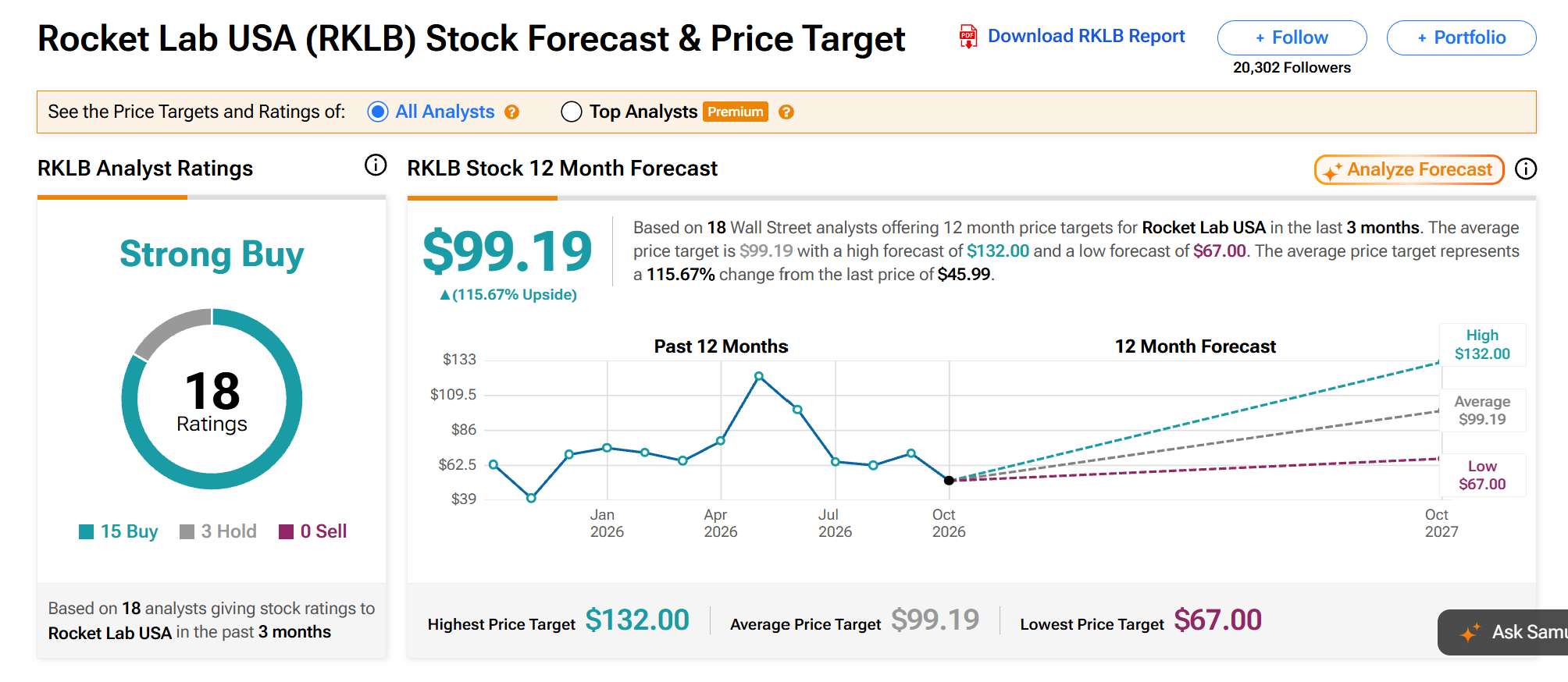
[Source: TipRanks]
As of November 6, according to TipRanks, 18 analysts have rated Rocket Lab over the past three months, with an average price target of $99.19, implying 115.67% upside from the current stock price; the high target is $132 and the low is $67.
Among them, Stifel maintained a "Buy" rating and a $132 price target on October 15, while Goldman Sachs (GS) maintained a "Hold" rating and lowered its price target from $75 to $67.
The wide divergence in analyst price targets reflects differing market expectations regarding Neutron's development progress, government contract deliveries, and the company's future profitability.
If this quarter's revenue and margins meet guidance, government programs advance as planned, and management provides a clearer timeline for Neutron testing, RKLB shares could find support. However, if gross margins fall short of expectations, project deliveries are delayed, or the maiden flight is postponed again, 2027 earnings expectations could still come under pressure even with rapid revenue growth.
Recommended Articles


