


Brent slips to $111 as a two-day Hormuz plan lands — the supply-risk premium is the only thing being sold


Mitrade Insights — Brent crude fell 1.95% to $111.20 on Monday and WTI dropped 1.70% to $101.92, even after two tankers — including a VLCC — were reported struck by mines in the Strait of Hormuz on Sunday. The trigger was diplomatic, not physical: Iran's foreign minister said a Qatar-brokered proposal had been compressed from seven days to two, with US measures on day one and a reopening of the strait on day two. Washington has not publicly responded. OPEC+ kept its December output target unchanged for a third month. The market is not selling oil. It is selling the premium attached to the risk that oil stops moving.
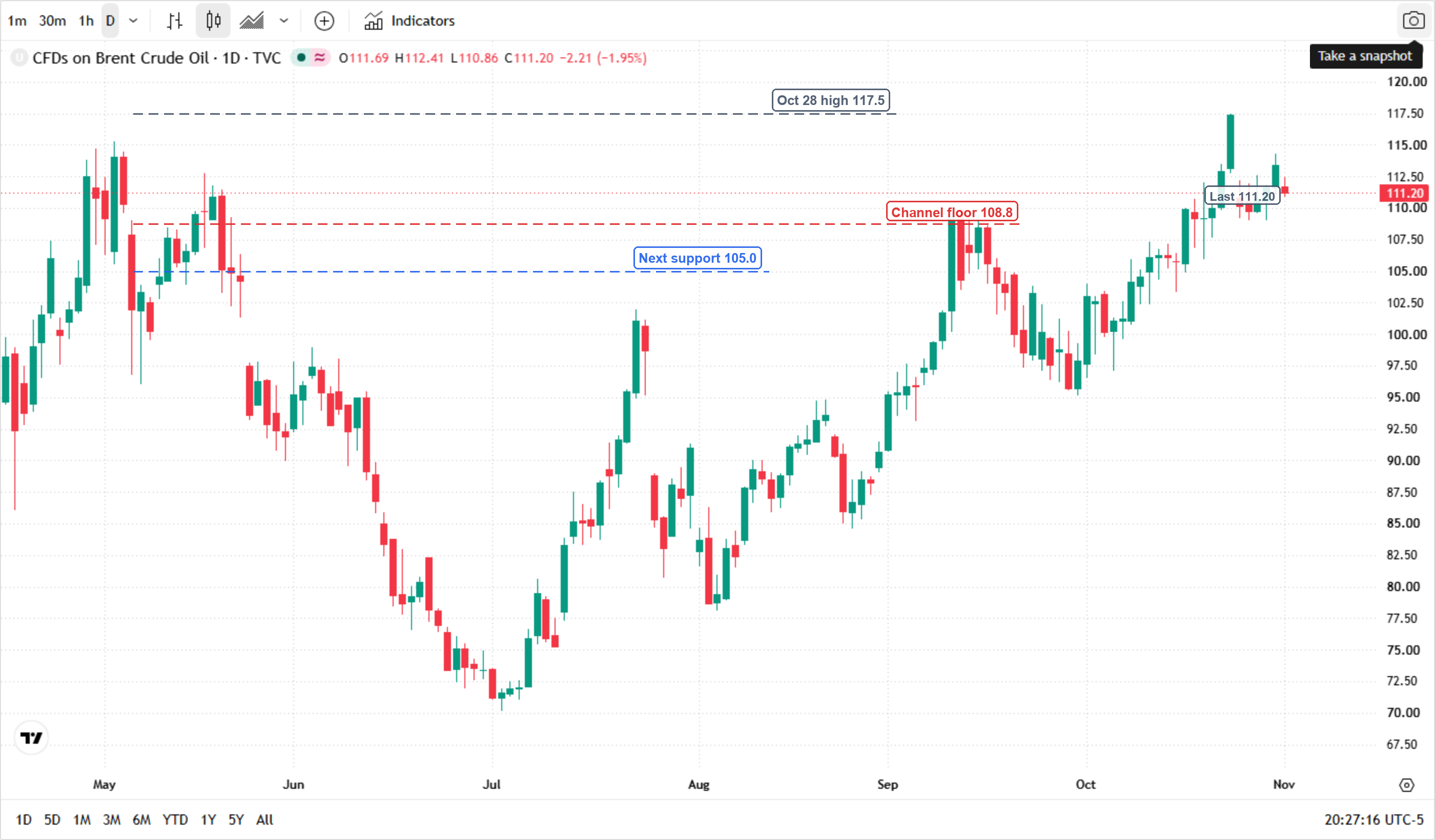
* Chart source: TradingView (UKOIL daily).
The contradiction: mines in the water, offers on the table
Two tankers were reportedly hit by mines in the strait on Sunday. That is a physical event. Brent still fell almost 2%. The reason is that the market had already priced a much larger disruption than the one that has actually occurred. When a two-day reopening plan appears — even an unconfirmed one — the first trade is to cut that excess premium, not to wait for the first barrel to move.
What the two-day plan actually says
According to Iran's foreign minister, the Qatar-brokered framework would work in two steps: day one, the US implements a package of measures; day two, the Strait of Hormuz reopens and shipping returns to normal. Tehran's conditions include sanctions relief and recognition of designated shipping routes. The US has not publicly accepted the framework, and there is no timeline. That is why the move is a repricing, not a resolution.
Why price fell before Washington responded
Because the position was crowded. Brent had rallied to 117.5 on October 28, a level that priced a prolonged closure, not a two-day plan. Once the plan was on the tape, the risk-reward for holding the premium flipped. The fall is the market taking insurance off the table before the claim is settled.
Decomposing $111.20: how much is supply risk?
There is no clean way to separate "war premium" from "fundamentals" in a single number, but the spreads tell you where the stress sits.
| Input | Level | What it tells you |
|---|---|---|
| Brent front month | $111.20 | Down 1.95% on the day; still above the August range |
| WTI front month | $101.92 | Down 1.70%; US benchmark lagging |
| Brent–WTI spread | $9.28 | Seaborne risk is still priced; a pure demand story would compress this |
| OPEC+ December output | Unchanged | Third straight month; no physical relief from the group |
| Hormuz status | Not normalized | Mines reported Sunday; insurance and route risk remain |
The $9.28 Brent–WTI spread is the tell
A widening Brent–WTI spread is what a supply-risk premium looks like: the seaborne benchmark carries the risk, the landlocked US benchmark does not. At $9.28, the spread is still wide enough to say the market has not abandoned the supply story. If the two-day plan were fully believed, this spread would compress first — and it has not.
OPEC+ is not adding barrels
The group kept its December target unchanged for a third month. That matters because a diplomatic reopening without additional barrels would still leave the market tight. The bear case for oil is a demand story, not a supply story — and the demand data this week is not weak enough to carry it alone.
108.8 is the line that decides whether the premium keeps unwinding
The technical map is simple. Brent is trading at 111.20, just above the rising channel floor at 108.8. A clean break below 108.8 would say the market is done pricing the closure and is moving to the next support at 105.0. A reclaim of 117.5 would say the two-day plan is not believed.
| Level | Price | What it means |
|---|---|---|
| October high | 117.5 | Reclaim = premium rebuilds |
| Spot | 111.20 | Mid-channel; the plan is priced, not resolved |
| Channel floor | 108.8 | Break = unwind toward 105.0 |
| Next support | 105.0 | Below = 101–102 area |
The line to watch is 108.8, not the headline. A diplomatic headline can move Brent $2 in an hour; the channel floor decides whether the move sticks.
The calendar: day one, day two, and the first real test
The two-day plan gives the market a timetable for the first time. That is why the reaction was so fast — and why it can reverse just as fast if day one does not happen.
| When | Event | If it delivers | If it stalls |
|---|---|---|---|
| Day 1 | US measures under the framework | Brent tests 108.8; spread compresses | Premium rebuilds toward 114–117.5 |
| Day 2 | Hormuz reopening and normal navigation | Next support 105.0 | Insurance risk stays; 111–115 range |
| Nov 6 | US October payrolls | Weak demand adds a second bear driver | Firm demand keeps the floor at 108.8 |
| Dec 1 | OPEC+ meeting | Output increase would confirm the unwind | No change keeps the market tight |
The base case is a 111–115 range until day one is either implemented or denied. A break of 108.8 is the market's way of saying the plan is real; a reclaim of 117.5 is its way of saying it is not.
Read more
* The content presented above, whether from a third party or not, is considered as general advice only. This article should not be construed as containing investment advice, investment recommendations, an offer of or solicitation for any transactions in financial instruments.


