


Apple M6 and First Touchscreen MacBook Pro Officially Go on Sale Today: Can AAPL Break $355 to Hit a New All-Time High?
TradingKey - Apple (AAPL)'s next-generation Mac lineup officially went on sale on November 6, including the 14-inch MacBook Pro powered by the M6 chip, the new M6 iMac, and Apple's first OLED touchscreen MacBook Pro. This refresh covers both mainstream professional users and the high-end creator market, as Apple aims to further drive a Mac upgrade cycle leveraging chip performance, display technology, and on-device artificial intelligence capabilities.
The 14-inch MacBook Pro powered by the M6 chip is the core model in this round of new releases. The M6 features a 12-core CPU, a 12-core GPU, and dual 16-core Neural Engines, with Apple claiming up to 30% higher graphics performance compared to the previous generation, up to 25% faster AI workloads, and up to 24 hours of battery life. Starting at 15,999 yuan in the Chinese market, it is priced significantly lower than the OLED touchscreen version, making it better suited for students, developers, business professionals, and small-to-medium content creators.
The high-end MacBook Pro represents Apple's most substantial laptop design overhaul in recent years. The new machine features a PROLED XDR display built with tandem OLED technology, supporting a 120Hz variable refresh rate, up to 2,000 nits of peak brightness, and touch input, while bringing a Dynamic Island-like interface to the Mac for the first time. The 14-inch and 16-inch versions are powered by M5 Pro or M5 Max chips, respectively, primarily targeting video production, artificial intelligence development, 3D modeling, and other heavy professional workloads.
Unlike past upgrades that simply boosted computing performance, Apple placed greater emphasis on on-device AI this time. The new chips accelerate local code generation, image processing, video editing, and language model inference, allowing certain artificial intelligence tasks to run without relying entirely on cloud servers. As macOS 27 and Apple Intelligence features gradually roll out, the Mac is becoming a critical endpoint in Apple's AI strategy, while also helping the company establish a product experience distinct from Windows PCs through hardware-software synergy.
However, the touchscreen MacBook Pro's high price tag could affect its pace of adoption. Starting at $2,899 in the U.S. market and 22,999 yuan in the Chinese market, the top-tier configuration even exceeds 100,000 yuan. While OLED, touch capabilities, and local AI can attract professional users, whether everyday consumers are willing to pay a substantial premium for these features remains to be seen through initial orders, delivery lead times, and holiday shopping season sales.
The Mac business is growing in importance for Apple. Apple's regulatory filings show that Mac sales were approximately $37.9 billion in fiscal 2026, up from $33.7 billion in the prior fiscal year. If the new products can sustain this growth, it will not only help improve the hardware revenue structure, but could also raise the share of high-end models and average selling prices.
Source: TradingView
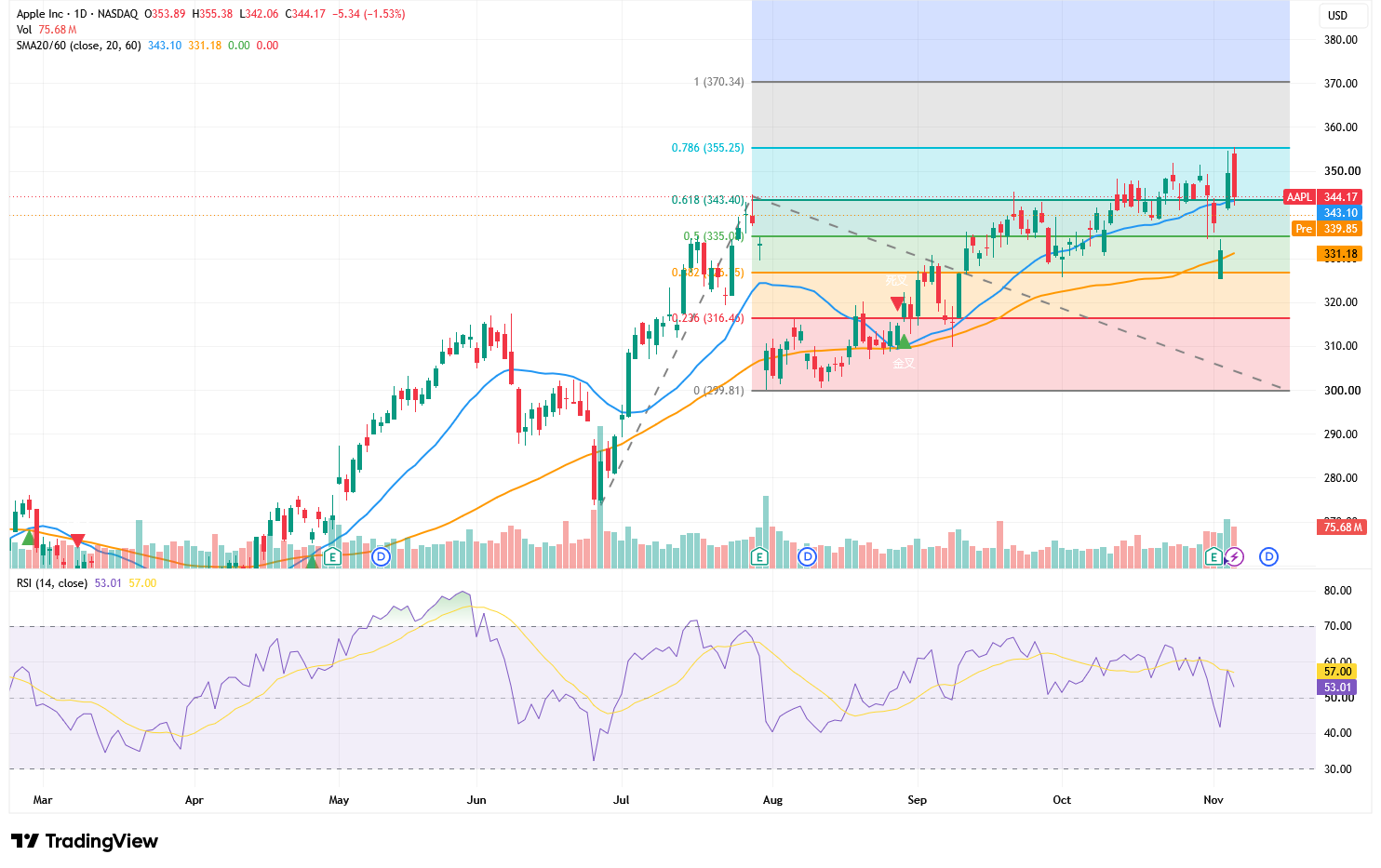
From a technical perspective, Apple's share price touched an intraday high of $355.38 before pulling back to close at $344.17, indicating evident profit-taking pressure near $355. This level also corresponds to the 0.786 Fibonacci retracement level of $355.25, representing a key resistance hurdle that must be broken before reaching new all-time highs.
Currently, the stock remains slightly above its 20-day moving average of $343.10 and the 0.618 retracement level of $343.40, while staying above the 60-day moving average of $331.18 over the medium term, leaving the overall upward trend intact. However, pre-market prices pulled back to $339.85, indicating that $343–$344 has become the short-term bull-bear dividing line. If the stock cannot quickly reclaim this zone, it could pull back further to test $335, with attention subsequently turning to the $331–$327 support band.
The RSI currently stands at 53.01 and has dropped below its signal line of 57, indicating that short-term momentum has cooled but has not yet entered weak or oversold territory. If new product sales deliver strong performance—particularly if OLED touchscreen models experience delivery delays or exceed demand expectations—the market could revise Mac revenue and earnings forecasts upward, driving the stock to break out above $355–$356 on heavy volume, with the upside target at the 1.0 Fibonacci level of $370.34. If $331 fails to hold, however, the upward structure will noticeably weaken, and the stock could retest near $316.
Recommended Articles


