


$10,000 in Rocket Lab at Its Record High Is Worth About $3,900 Today. Here's What Gets That Money Back.
Key Points
Rocket Lab stock is down roughly 61% from the lifetime high it reached in May.
The company will need to continue posting strong sales growth in order for its stock to bounce back.
Rocket Lab stock may also need interest in space stocks to rebound in order to power a rebound for its stock.
- Motley Fool Issues Rare "Total Conviction" Buy Alert ›
Rocket Lab (NASDAQ: RKLB) has solidified its position as a credible and reliable provider of launch services to place payloads into Earth orbit. The company trails behind only Space Exploration Technologies in the category.
Rocket Lab's strong sales growth has translated into huge valuation gains since it went public through a merger with a special purpose acquisition company (SPAC) in August 2021. The company's share price is up roughly 459% since its public debut. On the other hand, Rocket Lab is also currently down big from its valuation peak.
Missed Nvidia in 2009? This Rare Signal Is Flashing Again. In 2009, a "Double Down" signal flashed for a little-known chipmaker called Nvidia. For the first time in years, that same "Total Conviction" signal is flashing for a company 1/100th the size of Nvidia. Continue »

Image source: Getty Images.
Rocket Lab stock hit a lifetime high of roughly $150 per share late in May of this year. As of this writing, the stock is down roughly 61% from its peak. That means a $10,000 investment made at the height of the company's valuation surge would now be worth just $3,900.
What would it take for Rocket Lab to bounce back and reclaim its valuation?
Rocket Lab stock needs more contract wins and renewed industry momentum
While Rocket Lab stock has seen valuation drawdowns this year, the company has generally continued to post encouraging business performance. In the second quarter, the company grew its revenue 62% year over year to reach roughly $234 million. Meanwhile, Rocket Lab's order backlog grew to $2.36 billion -- up 137% year over year compared to where it stood at the end of the prior-year period.
On the other hand, the business has faced some material setbacks. The launch of the company's next-generation Neutron rocket was originally scheduled for this year, but it has now been pushed to 2027. The introduction of Neutron represents a meaningful step in scaling up Rocket Lab's operations and improving margins, and the delay has prompted investors to adopt a more cautious approach to the stock. Successfully introducing Neutron early next year could help reinvigorate bullish momentum for Rocket Lab stock.
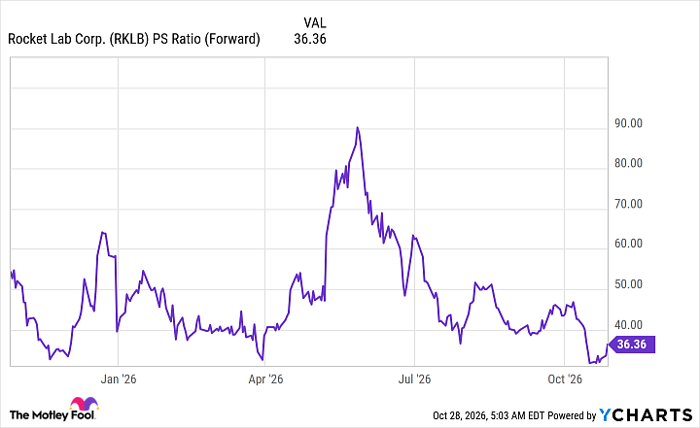
RKLB PS Ratio (Forward) data by YCharts
Rocket Lab has seen a substantial valuation pullback, and it's now valued at roughly 36 times this year's expected sales. That's still a heavily growth-dependent valuation, but it represents a huge multiple contraction relative to where the stock traded at its peak. When it comes to performance for space stocks over the last half year, this type of multiple contraction isn't unique to Rocket Lab.
Space stocks saw big valuation run-ups in the lead-up to the initial public offering of Space Exploration Technologies, but other stocks in the category have seen big multiple compressions following SpaceX's public debut. In general, bullish momentum for growth stocks has been heavily concentrated around artificial intelligence (AI) plays in the subsequent months -- and space stocks without strong AI stories have been punished.
So, in addition to posting stronger business results, Rocket Lab may need the market to reinvigorate interest in the broader space stock category to reclaim its previous valuation highs.
Missed AI’s "Act 1"? Act 2 Could Be 14x Bigger
Most investors think they missed the AI boat because they didn't buy Nvidia in 2005.
But according to our analysts, we’re only at the end of "Act 1"—the R&D phase. "Act 2" is the global rollout, a massive technology build-out that Google’s CEO says could be more profound than fire or electricity.
While everyone watches the chip designers, one "backbone" company provides the critical technology that Nvidia and AMD literally cannot function without. We’ve detailed this under-the-radar player in our new AI Playbook.
Continue »
Keith Noonan has no position in any of the stocks mentioned. The Motley Fool has positions in and recommends Rocket Lab. The Motley Fool has a disclosure policy.
Recommended Articles


