


Amazon Just Lost $42 Billion in Free Cash Flow. Is It a Red Flag for Investors?
Key Points
Amazon sold off after its Q3 report due to fears around its capex spending.
Amazon has had similar investment cycles in the past.
With strong AWS growth expected, Amazon should be able to pay for it.
- Motley Fool Issues Rare "Total Conviction" Buy Alert ›
Amazon (NASDAQ:AMZN) delivered another quarter of strong growth Thursday night, but investors were unimpressed.
The stock tumbled 7% in after-hours trading following the report, and closed the regular session down 1.4%.
Missed AI’s "Act 1"? Act 2 Could Be 15x Bigger. Most investors think they missed the AI boat because they didn't buy Nvidia in 2005. But according to our analysts, we’re only at the end of "Act 1"—the R&D phase. "Act 2" is the global rollout. Continue »
Growth on the top and bottom lines was strong, as revenue rose 17% to $201.9 billion after adjusting for foreign exchange and the shift in Prime Day, and operating income jumped 61% to $28.1 billion.
Amazon's revenue was slightly below the analyst consensus at $202.3 billion, but the biggest reason for the stock's slide is that investors are skeptical of its massive capital expenditures for AI.
The company plans to spend $220 billion on capital expenditures this year, and its finances are already feeling the weight of that decision.
In just the third quarter, Amazon reported a free cash flow loss of $33.4 billion as it spent $77.3 billion on property and equipment. That may be the largest capex outlay for any company in a single quarter, as well as the biggest FCF loss.
Over the last four quarters, it's burned $42 billion in free cash flow, an enormous sum, even for a company the size of Amazon.
For perspective, its trailing twelve-month free cash flow peaked in 2024 at $50 billion, so it's basically losing as much money as it's ever gained.
So is this a red flag for Amazon? Let's take a look at what the company's history tells us.

Image source: Getty Images.
Amazon's big spending
Amazon is the biggest company in the world by revenue, so it can more easily afford this kind of expense than a smaller company. Based on its trailing revenue of $795 billion, its free cash flow loss amounted to 5.4% of its revenue, which is comparable to the peaks of past cycles.
For example, in 2022, its trailing twelve-month free cash flow loss fell to $23.5 billion as the company ramped up spending on e-commerce fulfillment centers and cloud infrastructure as demand for both e-commerce and cloud computing spiked during the pandemic. At the time, that made up 4.8% of Amazon's revenue, or a similar percentage to where it is now.
After the ramp in spending, Amazon's capex leveled off, and revenue began to climb, quickly bringing the company back to cash flow profitability.
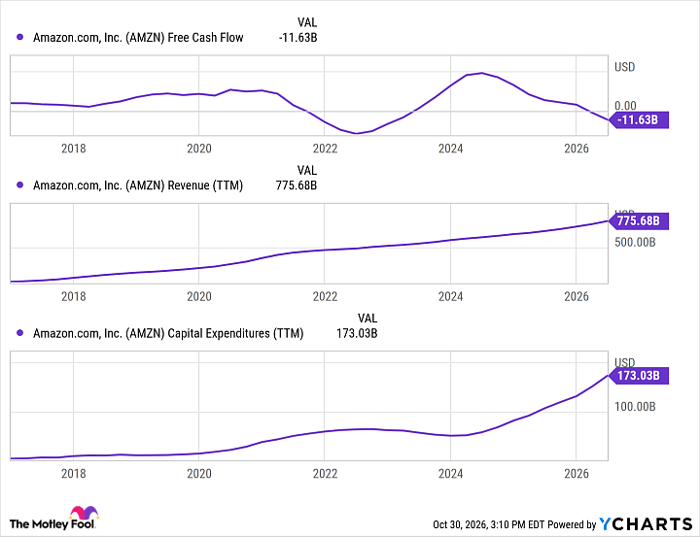
AMZN Free Cash Flow data by YCharts
Similarly, Amazon's capex spiked during the dot-com boom, dragging its free cash flow into the red. At that time, its free cash flow bottomed out at a loss of $560 million in Q2 2000, and just $2.2 billion in revenue, meaning the free cash flow loss made up more than a quarter of the company's revenue.
Amazon survived that crisis, but it did so with aggressive cost-cutting, reeling in capital expenditures from $134.8 million in 200 to $50.3 million, and it reported its first year of positive free cash flow in 2002.
What it means for investors
Investors aren't looking for a repeat of the dot-com era, and that's not going to happen. Amazon is a much different company and has grown its revenue by more than 100 times, and its core businesses are stable and profitable.
However, the experience with the pandemic-era capex boom should give investors confidence in the company's ability to manage investment cycles, and the company is on track to deliver the growth to absorb that spending. It forecast 40% growth in Amazon Web Services over the next two years, and its e-commerce business continues to deliver steady growth.
Amazon is spending even more than its peers on capex, but the company also looks better-prepared for this moment given its history with capex ramps. The company is spending a reasonable amount for its size, and it could monetize that spending through AWS. Over the long run, it should pay off.
Missed Nvidia in 2009? This Rare Signal Is Flashing Again
In 2009, a "Double Down" signal flashed for a little-known chipmaker called Nvidia. If you’d invested $5,000 then, you’d be sitting on $2,777,360 today.*
Now, for the first time in years, that same "Total Conviction" signal is flashing for a company 1/100th the size of Nvidia. It’s a key player in the $1.8 trillion space race, and with the stock recently sitting 20% off its highs, the window to get in early is closing fast.
Continue »
*Stock Advisor returns as of October 30, 2026.
Jeremy Bowman has positions in Amazon. The Motley Fool has positions in and recommends Amazon. The Motley Fool has a disclosure policy.
Recommended Articles


