


Boeing Stock Forecast: BA Holds $183.84 Support as Q3 Results Test Its Cash Flow Promise
TradingKey - Boeing (NYSE: BA) closed almost flat at $188.31 on Monday, October 26, down 0.02%, and premarket quotes sit slightly higher near $189.00. The company reports third-quarter results before the US open today, with a call at 10:30 a.m. ET.
The stock is down about 13% this year and about 26% below its 52-week high of $254.35, close to its 52-week low of $176.77. That slide has come despite a run of good news, so the report has to show that the turnaround is reaching the cash flow line.
Good News Has Not Lifted the Stock
Since the July report, the Navy selected Boeing for its F/A-XX fighter on September 29, the FAA certified the 737-10, the largest 737 MAX, on October 20, and Boeing's SPEEA engineers ratified a new contract on October 1, removing a strike threat. Yet shares fell about 15% from $221.56 on July 28, and analysts made nine downward EPS revisions in the past month.
What Wall Street Expects
Analysts expect a loss of about $0.20 to $0.21 per share, against a core loss of $7.47 a year ago, when Boeing took a $4.9 billion charge on its delayed 777X jet. Revenue is seen at about $23.8 billion to $24.4 billion, up from $23.27 billion a year earlier.
Boeing has beaten revenue estimates for six straight quarters but missed EPS estimates in seven of the last 10, often because of one-off charges. That makes the EPS headline a weak guide to how the stock trades.
Free Cash Flow Is the Number That Matters
Free cash flow is the cash left after operating costs and capital spending. In July, management guided third-quarter free cash flow to positive "low hundreds of millions" of dollars, even after a $700 million Justice Department payment, and kept its full-year target of $1 billion to $3 billion.
Most of that cash still has to come late in the year. Boeing used $823 million in the first half, even with $631 million of positive free cash flow in the second quarter. By my calculation, the fourth quarter would need roughly $1.5 billion to $3.7 billion to reach the range, so any cut to the full-year guide would be the clearest sign the recovery is slipping.
Deliveries Slowed in Q3
Boeing delivered 161 commercial jets in the third quarter, including 124 737s and 22 787s, down from 171 in the second quarter, for 475 so far this year. Production of the 737 began moving to 47 jets a month in the second quarter, and low-rate output started on a new North Line in July.
On the 777 line, Reuters reported that a dispute with supplier Vaero halted 777 freighter production for nearly two months and also disrupted 767 output, and production had not resumed after a late-September settlement.
Charges Are the Main Risk
The Commercial Airplanes unit posted a negative 2.7% operating margin in the second quarter, so higher volume still has to start covering fixed costs. The 777X first delivery is still expected in 2027, and any further slip could bring another charge. A quarter without a large new charge and with positive cash flow would matter more than the EPS figure.
Analysts Cut Targets but Stay Positive
Ahead of the report, Morgan Stanley cut to $225 from $250, RBC to $235 from $265, TD Cowen to $240 from $250 and Bernstein to $278 from $298. Even so, most still rate the stock a Buy, though Morgan Stanley is at Equal-Weight. BofA's Ron Epstein argued that the F-47 and F/A-XX wins put Boeing at the center of future US tactical aircraft. Boeing's backlog stood at a record $715 billion at the end of June, including more than 6,200 commercial jets.
Boeing Technical Analysis: 4-Hour Close Above $195.08 Could Open $204.03
That split between good news and weak cash flow shows on the 4-hour chart. BA is stuck between support at $183.84, a level that has held several times since late September, and a falling trendline from the August high, a line drawn across its lower highs that has capped each rally. Price also sits below both moving averages, which track the average price over a set period, so sellers still have the upper hand.
RSI, a momentum gauge that runs from 0 to 100, is near 45, just below the 50 midline, so momentum is neutral to slightly weak.
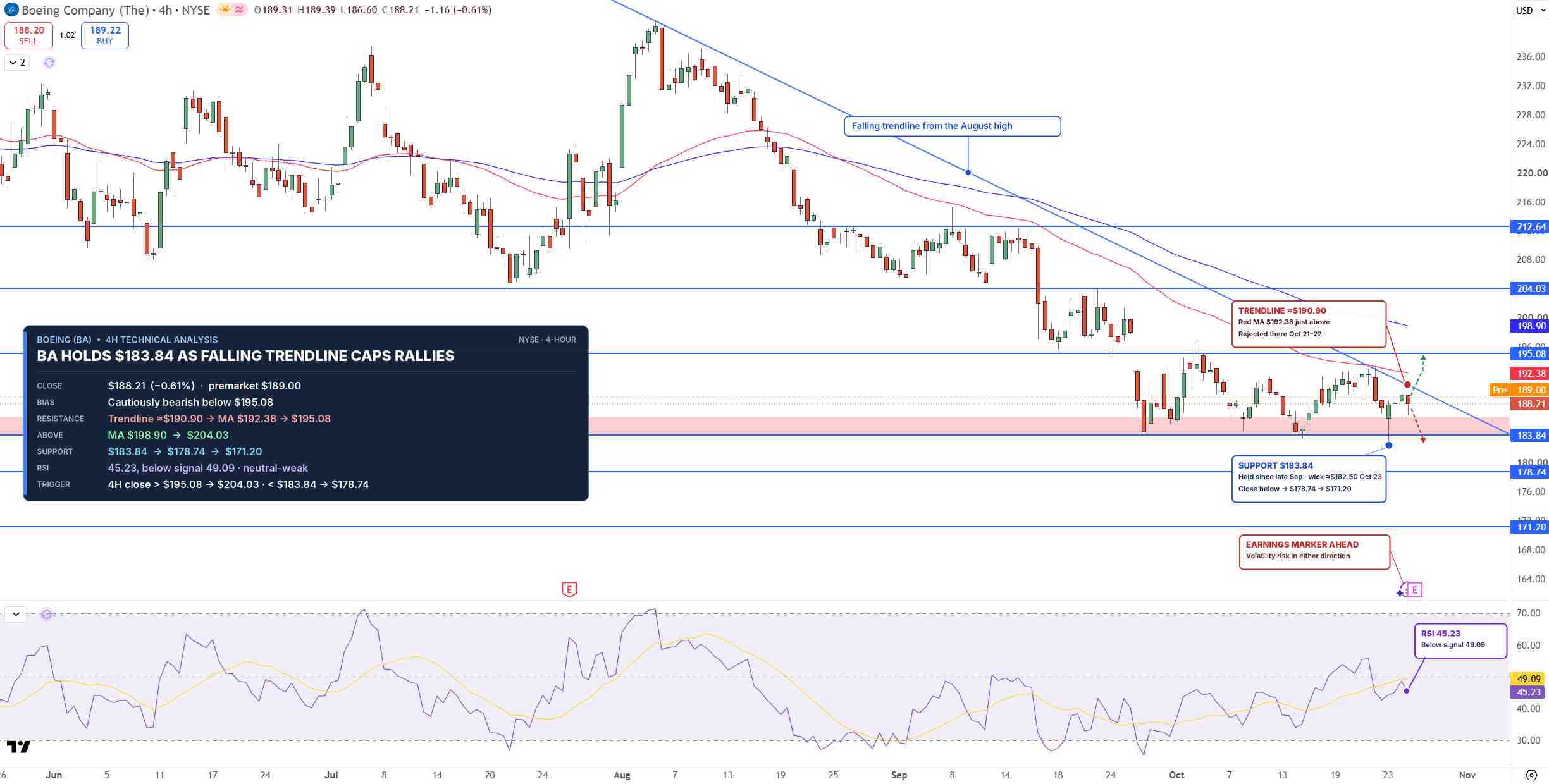
BA Price Chart - Source: Tradingview
A 4-hour close above $195.08 would break the trendline and could open $204.03. A close below $183.84 could send BA toward $178.74, just above the 52-week low, and then $171.20.
I lean cautiously bearish while BA stays below $195.08, and a break below $183.84 would confirm further downside.
Key Levels
- Last close: $188.31, down 0.02% on October 26
- Support: $183.84, $178.74, $171.20
- Resistance: $192.38, $195.08, $198.90, $204.03
- RSI: 45.23, below the 50 midline
- Bullish trigger: 4-hour close above $195.08
- Bearish trigger: 4-hour close below $183.84
FAQs
What is expected from Boeing's Q3 2026 earnings?
Analysts expect a loss of about $0.20 to $0.21 per share on revenue of about $23.8 billion to $24.4 billion. Investors care more about free cash flow and whether Boeing keeps its $1 billion to $3 billion full-year target.
What is the Boeing stock forecast?
The bias is cautiously bearish below $195.08 on the 4-hour chart. A 4-hour close above $195.08 targets $204.03, while a close below $183.84 opens $178.74 and $171.20.
Bottom Line
Boeing has the certifications, contracts and backlog, but the stock will not move on those until cash flow catches up. The level that matters is $183.84. In my view, a weak cash update that breaks it would open $178.74, while a 4-hour close above $195.08 would end the trendline's control and open $204.03.
Recommended Articles


