


Apple vs. ASML: Which Tech Stock Is a Better Buy in 2026?
Key Points
Apple maintains a massive global ecosystem and a robust services segment that provides significant recurring revenue.
ASML holds a near-monopoly on the advanced lithography machines essential for manufacturing modern semiconductors.
Which tech leader offers the most compelling balance of growth and valuation for your portfolio?
- Motley Fool Issues Rare "Total Conviction" Buy Alert ›
Should you bet on the world's most iconic consumer device brand, or the company that builds the machines required to make them? Comparing Apple (NASDAQ:AAPL) and ASML (NASDAQ:ASML) reveals two different ways to play the tech sector.
Apple dominates the high-end consumer electronics market through a tightly integrated ecosystem of hardware and services. ASML provides the essential lithography equipment used by every major chip foundry to produce advanced semiconductors. While one interacts directly with billions of users, the other operates as a critical bottleneck in the global technology supply chain.
The case for Apple
Apple generates revenue by selling consumer electronics like the iPhone while growing its services segment. Indirect distribution channels, including third-party cellular network carriers and resellers, account for roughly 60% of total net sales. The company also maintains a licensing arrangement with Alphabet (NASDAQ:GOOG) (NASDAQ:GOOGL) to offer search services on its various platforms.
In fiscal 2025, revenue reached nearly $416.2 billion, representing growth of approximately 6.4% over the prior year. Net income was close to $112 billion, yielding a net margin of 26.9%. This reflects a steady increase from the $93.7 billion in net income reported in fiscal 2024.
As of Apple’s September 2025 balance sheet, the company reported a debt-to-equity ratio of approximately 1.5. This indicates that total debt is 1.5 times shareholder equity. The current ratio of 0.9 suggests liabilities outpace liquid resources, while free cash flow reached roughly $98.8 billion in fiscal 2025.
The case for ASML
ASML manufactures the lithography systems that enable chipmakers to print patterns onto silicon wafers. This equipment is vital for the production of advanced microchips used in everything from smartphones to artificial intelligence hardware. The company operates as a primary supplier to global semiconductor manufacturers and maintains more than 60 locations worldwide.
In fiscal 2025, ASML reported revenue of nearly $36.8 billion, a 15.6% year-over-year increase. Net income for the fiscal year reached $10.8 billion, resulting in a net margin of roughly 29.4%. This performance improved upon the 2024 fiscal year, when the company earned approximately $8.5 billion in net income.
As of ASML’s December 2025 balance sheet, the company maintains a debt-to-equity ratio of approximately 0.2. The current ratio stands at nearly 1.3, indicating the company has sufficient liquid assets to cover its upcoming liabilities. During fiscal 2025, ASML produced approximately $12.5 billion in free cash flow.
Risk profile comparison
Apple faces intense global competition in its primary hardware markets, which are characterized by aggressive pricing and rapid technological shifts. The company is currently subject to significant antitrust litigation, including an ongoing 2024 DOJ lawsuit regarding alleged monopolization. Furthermore, a heavy reliance on single-source suppliers in Asia makes the business vulnerable to geopolitical tensions and trade restrictions.
ASML operates in the highly cyclical semiconductor industry, where shifts in demand can lead to volatile spending by chip manufacturers. Because its lithography machines are essential and expensive, any delay in customer orders can significantly impact quarterly results. The company also faces geopolitical risks, as governments may impose export restrictions on advanced technology to certain countries.
Valuation comparison
Apple appears more attractive based on its sales multiple, though both companies trade at similar premiums relative to future earnings estimates.
| Metric | Apple | ASML Holding N.V. |
|---|---|---|
| Forward P/E | 35.8 | 36.3 |
| P/S ratio | 10.7 | 14.2 |
Valuation metrics include sourcing from Financial Modeling Prep (FMP) and may differ from other data providers.
The P/S ratio measures a company's market value against its sales over the past 12 months.
Which stock would I buy in 2026?
Best to say it up front: I'm a longtime Apple shareholder, having bought my first shares in 2012. It's my best-performing stock, and it's not even close. So I'm a bit biased here; I obviously already think Apple is a great company, otherwise I wouldn't still own shares.
I don't think my investing thesis was particularly sophisticated. If memory serves, it was basically something along the lines of, "Shares look undervalued, seemingly everyone owns an iPhone, and I like my MacBook." (Warren Buffett, I am not.)
That said, I find ASML's positioning in the industry extremely appealing. Having a near-monopoly on the machines needed to manufacture the most advanced microchips is a great place to be. Its net margin compares favorably to Apple's, and its valuation doesn't seem unreasonable given its strong moat.
Now, turning to the historical data, Apple's stock has absolutely crushed ASML shares over time:
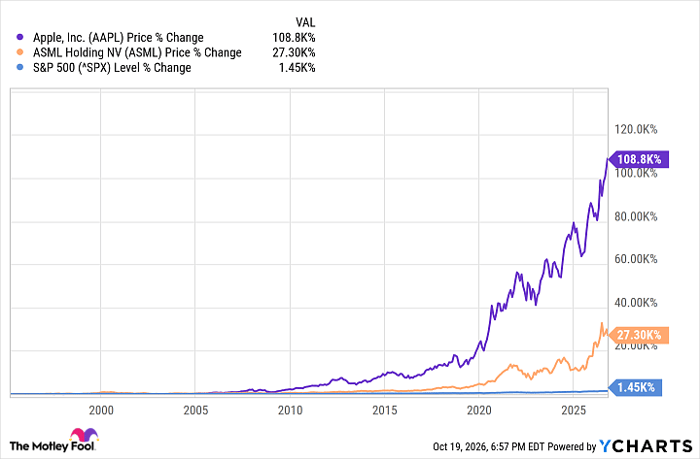
AAPL data by YCharts
But that leads me to a final, perhaps counterintuitive point that I think is in ASML's favor. Sure, Apple was a good investment for me in 2012, but we're talking about 2026. The iPhone maker is one of the biggest companies in the world now, valued in the trillions. How much more growth can we expect Apple to have in the tank? The tech titan also got a new CEO recently, which is likely nothing too worrisome; a ham sandwich can probably run the company at this point. But former CEO Tim Cook presided over the stock's incredible performance over the past 15 years, so any new person has really big shoes to fill.
This is a long way of saying that, between the two companies, Apple looks closer to a ceiling to me than ASML. Apple's not going anywhere, to be clear. People will keep buying iPhones and MacBooks, and the company's "walled garden" strategy will continue to grow and retain users. But I think if you're looking for growth, ASML looks more attractive. That's why I'd be more likely to buy shares of ASML here.
Missed AI’s "Act 1"? Act 2 Could Be 14x Bigger
Most investors think they missed the AI boat because they didn't buy Nvidia in 2005.
But according to our analysts, we’re only at the end of "Act 1"—the R&D phase. "Act 2" is the global rollout, a massive technology build-out that Google’s CEO says could be more profound than fire or electricity.
While everyone watches the chip designers, one "backbone" company provides the critical technology that Nvidia and AMD literally cannot function without. We’ve detailed this under-the-radar player in our new AI Playbook.
Continue »
Erin Kennedy has positions in Apple. The Motley Fool has positions in and recommends ASML, Alphabet, and Apple. The Motley Fool has a disclosure policy.
Recommended Articles


