


Euro slides to a 17-month low as France's budget crisis spreads — can 1.12 hold?


The euro fell to 1.1162 against the dollar on 5 October, its weakest level in 17 months, as France's budget standoff spilled out of French bonds and into the currency. The 10-year OAT yield briefly climbed above 5% — its highest since July 2002 — and the OAT-Bund spread widened to roughly 160 basis points, the widest since the 2011-12 eurozone debt crisis. EUR/USD now trades near 1.1215. With the dollar near an 18-month high and tonight's US data and Treasury auction on deck, the question is simple: does 1.12 hold?
The move
The euro was trading around 1.133 in late September and then broke down through the first week of October: 1.1162 on 5 October (the 17-month low), a marginal rebound to 1.1255 by 6 October, and a fresh slide since. The pair now sits at 1.1215, with the 1.12 handle under pressure for a fourth straight session.
The bond market tells the same story more dramatically. France's 10-year yield posted its biggest quarterly increase in nearly four decades in Q3, and French borrowing costs briefly traded above those of Greece and Italy — the two countries that defined the last European debt crisis. French equities have followed: the CAC 40 is down about 2.5% this week alone.
Why France's budget crisis is a euro story
France's problem is arithmetic meeting politics. The government's 2027 budget aims to cut the deficit from 5.4% of GDP to 5.0% — still far above the EU's 3% ceiling — while public debt of roughly €3.5 trillion (about 120% of GDP) is refinanced at progressively higher rates. With parliament split three ways, passage of the austerity measures is genuinely uncertain; Moody's reviews France's Aa3 rating with a negative outlook on 23 October.
The transmission channel into the euro is the fiscal-risk premium. When investors demand more compensation to hold French debt, they are pricing the possibility that the adjustment never happens — and a currency is the fastest instrument to express a sovereign-credit view. Two institutional voices frame the debate: Citadel's Angel Ubide warned France "has no room for error" while judging it not yet a systemic European risk, and Candriam's CIO said the stress is echoing eurozone debt-crisis levels. The ECB has pushed back on the idea of capping the spread — Bundesbank President Joachim Nagel said bond-purchase tools are not designed to target specific sovereign spreads.
The other side of the pair, and what the institutions say
The euro is not falling in isolation — it is falling against a dollar that keeps grinding higher. The dollar index sits near an 18-month high after the Fed's September minutes showed all officials backed last month's hike, with most seeing one more increase as appropriate by year-end (though not as the start of a consecutive hiking cycle). Markets price roughly 19% to 22% odds of a hike at the 27-28 October meeting.
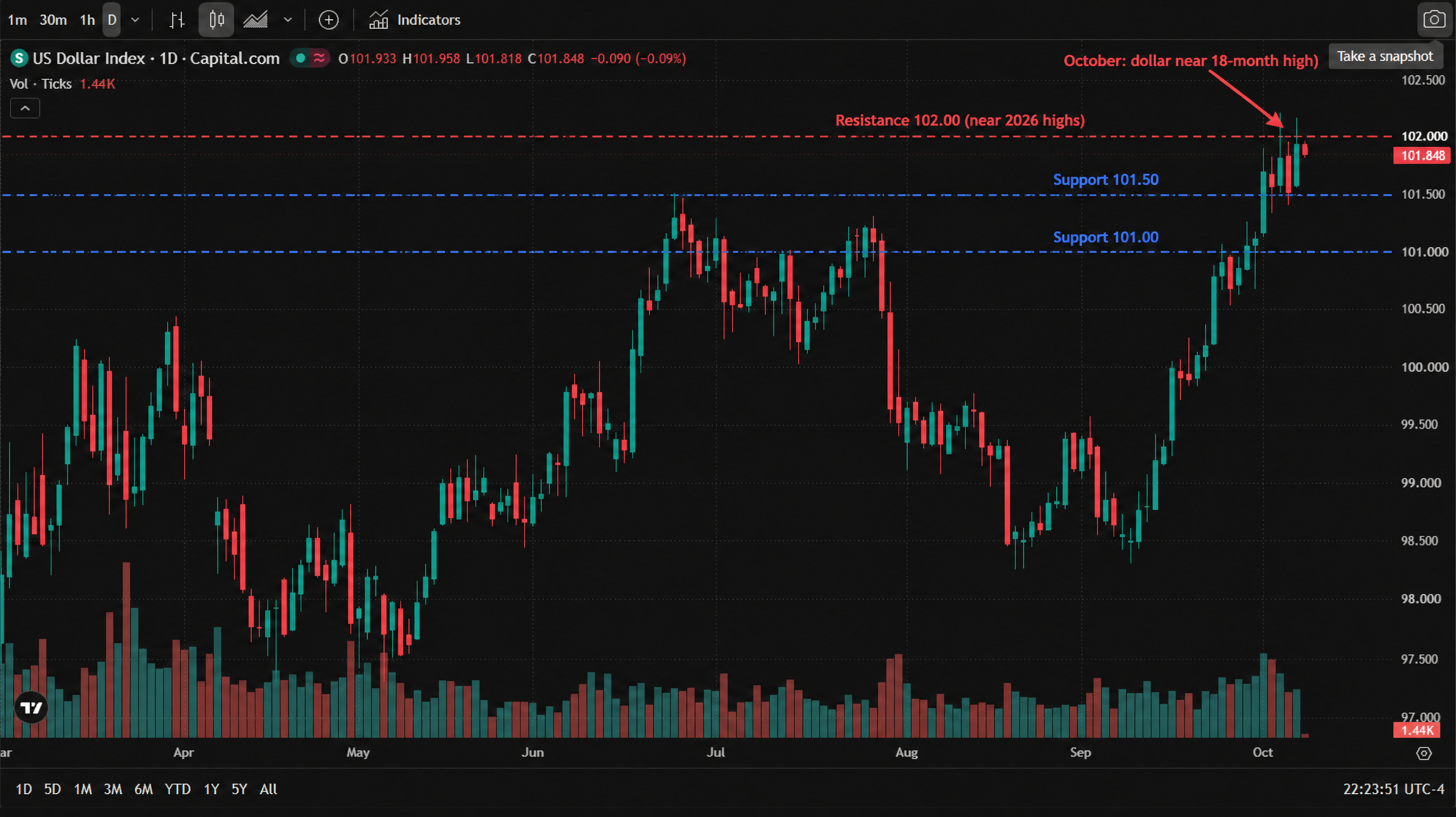
* Chart source: TradingView official chart screenshot, data source Capital.com (US Dollar Index).
Levels and technicals
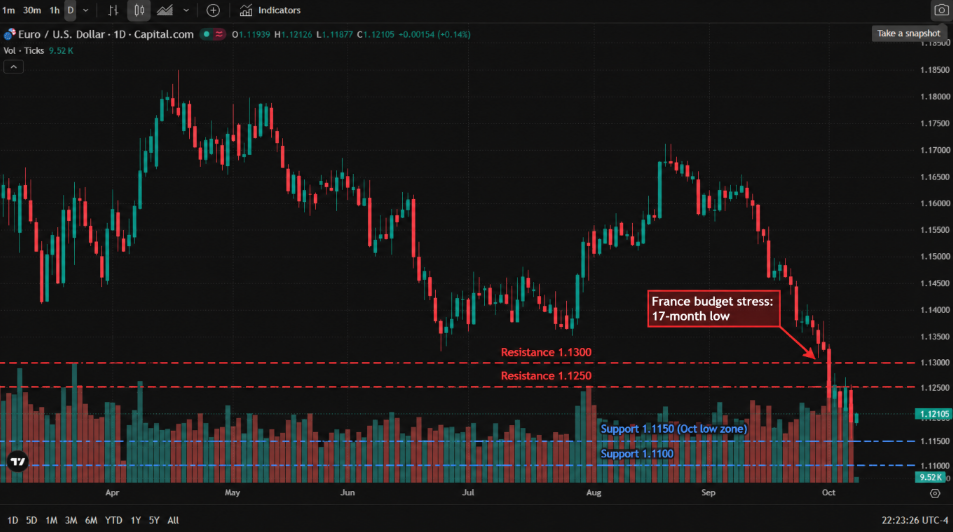
* Chart source: TradingView official chart screenshot, data source Capital.com (EUR/USD).
EUR/USD key levels. Support: 1.1150–1.1160 (the October low zone containing the 1.1162 low) / 1.1100 / 1.1000. Resistance: 1.1250 (the 6 October rebound high) / 1.1300 (the early-October breakdown level) / 1.1340 (the September close). 1.1150 is the gate: a weekly close below it would confirm the fiscal-premium trade is in control, while a defence sets up a rebound toward 1.1250.
What to watch, and the two scenarios
Two scheduled events land tonight: US initial jobless claims (consensus 200k, prior 197k) at 8:30 ET, and the $22 billion 30-year Treasury auction at 1:00 pm ET (previous award 5.308%). A soft claims print would cool hike odds and give the euro breathing room; a strong auction would pull long-end yields lower and ease the global bond pressure that France amplified. On the French side, headlines into the 23 October Moody's review remain the wildcard.
Scenario A — 1.1150 holds. If US data softens and no fresh French escalation lands, the euro bases above 1.1150 and reclaims 1.1250, with 1.1300 the next test. In this reading, the slide was a positioning flush, and the fiscal risk is being repriced, not re-rated.
Scenario B — 1.1150 breaks. A daily close below the October low opens 1.1100 and then the 1.1000 psychological level. The trigger would likely be a combination of French spread widening toward new highs and a dollar pushing through 102 on the index — a fiscal story on one side and a rate story on the other, both pointing the same way.
Read more
* The content presented above, whether from a third party or not, is considered as general advice only. This article should not be construed as containing investment advice, investment recommendations, an offer of or solicitation for any transactions in financial instruments.


