


Samsung Q3 Operating Profit Surges Nearly 8-Fold to Record High: What Is the Outlook for Micron, Nvidia, and Memory Stocks?
TradingKey - On October 8, Samsung Electronics released its preliminary Q3 2026 earnings guidance: consolidated revenue was approximately 195 trillion won, up 126.6% year-over-year; operating profit was around 107.4 trillion won, up 782.5% year-over-year and about 20% quarter-over-quarter. Both revenue and operating profit reached quarterly record highs, with operating profit coming in approximately 1.2% above the LSEG SmartEstimate expectation of 106.1 trillion won.
As of press time, Samsung Electronics' stock price fell 0.19% to 268,000 won. The stock's failure to rise indicates that the record performance had largely been priced in by the market.
Samsung and Micron (MU)'s latest financial results show that growing AI demand and rising memory chip prices continue to support industry profitability. Going forward, attention should be paid to how long the price increases can persist and whether the release of new capacity will ease supply tightness.
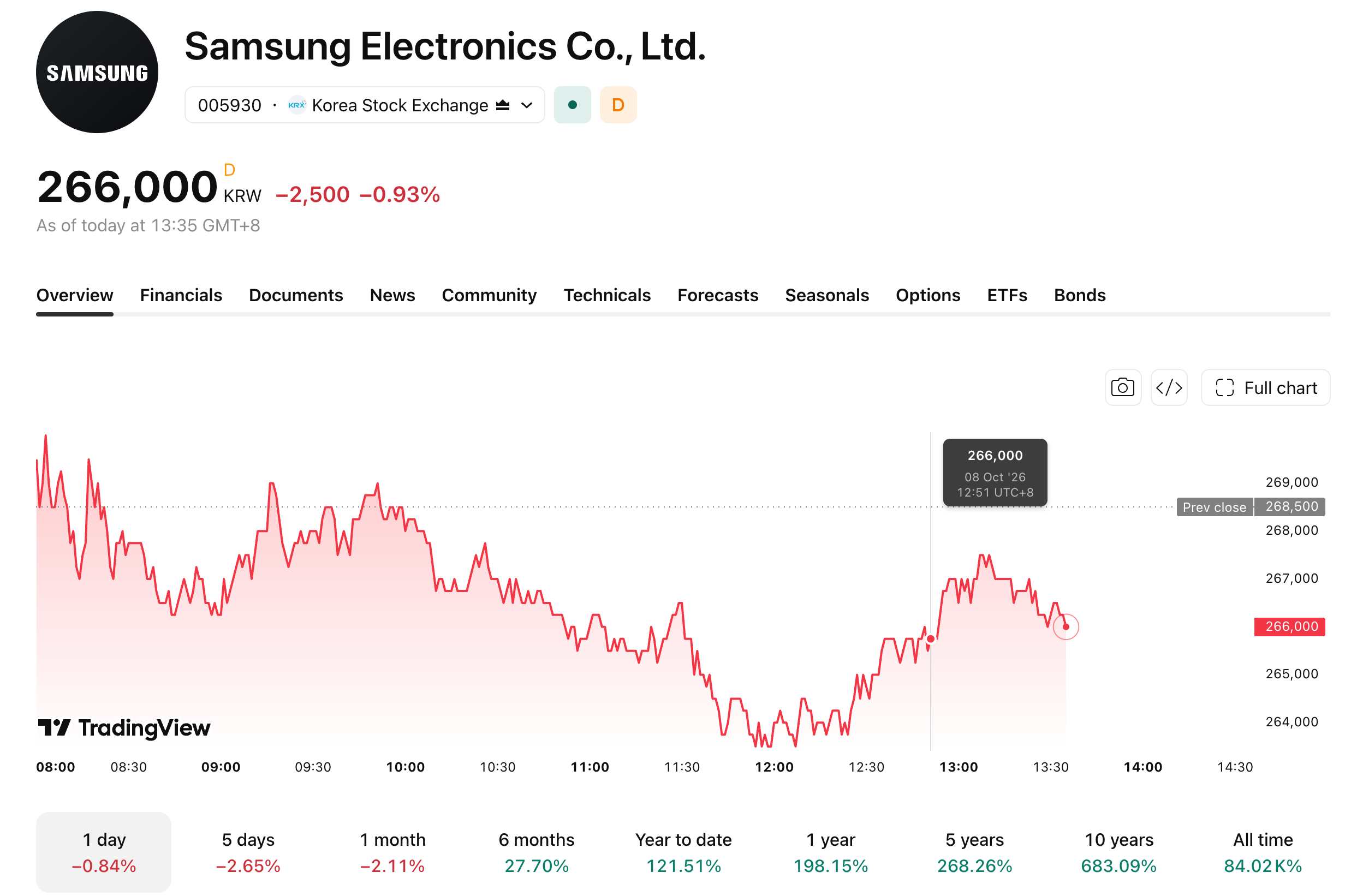
[Source: TradingView]
Samsung Profits Hit Record High: How Long Can Memory Price Hikes Last?
According to Reuters, tight supplies of conventional DRAM and NAND, alongside growing demand for HBM, are expected to make the memory business the primary source of Samsung's third-quarter profit growth. Douglas Kim, an analyst at Douglas Research Advisory, estimates that Samsung's Q3 HBM bit shipments increased by nearly 50% quarter-on-quarter.
Memory price increases are expected to extend into the fourth quarter, but the growth rate for conventional DRAM has moderated. TrendForce projects that conventional DRAM contract prices will rise 10% to 15% quarter-on-quarter in the fourth quarter, lower than the nearly 60% surge reported by Reuters for the second quarter, while NAND Flash contract prices are expected to rise 15% to 20% quarter-on-quarter. Subsequent profit growth will still depend on shipments, product mix, and cost changes.
Rising memory chip prices have also heightened cost pressures on Samsung's mobile and consumer electronics businesses. Analysts expect the foundry business to remain loss-making due to low capacity utilization and fixed cost burdens. Samsung plans to disclose detailed financial results on October 29, which will offer further visibility into the memory business's profit contribution, HBM progress, and the performance of other divisions.
Micron Earnings Surge: Why Are Memory Stocks Diverging?
On September 30 ET, Micron reported its fourth-quarter fiscal 2026 results, with revenue reaching $54.23 billion, up about 379% year-over-year; non-GAAP diluted EPS was $33.42, and non-GAAP gross margin reached 87%, compared to 45.7% in the same period last year.
The company expects first-quarter fiscal 2027 revenue of $60 billion to $63 billion and non-GAAP diluted EPS of $37.15 to $39.15. The midpoint of the revenue guidance represents quarter-over-quarter growth of approximately 13.4%, with non-GAAP gross margin projected at around 86.25%, down 0.75 percentage points sequentially. Management expects memory supply and demand dynamics in 2027 and 2028 to be tighter than in 2026.
However, supply and demand dynamics vary across different memory products. Micron primarily operates in DRAM, HBM, and NAND, while SanDisk (SNDK) mainly operates in NAND flash memory and related products; Western Digital (WDC) and Seagate (STX) are centered on the hard disk drive business, with their earnings outlooks more heavily influenced by HDD supply-demand dynamics and price changes.
According to MarketWatch, citing Nikkei Asia, Toshiba plans to expand its HDD capacity for AI data centers, raising market concerns that additional supply could weaken HDD makers' pricing power. On October 2, Western Digital and Seagate both closed down by about 10.2%. The actual impact of the expansion on the two companies' earnings remains contingent on the scale of new capacity, production timelines, and customer demand growth.
Since then, performance among related stocks has continued to diverge. On October 7 ET, Micron and SanDisk closed up 4.06% and 1.92%, respectively, while Western Digital closed down 1.37% and Seagate rose slightly by 0.24%. Going forward, key factors to watch include the sustainability of price increases for memory chips and the impact of HDD capacity expansion on selling prices and profit margins.
How HBM4 Supply and Costs Will Affect Nvidia?
Nvidia (NVDA) Rubin GPUs adopt HBM4. Micron stated that 36GB, 12-layer HBM4 for the Vera Rubin platform began volume shipments in the first calendar quarter of 2026. HBM4 supply is a crucial condition for the production and delivery of Rubin systems.
For Nvidia, an increased HBM4 supply helps meet production demand; if procurement prices rise, it may increase costs, with the specific impact depending on supply contracts and system sales pricing. Going forward, key factors to watch include whether HBM4 deliveries can match Rubin's production schedule and whether procurement demand from cloud providers and AI companies can sustain growth.
Samsung's preliminary results reflect how memory demand and price increases support profitability. Looking ahead, memory makers need to focus on selling prices and additional supply, while Nvidia needs to monitor key component supply, procurement costs, and system orders.
Recommended Articles


