

WTI and Brent Crude Prices Surge Over 4%: Why Are Oil Prices Rising?

Source Tradingkey

TradingKey - On October 8, international oil prices surged intraday, with both WTI (USOIL) crude and Brent (UKOIL) crude rising by over 5% at one point. Middle East shipping security risks escalated again, while some crude oil production in the U.S. Gulf of Mexico was suspended due to a hurricane, with supply-side uncertainty driving oil prices rapidly higher.
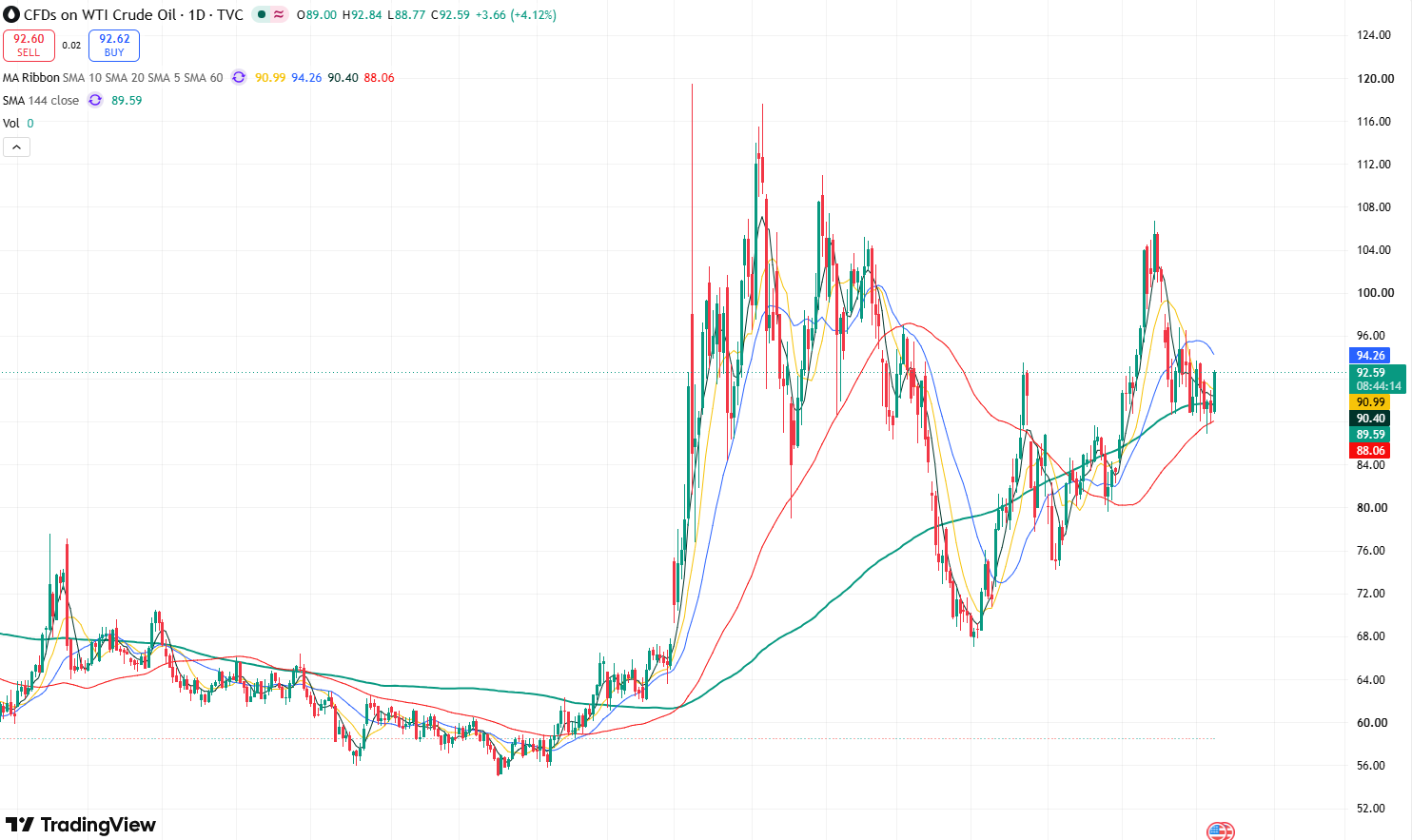
wti-f81316923de2469db54e69e49315e66f

WTI crude oil price daily chart, source: TradingView

As of press time, Brent crude rose about 3.8% to $105.10 per barrel, reaching its highest level since September 29; WTI crude rose about 4.1% to $92.50 per barrel, its highest level since October 2.

Middle East supply risks have become a key driver of this rally. Recent attacks on tankers in the Strait of Hormuz have increased noticeably, with the number of related attacks last week reaching the highest single-week level since the outbreak of the U.S.-Iran conflict. Latest shipping data showed that on October 6, only seven commodity vessels passed through the Strait of Hormuz, the lowest level in over two months, while crude oil flows through the strait dropped to about 10.1 million barrels per day.

Meanwhile, Hurricane Isaias is approaching the U.S. Gulf Coast. Energy companies such as Shell and Chevron have curtailed some offshore production activities. As of Wednesday, approximately 25.08% of crude oil production and 16.37% of natural gas production in the U.S. Gulf of Mexico were shut in, further adding to short-term supply pressure.

U.S. inventory data also provided support for oil prices. EIA data showed that for the week ending October 2, U.S. commercial crude oil inventories decreased by 3.2 million barrels to 424.1 million barrels, compared with market expectations for an increase of about 1.7 million barrels; over the same period, U.S. crude oil exports increased to 4.77 million barrels per day.

Earlier, the International Energy Agency's decision to accelerate the release of emergency petroleum reserves weighed on oil prices for a time, but Middle East shipping risks and U.S. supply disruptions have now returned to the market focus. Future oil price trends will still depend on transit conditions in the Strait of Hormuz, the pace of capacity recovery in the U.S. Gulf of Mexico, and further developments in the Middle East situation.

Disclaimer: For information purposes only. Past performance is not indicative of future results.
placeholder
Gold Price Forecast: Gold Rebounds Above $4,200, Can Falling Oil Prices Drive Another Rally?As of Friday (October 9), gold prices (XAUUSD) rebounded noticeably after consecutive declines. During today's Asian session, gold prices briefly rebounded above $4,200, reaching an intra
Author  TradingKey
11 hours ago
As of Friday (October 9), gold prices (XAUUSD) rebounded noticeably after consecutive declines. During today's Asian session, gold prices briefly rebounded above $4,200, reaching an intra
placeholder
Hurricane Isaias has shut in a quarter of Gulf oil output — can WTI clear $92 before Thursday's EIA report?WTI trades at $90.80 after rebounding roughly 3% from Wednesday's $87.96 low as Hurricane Isaias — the Atlantic season's first — forces producers to shut in about 25% of US Gulf of Mexico output. Brent holds at $103.41. The first official read on the disruption arrives with the EIA weekly petroleum report on Thursday 15 October — here are the key levels and both scenarios.
Author  Irene Q.
14 hours ago
WTI trades at $90.80 after rebounding roughly 3% from Wednesday's $87.96 low as Hurricane Isaias — the Atlantic season's first — forces producers to shut in about 25% of US Gulf of Mexico output. Brent holds at $103.41. The first official read on the disruption arrives with the EIA weekly petroleum report on Thursday 15 October — here are the key levels and both scenarios.
placeholder
【Daily Brief】Gold rebounds 1% off a two-month low, Nasdaq drops 1.25% and yields ease — the storm premium keeps WTI near $91Gold trades at $4,174 after rebounding from Wednesday's $4,090 two-month low, the Nasdaq fell 1.25% while the Dow edged higher, and the 10-year Treasury eased to 5.23% from the week's highs. Hurricane Isaias keeps about 25% of Gulf output shut in with WTI near $91, and bitcoin holds below $82,000. The next scheduled tests are the EIA report on 15 October and the FOMC on 27-28 October.
Author  Irene Q.
14 hours ago
Gold trades at $4,174 after rebounding from Wednesday's $4,090 two-month low, the Nasdaq fell 1.25% while the Dow edged higher, and the 10-year Treasury eased to 5.23% from the week's highs. Hurricane Isaias keeps about 25% of Gulf output shut in with WTI near $91, and bitcoin holds below $82,000. The next scheduled tests are the EIA report on 15 October and the FOMC on 27-28 October.
placeholder
WTI slips below $90.50 as Trump signals no pre-election strike on IranWest Texas Intermediate (WTI) oil price declines after posting nearly 2.5% gains in the previous day, trading around $90.30 per barrel during Asian hours on Friday.
Author  FXStreet
19 hours ago
West Texas Intermediate (WTI) oil price declines after posting nearly 2.5% gains in the previous day, trading around $90.30 per barrel during Asian hours on Friday.
placeholder
Bitcoin Drops Below $83,000 as US Government Transfers Over 10,000 BTC, Sparking Panic Over Potential Selling PressureUS government transfers over 10,000 BTC as Bitcoin extends losses to breach $83,000, but a further sharp decline remains unlikely.On October 8, Bitcoin (BTC) extended its recent losses, f
Author  TradingKey
Yesterday 07: 32
US government transfers over 10,000 BTC as Bitcoin extends losses to breach $83,000, but a further sharp decline remains unlikely.On October 8, Bitcoin (BTC) extended its recent losses, f
goTop
quote