




If a Bear Market Is Coming, Here's What All of the Smartest Investors Are Doing Right Now
Key Points
Bear markets follow bull markets, and vice versa.
The smartest investors prepare for the inevitable downturns during the upturns.
- 10 stocks we like better than Vanguard S&P 500 ETF ›
With great certainty, I can say there will be a bear market. What I can't tell you is when, though I expect one sooner than later. Right now, with the market trading near all-time highs, investors appear to be shrugging off a lot of bad news. Even JPMorgan Chase (NYSE: JPM) CEO Jamie Dimon has been offering warnings about the increasing risk of a downturn, so I'm not going out on a limb here. But if there is a bear market ahead, now or in a more distant future, the smartest investors prepare before the inevitable downturn.
Fear is your biggest enemy
I've lived through numerous bear markets, including the very deep dot-com crash and the Great Recession, when there were legitimate concerns about the stability of the global financial system. When stock prices fall day after day, week after week, month after month, and year after year, it is hard not to panic. You are watching your wealth slip away little by little and, at some point, you feel like you need to stop the bleeding before you lose it all.
Missed Nvidia in 2009? This Rare Signal Is Flashing Again. In 2009, a "Double Down" signal flashed for a little-known chipmaker called Nvidia. For the first time in years, that same "Total Conviction" signal is flashing for a company 1/100th the size of Nvidia. Continue »

Image source: Getty Images.
There are no free lunches on Wall Street, as the old saying goes. You have to take the good with the bad. And bear markets are part of that story, but, historically, they've always been followed by new bull markets. You may feel like the bleeding will never stop, but history says it will. And that the market will eventually post even higher highs.
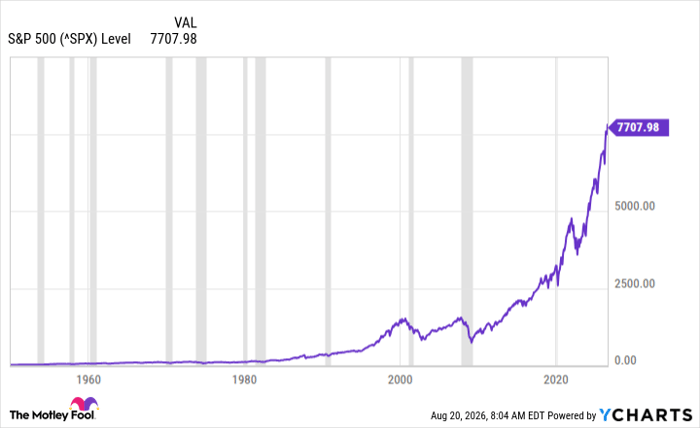
^SPX data by YCharts
So the big thing you need to do is remember the history, so you have the wherewithal not to panic and follow the crowd. A really simple approach is to buy a low-cost S&P 500 index fund, such as Vanguard S&P 500 ETF (NYSEMKT: VOO) and its 0.03% expense ratio, and just keep buying. Right through the downturn, as well, since you'll be able to buy more shares of the exchange-traded fund (ETF) while they are cheap. That's known as dollar-cost averaging, and it can be a very powerful wealth-creation tool.
Step back on the risk
Another smart move is to reduce the risks you are carrying if you prefer to buy individual stocks. For example, you could trim your stake in a high-flying technology stock like Nvidia (NASDAQ: NVDA) and use the proceeds to diversify into a boring consumer-staples Dividend King like Procter & Gamble (NYSE: PG) or a utility Dividend King like Black Hills (NYSE: BKH). With over 50 annual dividend increases, these companies have proven that their reliable businesses can survive tough times. And you can watch your dividend checks roll in instead of focusing on the falling market.
Should you buy stock in Vanguard S&P 500 ETF right now?
Before you buy stock in Vanguard S&P 500 ETF, consider this:
The Motley Fool Stock Advisor analyst team just identified what they believe are the 10 best stocks for investors to buy now… and Vanguard S&P 500 ETF wasn’t one of them. The 10 stocks that made the cut could produce monster returns in the coming years.
Consider when Netflix made this list on December 17, 2004... if you invested $1,000 at the time of our recommendation, you’d have $429,223!* Or when Nvidia made this list on April 15, 2005... if you invested $1,000 at the time of our recommendation, you’d have $1,317,883!*
Now, it’s worth noting Stock Advisor’s total average return is 965% — a market-crushing outperformance compared to 212% for the S&P 500. Don't miss the latest top 10 list, available with Stock Advisor, and join an investing community built by individual investors for individual investors.
See the 10 stocks »
*Stock Advisor returns as of August 23, 2026.
JPMorgan Chase is an advertising partner of Motley Fool Money. Reuben Gregg Brewer has positions in Black Hills and Procter & Gamble. The Motley Fool has positions in and recommends JPMorgan Chase, Nvidia, and Vanguard S&P 500 ETF. The Motley Fool has a disclosure policy.
Recommended Articles


