




KKR Stock Outlook: $9B UGI Bid, Integer Deal and Record Q2 Earnings
TradingKey - KKR & Co. (NYSE: KKR) is currently trading around $107 and is off roughly 21% year to date, despite being in the midst of one of its biggest deal-making years of the company's history.
Shares recently traded between $106.91 and $110.51, with volume below the stock’s average. The stock remains within a 52-week range of $82.67 to $152.10.
The decrease is noteworthy in the context of KKR's core business's solid performance. The company just reported record quarterly profits, is closing a record infrastructure fund and is simultaneously looking to make two multibillion-dollar deals.
$9 Billion UGI Bid Highlights KKR’s Power Infrastructure Push
KKR's largest deal of the month is its unsolicited bid of about $9 billion for UGI Corporation, a Pennsylvania-based natural gas and electricity distributor with a known AmeriGas propane business.
KKR’s proposal values UGI at $42.50 per share, representing a premium of about 21% to its pre-announcement price. The agreement would provide KKR more access to regulated gas and electric infrastructure as AI data centers are driving massive demand for reliable power.
If UGI's approximately $6.8 billion in long-term debt is added to the transaction, the enterprise value would be nearer $15 billion.
UGI has not indicated whether it will engage with KKR, so there is no guarantee the deal will move forward. The idea does, however, align with KKR's recent purchase of DCC Energy's LPG assets and may offer potential to integrate its LPG assets with UGI's propane distribution network.
Integer Holdings Could Add Another Multibillion-Dollar Deal
KKR signed a definitive agreement on August 3 to acquire Integer Holdings in an all-cash take-private transaction. Integer stockholders will receive $127 per share in cash, with the total enterprise value of the deal — including the assumption of Integer's outstanding debt — approximately $5.7 billion
The deal follows sustained pressure from activist investor Irenic Capital Management, which built a stake of more than 3% in Integer and successfully pushed for board changes in March 2026, leading Integer's board to initiate a formal strategic review in April that ultimately produced the KKR agreement.
As both deals proceed, they would showcase KKR's appetite for investing large amounts in two seemingly disparate industries, ranging from healthcare to energy infrastructure.f
Such an aggressive strategy is significant in light of KKR's own stock price action. The company's management has said the share price is weak and not indicative of the underlying business and that there is a disconnect between investor sentiment and company performance.
Record Q2 Results Strengthen the Bull Case
The second quarter results of KKR substantiated that opinion.
Earnings per share on fee revenue rose 34% year-over-year to $1.32. Total operating earnings per share grew by 27% to $1.68, and adjusted net income per share grew by 38% to $1.63. That was also ahead of the $1.43 consensus estimate.
AUM hit a new high of $796 billion, growing 16% from a year ago. KKR's biggest ever monetization quarter was also a strong one, with $848 million in realized performance income.
The firm also hit an important milestone with the completion of its three-year fund raising target of $300 billion about six months ahead of schedule. Since the beginning of 2024, KKR has raised approximately $305 billion.
In addition, Co-CEO Scott Nuttall discussed a number of questions on investors' minds, such as private credit, private-wealth redemptions, a potential slowdown in monetizations, the effect of AI on software investments, and weaker fundraising. He cited KKR's recent performance as a reminder that such fears might be exaggerated.
AI Infrastructure and Renewable Energy Open New Growth Paths
KKR is expanding its scope beyond traditional private equity and into infrastructure sectors related to long-term demand.
The company recently announced the launch of Helix Digital Infrastructure, a $10+ billion-plus committed capital, perpetual investment vehicle in the emerging AI Data Center market. The approach is based on KKR's current collaboration with ECP on power investments for hyperscalers.
KKR also has signed an agreement to purchase a 50% stake in a 1.2 GW onshore solar and wind portfolio in Germany, Spain, France and Poland from TotalEnergies.
Investments include a record $19.2 billion infrastructure fund and a $16 billion Kuwait infrastructure transaction led by KKR, Blackstone and Brookfield.
In all, the deals highlight some of the biggest long-term opportunities for KKR: power, digital infrastructure, renewable energy and other asset-backed deals that complement the group's private equity business.
Valuation Remains a Key Risk
KKR's operating result is good, but it is still at a P/E above 35x. This is above many industry averages and the five-year historical median.
The high valuation implies the stock may continue to be price sensitive to a further decline in investor appetite. Other factors that can have a negative impact on alternative asset managers include higher interest rate volatility and the weakness of public markets, as worries about valuations and the timing of asset sales can rapidly influence sentiment.
This is an odd situation for KKR. Earnings and assets under management continue to grow, but the stock has struggled.
Nuttall and CFO Rob Lewin have been saying for months that the slower monetization timing is a structural issue, but they actually think it's more of a timing issue.
Analyst Targets and What Comes Next
Wall Street remains generally positive on KKR despite its year-to-date decline. The consensus price target on average is approximately $126 to $147, with 12 of the approximate 13 analysts rating the stock a Buy or Outperform and zero rating the stock a Sell.
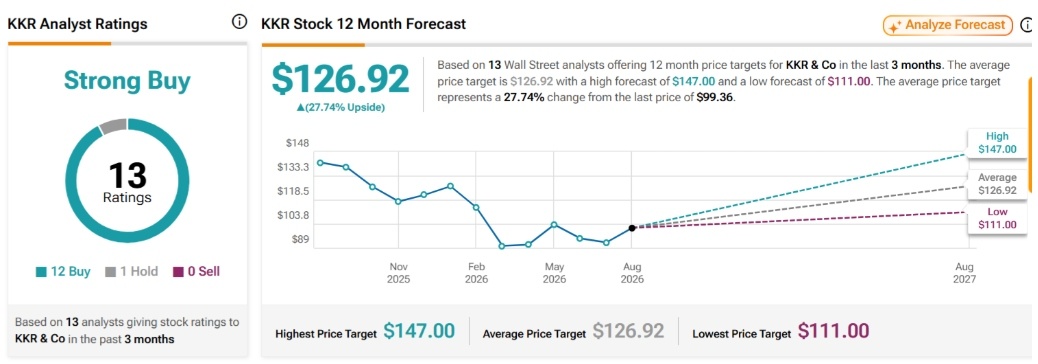
Image Source: tipranks.com
The key catalysts are expected to be UGI's response to the board, progress on the Integer Holdings deal and other fundraising or monetization updates.
KKR's next earnings report is scheduled for Nov. 3. Investors will also be paying attention to new capital investments in Helix Digital Infrastructure and signs of increased monetization activity.
Right now, KKR is an interesting study: its stock is down significantly this year, yet its underlying business is reporting record results. Whether that gap will ever be bridged will rely on deal execution, fundraising, monetizations as well as the willingness of the wider market to pay a premium for alternative asset managers.
KKR Technical Analysis: KKR Tests Rising Support as Momentum Weakens Near $107
KKR is approaching an important technical area on the 2-hour chart as it trades near $107.09 having pulled back from the August peak at $116.21. The broader structure remains positive as price continues to move within an ascending channel. The recent area of higher lows shows that price is trending within an upward channel, but short-term buying momentum has begun to fade. Immediate support is at $106.65 and is also the lower channel line.
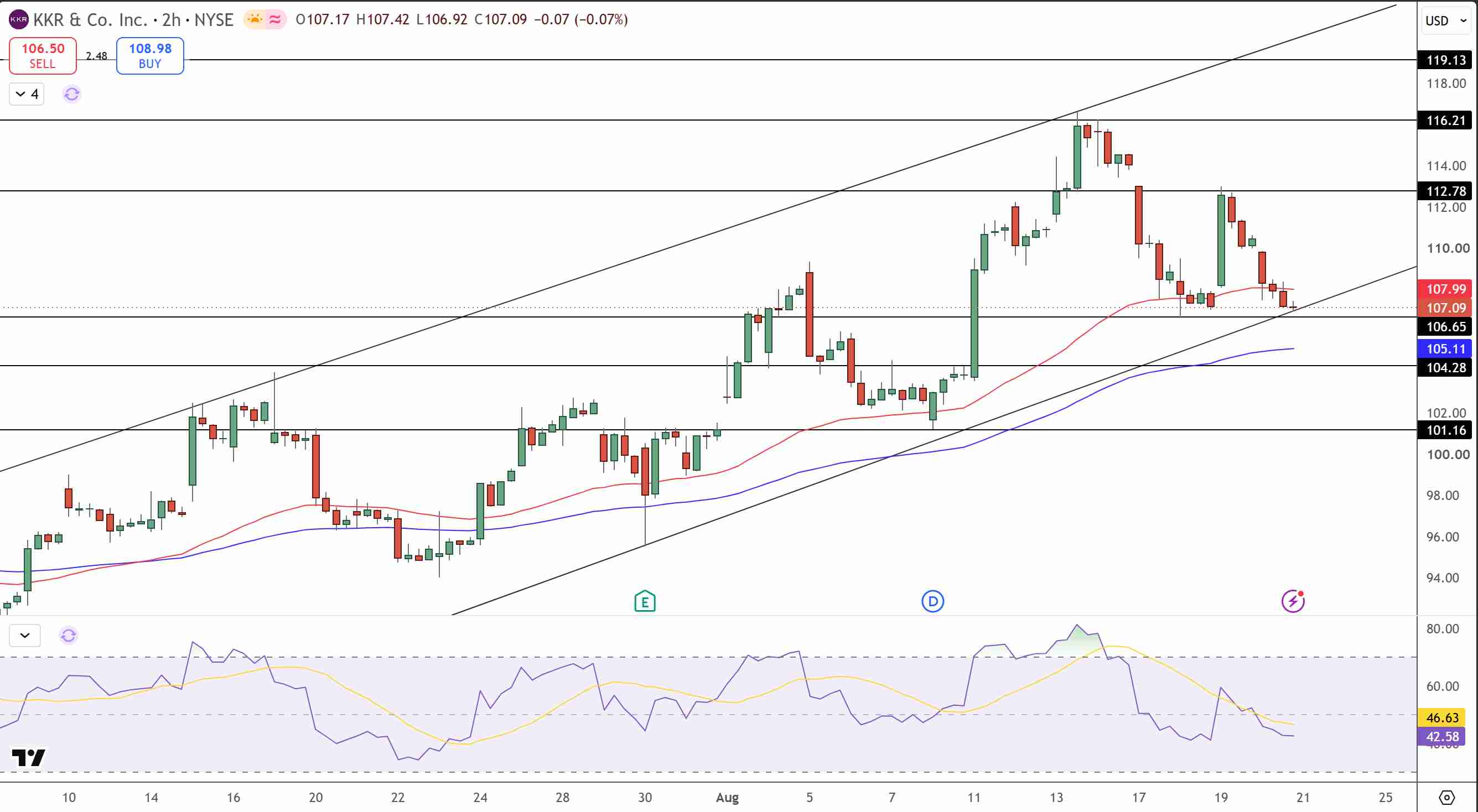
KKR Stock Price Chart - Source: Tradingview
Consequently, $106.65 is an important level for the next move. A decisive push above $106.65 creates an Environment for a move to $107.99 then $112.78. Beyond that, $116.21 remains the bigger resistance.
Currently, momentum is bearish. RSI is at 43, below its signal line at 47 and below the neutral level at 50, Illustrating increased selling pressure after price was rejected from $112.78. Should $106.65 break, support would come around the longer moving average at $105.11 and $104.28. A move below that would take $101.16.
Forecast: KKR retains a cautiously bullish structure above 104.28–105.11, but defending $106.65 is very important for a move to $112.78.
FAQs:
1. Is KKR stock expected to rise?Analysts remain broadly bullish, with the latest consensus target near $126.63 versus KKR’s $107.02 closing price.
2. What is driving KKR stock right now?The proposed UGI acquisition, potential Integer Holdings takeover, strong earnings and growing investments in AI and power infrastructure are key catalysts.
Bottom Line:
KKR’s stock has struggled despite record operating results, creating a noticeable gap between its market performance and business fundamentals. The UGI proposal, Integer deal and growing AI infrastructure exposure could help close that gap, but valuation and deal-execution risks remain.
Recommended Articles


