




If a Stock Market Crash Is Coming, History Says Buying and Holding These Stocks Is a Smart Move
Key Points
Buying and holding the "market" has historically worked out well, no matter when you buy.
Healthcare and consumer staples are two sectors driven by necessity purchases.
Johnson & Johnson, Becton, Dickinson, Coca-Cola, and PepsiCo are all worth a deep dive today.
- 10 stocks we like better than Johnson & Johnson ›
Markets go both up and down, sometimes in dramatic fashion. Right now, the markets are rising dramatically, trading near all-time highs. But, eventually, there will be a bear market. That's just how investing works. If you are worried about the next deep downturn, you may want to consider stocks in the healthcare and consumer staples spaces. But first, make sure you look at the long-term, so you understand just how important buying and holding are to your financial future.
The market has always come back before
If you bought the S&P 500 index (SNPINDEX: ^GSPC) at the peak of the dot-com bubble at the start of the century, you would have suffered through a particularly brutal bear market. If you had purchased the index just before the Great Recession hit, you would have, likewise, been hit by a shocking market downturn. And, in each case, the S&P 500 index recovered and moved on to higher highs.
Missed Nvidia in 2009? This Rare Signal Is Flashing Again. In 2009, a "Double Down" signal flashed for a little-known chipmaker called Nvidia. For the first time in years, that same "Total Conviction" signal is flashing for a company 1/100th the size of Nvidia. Continue »

Image source: Getty Images.
In fact, each time there has been a bear market, the S&P 500 has recovered and resumed its long upward climb. If you don't want to go through the effort of buying individual stocks, a good alternative is to buy and hold the Vanguard S&P 500 ETF (NYSEMKT: VOO). It's 0.03% expense ratio is about as cheap as it gets for exchange-traded funds.
Buying and holding "the market," which is basically how the S&P 500 index is viewed, isn't an exciting investment strategy. However, as the graph below highlights, it is a reliable way to grow your wealth.
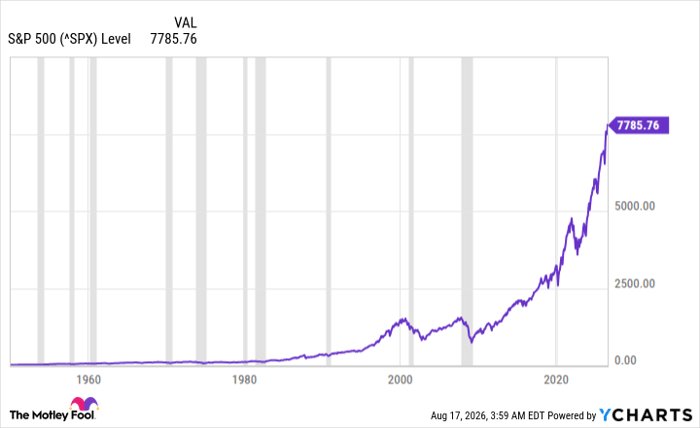
^SPX data by YCharts
Buy dividend-paying stocks that have resilient businesses
That said, if you prefer to own individual stocks, you should consider buying reliable dividend stocks. A good group to start with is the Dividend Kings, or companies that have increased their dividends annually for at least 50 years. They have proven their dedication to paying dividends even during market downturns, and, importantly, you can focus on your dividends rather than stock prices during the next inevitable bear market.
However, you can refine your search further by focusing on sectors driven by necessity purchases. Two good options are healthcare and consumer staples stocks. Consumers reliably buy products from both sectors, regardless of the market environment. Johnson & Johnson (NYSE: JNJ) and Becton, Dickinson (NYSE: BDX) are Dividend King healthcare giants. Coca-Cola (NYSE: KO) and PepsiCo (NASDAQ: PEP) are consumer staples Dividend Kings and two of the world's largest consumer staples makers.
Becton, Dickinson focuses on medical devices, and Coca-Cola focuses on beverages. They are less diversified than Johnson & Johnson, which makes pharmaceuticals and medical devices, and PepsiCo, which makes beverages, snacks, and packaged food products. If owning diverse businesses is important to you, then you'll probably prefer J&J and PepsiCo.
That said, Becton, Dickinson and PepsiCo are both struggling a little bit right now, so they are out of favor with investors. Becton, Dickinson's 2.3% dividend yield is above its five-year average of around 1.7%. PepsiCo's 4.2% yield is above its five-year average of 3.1%. That suggests they are attractively priced right now, noting that their dividend histories suggest they will manage to work through their current headwinds.
Coca-Cola's 2.4% yield is below its five-year average of 2.8%. And J&J's roughly 2% yield is below its five-year average of 2.7%. That suggests that you would be paying a premium for both, but if you are worried about a bear market, it may be worth the price of admission. Both are highly reliable and resilient businesses, with J&J being one of the world's largest healthcare companies. And both companies are doing fairly well right now, business-wise.
No silver bullets, but perseverance has proven to be a successful strategy
Buying J&J, Becton, Dickinson, Coca-Cola, or PepsiCo won't save you from a bear market. When fear pushes investors to start selling stocks, just about everything gets hit. However, as the long-term history of the S&P 500 index highlights, buying and holding has proven to be a good strategy if you can stick it out through the bear markets you end up facing. Reliable dividend-paying stocks in sectors driven by necessity purchases, meanwhile, can help you stick to your buy-and-hold strategy. When the bear market does arrive, you can focus on the dividend checks you collect instead of stock prices to help calm your nerves through the downturn.
Should you buy stock in Johnson & Johnson right now?
Before you buy stock in Johnson & Johnson, consider this:
The Motley Fool Stock Advisor analyst team just identified what they believe are the 10 best stocks for investors to buy now… and Johnson & Johnson wasn’t one of them. The 10 stocks that made the cut could produce monster returns in the coming years.
Consider when Netflix made this list on December 17, 2004... if you invested $1,000 at the time of our recommendation, you’d have $432,189!* Or when Nvidia made this list on April 15, 2005... if you invested $1,000 at the time of our recommendation, you’d have $1,330,956!*
Now, it’s worth noting Stock Advisor’s total average return is 967% — a market-crushing outperformance compared to 212% for the S&P 500. Don't miss the latest top 10 list, available with Stock Advisor, and join an investing community built by individual investors for individual investors.
See the 10 stocks »
*Stock Advisor returns as of August 22, 2026.
Reuben Gregg Brewer has positions in PepsiCo. The Motley Fool has positions in and recommends Vanguard S&P 500 ETF. The Motley Fool recommends Johnson & Johnson. The Motley Fool has a disclosure policy.
Recommended Articles


