




Oracle Q4 FY2026: Record Revenue $19.2B, OCI Surges 93%, But Financing Risk Drives Stock Down to $142
TradingKey - Oracle (ORCL) reported revenue of $19.2B for its fourth quarter of FY2026, an increase of 21%, and reported OCI revenue of $5.8B, an increase of 93%, with remaining performance obligations of $638B, an increase of 363%, which provides impressive visibility into future AI infrastructure revenue. However, the sharp drop in ORCL stock price this August to approximately $142.07, from $156.22 in early August, illustrates that the decline is more about investors’ worry and apprehension regarding Oracle’s AI buildout. The expenses for business runs deep, even with impressive cash flow for FY2026 of $32B (an increase of 54%), free cash flow was negative $23.7B, due to a sharp increase in capital expenditures. The hypothesis with regard to capital expenditures is $70B for FY2027, and Oracle will seek to raise $40B via debt and equity offerings.
With increasing interest on U.S. Treasury bonds, thinning valuations, and over $194B of tech bond issuances made in 2026, Oracle is now facing a financial burden, and the concern for management is how they will fulfill the demand for OCI.
Q4 FY2026: Revenue $19.2B, Cloud Revenue $9.9B, OCI $5.8B Surge
Revenue for Q4 was $19.2B, an increase of 21% YoY and above the $19.09B estimate. Cloud revenue was $9.9B and grew by 47%. OCI revenue was $5.8B and grew by 93% YoY. Cloud applications (SaaS) were $4.1B and increased by 10%. Software revenue was $6.8B, a 2% decrease.
Services revenue was $1.5B and grew by 13%. Non-GAAP OI was $8.6B and grew by 22%. Non-GAAP EPS were $2.11, an over-performance from the $1.96 estimate and a 24% increase. Free cash flow for FY2026 was -$23.7B due to a sharp increase in capital expenditures.
RPO $638 Billion: Visibility Meets Financing Risk
Remaining performance obligations came in at $638 billion (up $85 billion in Q4, +363% compared to last year). Management believes 12% of RPO will be recognized within the next twelve months, and a further 34% will be recognized between 13 and 36 months (both accelerating). A large majority of that growth can be attributed to large AI-focused contracts that involved either customer-funded GPU purchases or customer self-procurement of GPUs.
The resulting customer supplied hardware totaled $75 billion. This self-procurement by customers greatly reduces the capital expenditure obligation for Oracle, and while the obligations still remain, there remains a large deployment obligation. The backlog does exist; however, now the challenge is to realize that backlog while effectively managing the debt.
FY2027 Guidance: $90B Revenue Reaffirmed, But Capex at $70B Raises FCF Concerns
Oracle has reaffirmed its FY2027 revenue guidance at $90B (approximately 34% growth in constant currency) and has now set its EPS guidance at $8.05 (18% growth). Oracle has shown strength in its initial quarter with ‘27 revenue growth of 27-29% and cloud revenue growth of 58-64%. However, management has targeted a capital expenditure spend of around $70B in FY2027 and plans to finance $40B of the buildout via debt and equity. The plan has caused stock weakness on June 10th (a 10% after hours decline). The need for funding continues to put pressure on the stock.
AWS Partnership Deepens: Aug 13 Expansion, Multicloud Strategy
On Aug-13, Oracle expanded its AWS partnership, and now Oracle AI Database@AWS is available in 22 AWS regions, and Oracle also launched Exadata Database Service on Exascale Infrastructure within AWS. Signature strategy: Oracle has decided to use its database technologies across hyperscalers (and compete) rather than forcing its customers to choose between Oracle Cloud Infrastructure (OCI) and multiple clouds. As such, Oracle has a larger market and less risk of losing customers to other competitors.
Financing Pressure Is the Core Issue, Not Demand Weakness
The weakness in ORCL doesn’t reflect a collapse in OCI demand. From an investment standpoint, the choice about where to put capital is beginning to matter. Reuters said Aug.19 that tech companies (Oracle, Amazon, Alphabet, Meta) have raised $194B in bonds (a 79% increase over last year) with a focus on longer maturities. Cloud computing projects will take longer to recoup the spending, and in the meantime, Oracle’s long-term commitments to build data centers continue to be an issue.
ORCL Technical: Support $136.85, Resistance $144.17, Stock Consolidating
ORCL closed trading on Aug 20 at a price of $142.07, down 1.21% for the day. Price has pulled back from the Aug 13 high of $156.22. 38.2% Fibonacci retracement level at $142.13 (technical support level). Price is below the moving average at $143.05, with resistance level at $144.17 and trendline support at $144.17.
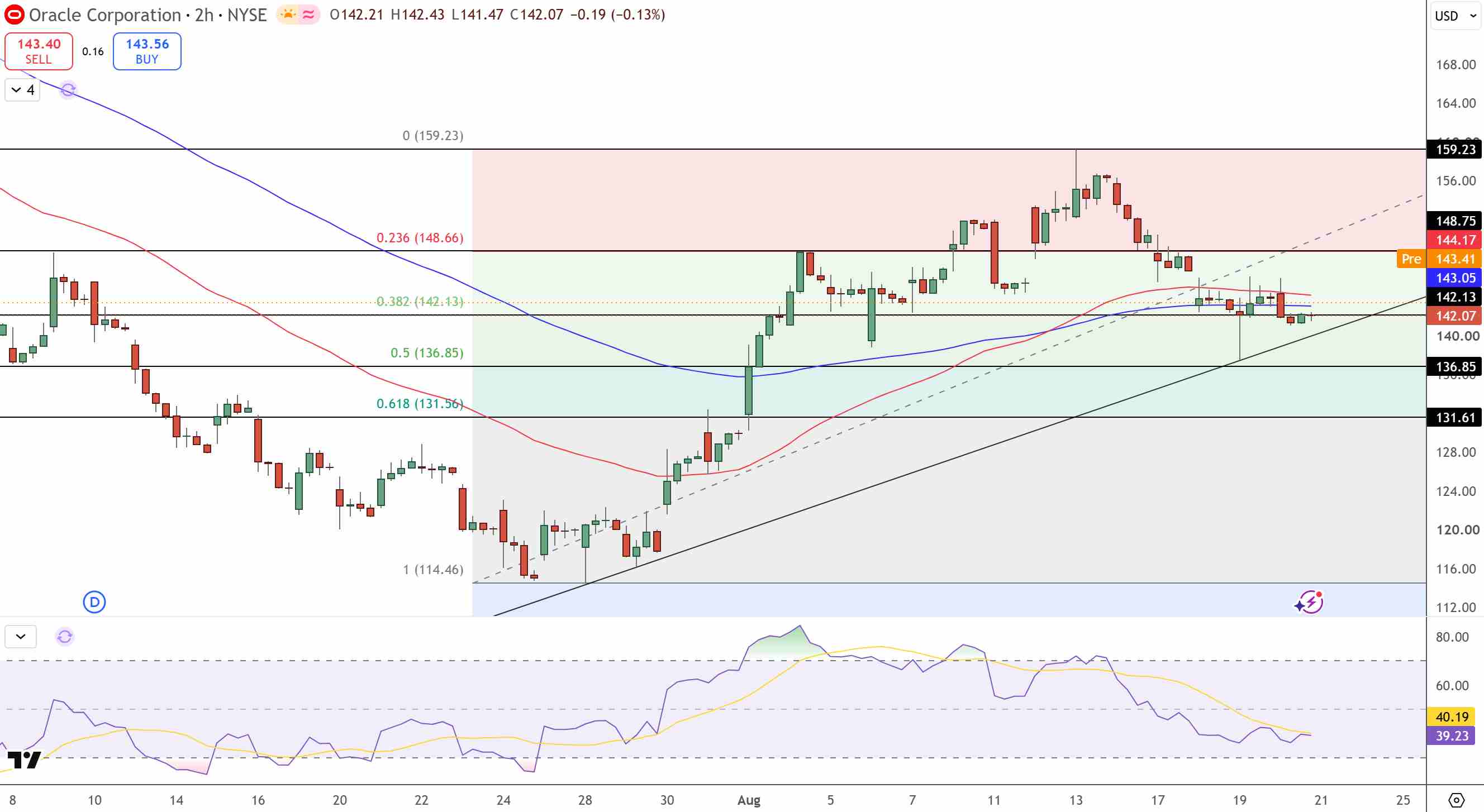
Oracle Price Chart - Source: Tradingview
Price has RSI of 39, which is near a “sell” signal at 40, showing no overselling of price. If price breaks above $144.17, the next resistance levels are at $148.66 - $148.75. If price breaks below $136.85 (50% Fibonacci retracement level), the next support levels are at $131.50 - $131.61.
Key Levels
- Support: $142.13 (38.2% Fib), $136.85 (50% Fib), $131.50-$131.61
- Resistance: $144.17, $148.66-$148.75, $159.23 (Aug high)
Bottom Line: Operational Growth Strong, Financing Risk Dominant
ORCL Q4: Revenue $19.2B (+21%), OCI $5.8B (+93%), RPO $638B (up 363%). FY2027 guidance $90B, EPS $8.05 (not reduced). AWS partnership expanded. Free cash flow -$23.7B FY26; capex ~$70B FY27; $40B financing plan. Stock weakness reflects AI infrastructure debt pressure, not demand collapse.
For investors: Inspiring OCI growth and excellent future performance are balanced by the risk of high financing and large-scale execution. Limiting valuation are increased yields, tech capex, extra commitments, and Jackson Hole Fed comments next week. Investment advice: Stocks consolidating in the short-term, technical support at $136.85. Break $136.85 and move to the downside for the long-term.
Recommended Articles


