




NVIDIA Q1 FY2027: Revenue $81.6B Beat, Data Center +92%, but August 26 Guidance Test Will Prove Sustainability
TradingKey - On May 20, Nvidia (NVDA) announced Q1 FY2027 revenue of $81.6 billion that exceeded consensus and increased by 85 percent from last year while data center revenue reached $75.2 billion, an increase of 92 percent from the previous year. However, the stock price fell after earnings as investors had more serious questions. Is this level of growth sustainable? The answer to that question will become available during the August 26 earnings as we will know if the guidance will be met as the Vera Rubin production begins to ramp up, the SB Energy financing closed at $105 billion with strong and secure demand, and hyperscaler data center capex remains strong despite the increase in bond yields. Several developments in August have moved the needle.
H200 chips began to reach China in small quantities, Nvidia invested $1.5 billion in SB Energy for securing 8 GW of Ohio infrastructure, and joined a $500 billion financing platform with BlackRock and Apollo. The new focus for Nvidia suggests that while this may drive near-term revenue, it may also increase credit risk. The upcoming Jackson Hole Fed meeting, scheduled for August 27-29, will be a good indicator of the overall economy.
Q1 FY2027: Record Revenue $81.6B (+85% YoY), Data Center $75.2B (+92%)
Q1 FY2027 revenue was $81.6 billion, an increase of 85 percent from last year, and 20 percent from the last quarter. Data Center revenue for the same period was $75.2 billion and increased by 92 percent from last year and 21 percent from the last quarter.
Of this, revenue from hyperscale data center customers was $37.9 billion and from AI clouds, industrial, and enterprise customers was $37.4 billion. For the data center, the computing revenue was $60.4 billion and networking equipment revenue was $14.8 billion, an increase of 199 percent from the last year.
GAAP gross margin was 74.9 percent. The 92 percent year over year growth can be attributed to the extraordinary demand for AI combined with constrained supply. Going forward, the guidance will exclude China data center compute (export controls still in effect).
Q2 FY2027 Guidance: $91B Revenue, No China Compute Assumed, August 26 Earnings Test
NVIDIA set $91.0B revenue for the second quarter of FY2027, reflecting ~12% midpoint sequential growth. The expected GAAP and non-GAAP gross margins are 74.9% and 75.0%, respectively. Guidance also noted that there would be no data center compute revenue from China. Without this revenue contribution from China, any revenue contribution from China would signal a positive surprise, while sales from China would not count as a revenue miss.
The upcoming August 26 earnings call will illustrate whether revenue goals for the second quarter were met, whether there are revenue goals for the third quarter, and whether goals were met for gross margin goals with the increasing price of inputs and the high capital spend.
SB Energy Deal: $1.5B Investment, $105B Lease Guarantee, 8 GW Ohio Campus
NVIDIA announced on August 17 that it would invest $1.5B and give up to $105B leasing guarantees in SB Energy (SoftBank subsidiary) for OpenAI's PORTS-Pike data center at an 8 GW Ohio campus. The lease is for 20 years. First phase 4.25 GW capacity, possible 3.75 GW more. SB Energy/SoftBank are planning to build 10 GW power capacity, $4.2B grid infrastructure. It is both financially strategic and risky, as NVIDIA now funds chips, land, and power. While a $105B guaranteed lease shows demand confidence, credit exposure and circular financing would also be a concern.
$500B Financing Platform: NVIDIA Joins BlackRock, Apollo, Others
On August 10, NVIDIA teamed up with Apollo, BlackRock, Blackstone, Brookfield, Goldman Sachs, and KKR to aim to raise $500B+ in a financing platform to provide capital for AI infrastructure third parties. Strategy: provide Scope, Power, and Data Center developments to alleviate points of constraint for AI-related capital expenditure (capex).
According to the CEO of NVIDIA, Jensen Huang, the constraint for AI is now shifting from the chips to power and real estate. This may be a solutions-based approach addressing demand with regard to financing. On the other hand, this strategy could put NVIDIA in an uncomfortable contract with market forces. Should either of these two factors become pronounced; interest rates or confidence in the return on investment for AI decrease, financing may disappear.
Vera Rubin Production Ramping, H200 Small Shipments to China Begin
Vera Rubin is under full production support from over 350 factories across 30 countries. NVIDIA claims Rubin delivers a 10x scale agent compared to Grace Blackwell. Production racks have been set up in CoreWeave, Google Cloud, Microsoft Azure, and Oracle Cloud.
Wider production is expected in H2 2026. Ramping up Vera Rubin has a strong positive effect, as it will reduce the chance customers will defer orders due to a lack of next-gen technology. Additionally, small shipments of H200 chips started to arrive in mainland China in the middle of August.
According to the Financial Times, ByteDance and Tencent each received around 10,000 chips. While small, this should not be underestimated as it is a clear case of export controls being tested. NVIDIA has denied they create a chip specific to China. Any revenues from China will be a positive surprise for NVIDIA in Q2.
Technical: Support $214.40, Resistance $221.01, Earnings Aug 26 Near
NVDA closed at $217.56 (Aug 20), trading within the range of $215.66-$219.86. Support is at $214.40, confluence of the trendline, a moving average, and a horizontal level. Below that is support at $209.21 and $205. The first major resistance is at $221.01, while $229.51 and $234.51 are also key levels.
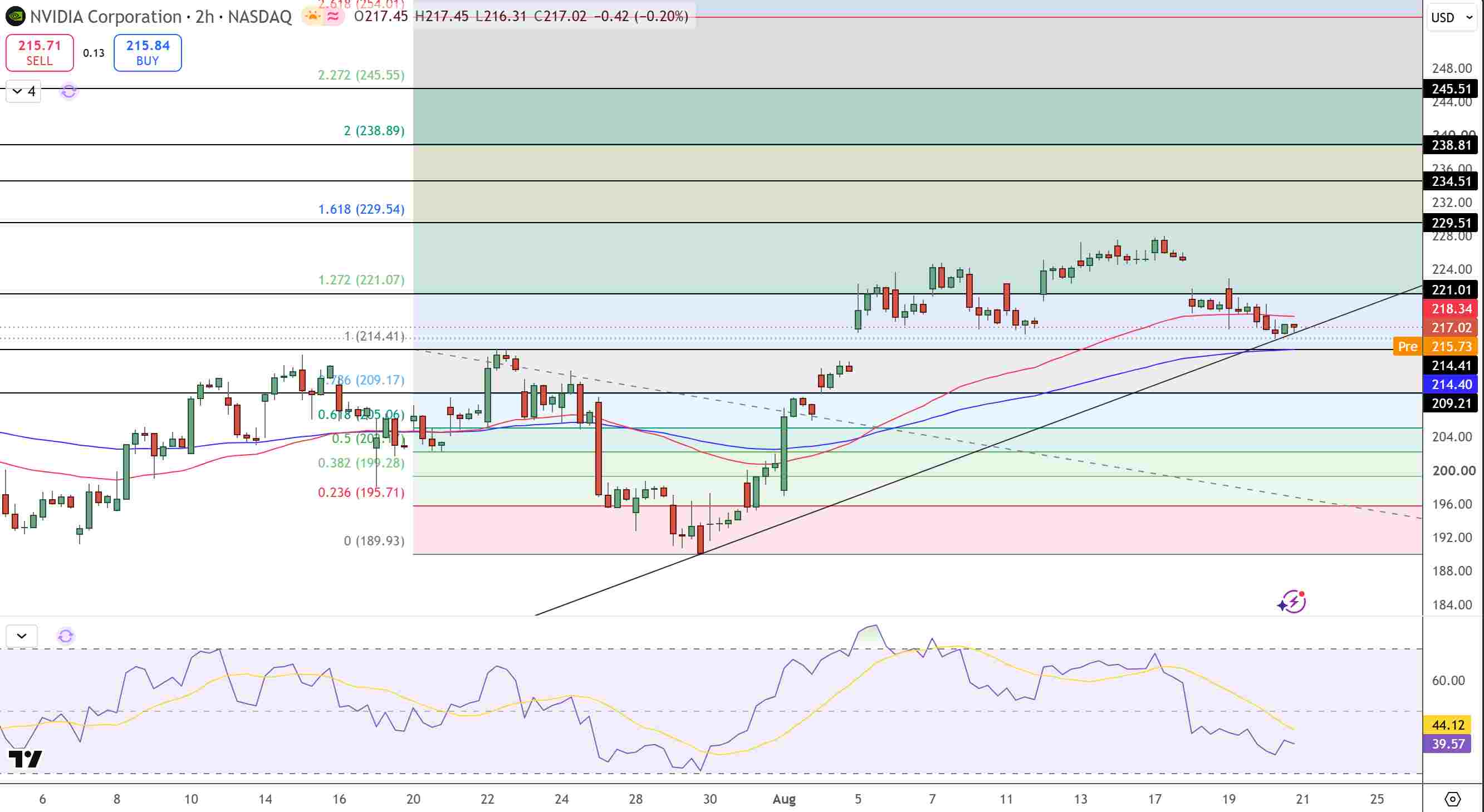
NVIDIA Price Chart - Source: Tradingview
Strong buying is present as the RSI is at 40. The stock is trading after a large run from the peak of $236.54. The 52-week high is $236.54, while the 52-week low is $164.07. Earnings are scheduled to come out after the close on Wednesday (Aug 26).
Key Levels
- Sustaiing/Resistant: $221.01 (first) | $229.51 | $234.51 | $238.81
- Supported/Weak: $214.40 (critical) | $209.21 | $205.00
- NR52-Week Range: $164.07 - $236.54 (peak on May 14)
Bottom Line: Guidance Beat Required, But Financing Risk Matters More
NVDA Q1: Revenue $81.6B (+85%, beat) | Data Center $75.2B (+92%). Q2 guidance $91B (+/- 2%), no China compute. SB Energy $1.5B invest, $105B guarantee, 8 GW Ohio, 20-year lease. Vera Rubin in production. H200 China shipments begun (incremental). $500B financing platform joined. August 26 earnings will be crucial.
For investors: Q2 guidance is not a problem, but margins and the sustainability of the hyperscaler demand are real issues. The SB Energy deal commits the company to the cash flow from OpenAI but concentrates credit risk. Rising bond yields indicate that the financing platforms will become the most important aspect of capital expenditures in the future.
The Aug 27-29 Jackson Hole Fed meeting might change the sentiment. $214.40 provides the best technical support, and above $221, the structure will be bullish.
Recommended Articles


