




Nvidia Denies Launching Custom AI Chips to China Before Year-End
TradingKey — Nvidia (NVDA) has explicitly denied recent rumors that it plans to launch a customized AI chip for Chinese customers by the end of the year.
On August 20, Eastern Time, tech media outlet The Information cited two Nvidia employees as saying that the company plans to ship a small batch of an AI chip to Chinese customers before the end of the year. Based on licensed Groq technology, the chip is a Language Processing Unit (LPU) designed to work alongside GPUs to accelerate AI chatbot response speeds. The report stated that its specifications comply with U.S. export control regulations, and multiple customers have already placed orders.
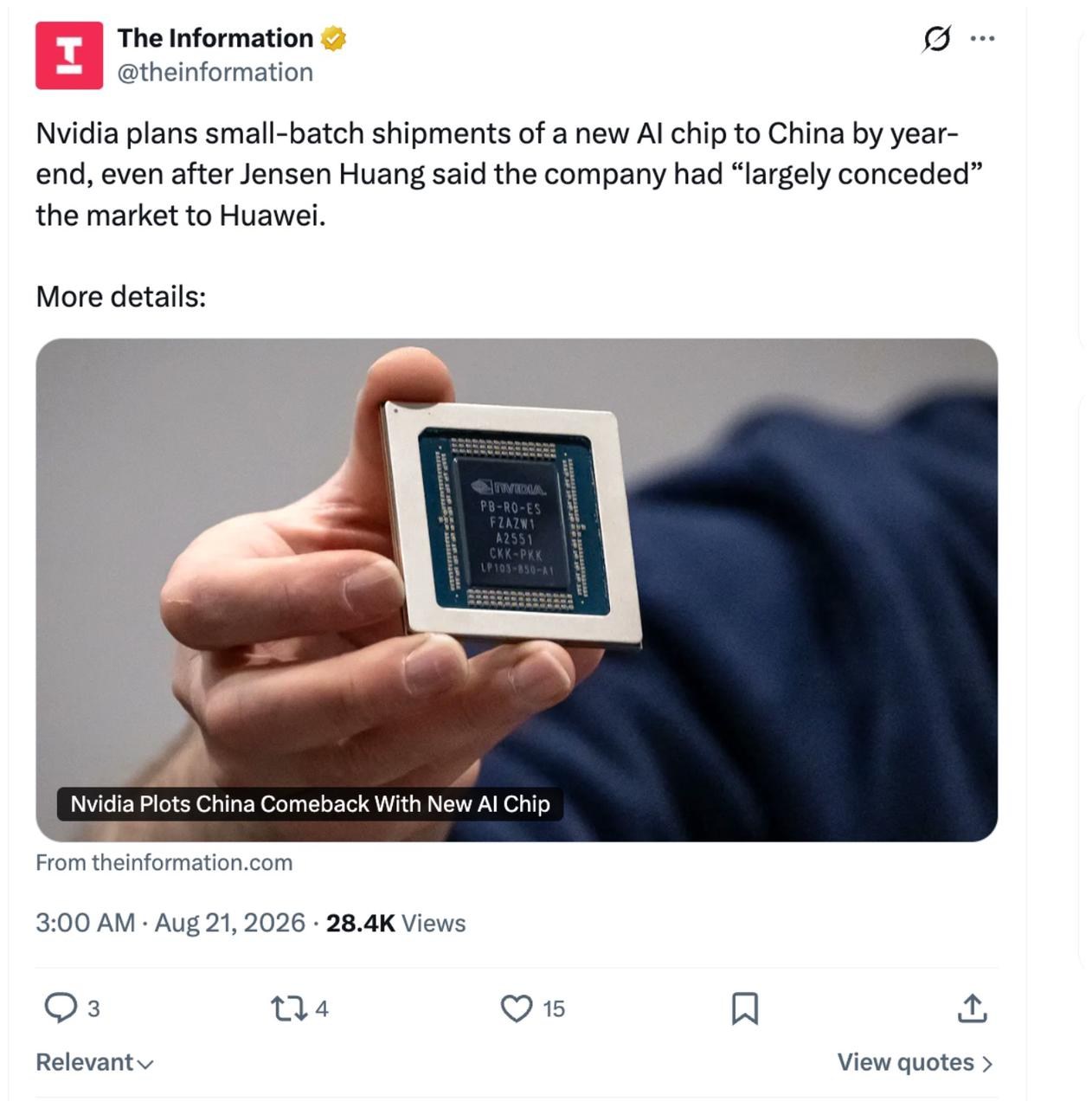
[Source: X]
An Nvidia spokesperson responded that The Information's report was "incorrect," stating that the company currently has no LPU sales in the Chinese market and that no China-exclusive LPU product exists on its product roadmap.
This is not the first time Nvidia has clarified rumors regarding products targeting the Chinese market. In March this year, Reuters reported that Nvidia was preparing to sell Groq chips to China, a report that Nvidia CEO Jensen Huang subsequently called "completely wrong."
Notably, Jensen Huang publicly stated in May this year that, due to U.S. export restrictions, the company had "largely surrendered the advanced AI chip market in China to Huawei." In an exclusive interview with CNBC, he candidly admitted, "Huawei is very, very formidable. Their local chip companies and software ecosystem are doing quite well because we vacated that market."
Meanwhile, the company explicitly pointed out in its fiscal Q1 2027 report and future guidance that, due to Washington's escalating comprehensive ban on high-performance computing chips, Nvidia has directly assumed zero expected revenue from computing products for mainland Chinese data centers in its financial forecasts.
However, Nvidia is not entirely absent from the Chinese market. In May this year, the U.S. approved the supply of H200 AI chips to select Chinese companies, including Alibaba (BABA), Tencent, and ByteDance. According to the Financial Times, ByteDance and Tencent have each received about 10,000 H200 processors in recent weeks, though overall supply remains strictly controlled.
Recommended Articles


