




Prediction: This Will Be the Next Artificial Intelligence (AI) Semiconductor Stock to Go Parabolic
Key Points
Chips stocks such as Micron, Sandisk, and Intel have been outperforming yesterday's winners like Nvidia.
One industry player, Qualcomm, is emerging as a leader in the on-device and agentic AI markets.
Its valuation relative to its growth prospects suggests the stock could be set up for market-beating gains.
- 10 stocks we like better than Qualcomm ›
The artificial intelligence (AI) revolution has so far been dominated by data center service providers. But the next phase is shifting dramatically toward the edge. Billions of devices -- from smart phones, wearable tech, and the Internet of Things (IoT) -- are expected to run intelligent agents that perceive, reason, and act locally rather than constantly outsourcing workloads to the cloud.
Qualcomm (NASDAQ: QCOM) is uniquely positioned to capture this wave. The company's aggressive push into new AI-enhanced devices and a surprisingly attractive valuation profile make the case for why Qualcomm stock could deliver the kind of multibagger returns investors have seen from other infrastructure titans in the AI chip space.
Where to invest $1,000 right now? Our analyst team just revealed what they believe are the 10 best stocks to buy right now, when you join Stock Advisor. See the stocks »

Image source: Getty Images.
Jensen Huang says buy Qualcomm stock
Last month, Nvidia CEO Jensen Huang traveled to Seoul, South Korea, for a multi-day visit focused on forging AI partnerships. During discussions about the future of AI-powered smartphones and edge computing, Huang directly complimented Qualcomm.
Huang stated that Nvidia is "not incredibly good at mobile devices" and doesn't necessarily need to be because Qualcomm is "doing such a good job." Huang went further by telling investors plainly: "Buy their stock. It's good."
The moment was notable not just for the respect of Qualcomm's expertise in on-device AI, but because it came from the undisputed leader of the AI chip boom. Huang's comments come at a time when most investors still associate AI infrastructure almost exclusively with graphics processing unit (GPU) clusters.
Qualcomm's role is expanding across the AI stack
Qualcomm's strengths are in designing highly integrated system-on-chips that combine central processing units (CPUs), GPUs, and neural processing units (NPUs) optimized for battery-constrained environments. This architecture is becoming increasingly critical as AI applications move beyond chatbots to agentic systems. Autonomous agents are developed to operate continuously across phones, wearables, cars, and more with minimal latency.
In mid-June, Qualcomm CEO Cristiano Amon told reporters on CNBC that the company is currently working on more than 40 designs for new AI-powered devices. Amon emphasized that AI agents are the "new apps," and a broader suite of personal devices will serve as always-available interfaces rather than the smartphone alone.
In late June, Qualcomm announced an agreement to supply data center CPUs to Meta Platforms. The first product, dubbed Dragonfly C1000, is scheduled for production in 2028 and will support Meta's expanding AI compute demands. Working with Meta diversifies Qualcomm beyond its roots in mobile devices and places the company directly inside hyperscaler infrastructure stacks.
While cloud GPUs excel at training generative models, inference deployments happening across consumer electronics, vehicles, and factory floors require purpose-built silicon. Qualcomm's low-power, always-connected architecture provides the company with a competitive advantage over general-purpose chip designers.
Is Qualcomm stock a buy right now?
As of this writing (July 2), Qualcomm's price-to-earnings (P/E) and forward P/E multiples are hovering around 19 and 16, respectively. These multiples are modest for a company that boasts a leading position in emerging pockets of the AI ecosystem. Moreover, Qualcomm's valuation profile is especially muted when compared to many of its peers in other areas of the AI chip value chain.
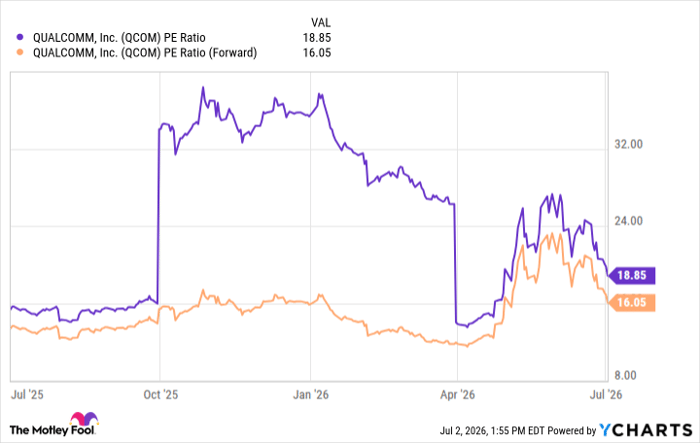
QCOM PE Ratio data by YCharts.
I think Qualcomm's setup for valuation expansion is compelling. The company's new AI device designs represent product pipelines that have the potential to open new addressable markets in wearables and autonomous agents. Moreover, while the Meta relationship is still early, it provides a visible path to new server revenue over the next couple of years.
If even a fraction of the broader agentic and edge-AI opportunity materializes, Qualcomm's revenue and earnings power is positioned to expand materially throughout the AI infrastructure era. At its current valuation, the stock does not appear to be pricing in overly aggressive success across these growth vectors.
As we've seen with Nvidia, Broadcom, Micron, Sandisk, and Advanced Micro Devices, semiconductor companies that diversify into high-growth adjacent markets while also maintaining strong capital returns witness significant valuation expansion alongside earnings growth. Qualcomm's combination of product-market fit, recent high-profile validation from Huang, and a reasonable valuation profile positions the stock as one of the more asymmetric opportunities in the broader AI chip ecosystem right now.
Should you buy stock in Qualcomm right now?
Before you buy stock in Qualcomm, consider this:
The Motley Fool Stock Advisor analyst team just identified what they believe are the 10 best stocks for investors to buy now… and Qualcomm wasn’t one of them. The 10 stocks that made the cut could produce monster returns in the coming years.
Consider when Netflix made this list on December 17, 2004... if you invested $1,000 at the time of our recommendation, you’d have $418,761!* Or when Nvidia made this list on April 15, 2005... if you invested $1,000 at the time of our recommendation, you’d have $1,195,804!*
Now, it’s worth noting Stock Advisor’s total average return is 918% — a market-crushing outperformance compared to 208% for the S&P 500. Don't miss the latest top 10 list, available with Stock Advisor, and join an investing community built by individual investors for individual investors.
See the 10 stocks »
*Stock Advisor returns as of July 6, 2026.
Adam Spatacco has positions in Nvidia. The Motley Fool has positions in and recommends Meta Platforms, Nvidia, and Qualcomm. The Motley Fool has a disclosure policy.
Recommended Articles


